Building strength and endurance at home does not require a full commercial gym. With a pair of dumbbells and a set of resistance bands, you can run a highly effective pyramid training session in about 40 minutes. This structure lets beginners start light and progress safely, while intermediates can push intensity by adding load, shortening rest, or climbing higher up the pyramid. Below you will find a complete, scalable workout you can do in your living room, plus tips on how to adapt it to your current fitness level.
What pyramid training is and why it works at home
Pyramid training is a way of organising sets and reps so that the difficulty rises and then falls, like climbing up and down a pyramid. For example, you might perform 8–10–12–10–8 reps, or gradually add weight as reps decrease. This method is ideal for home workouts because you can get a lot of volume and time under tension from just a few compound exercises. The increasing sets challenge your muscular endurance and coordination, while the decreasing side of the pyramid helps you maintain output even as fatigue sets in. It also keeps the session mentally engaging: you always know what comes next, and you can easily adjust the height of the pyramid to fit a 40‑minute window.
Equipment you need: dumbbells and resistance bands
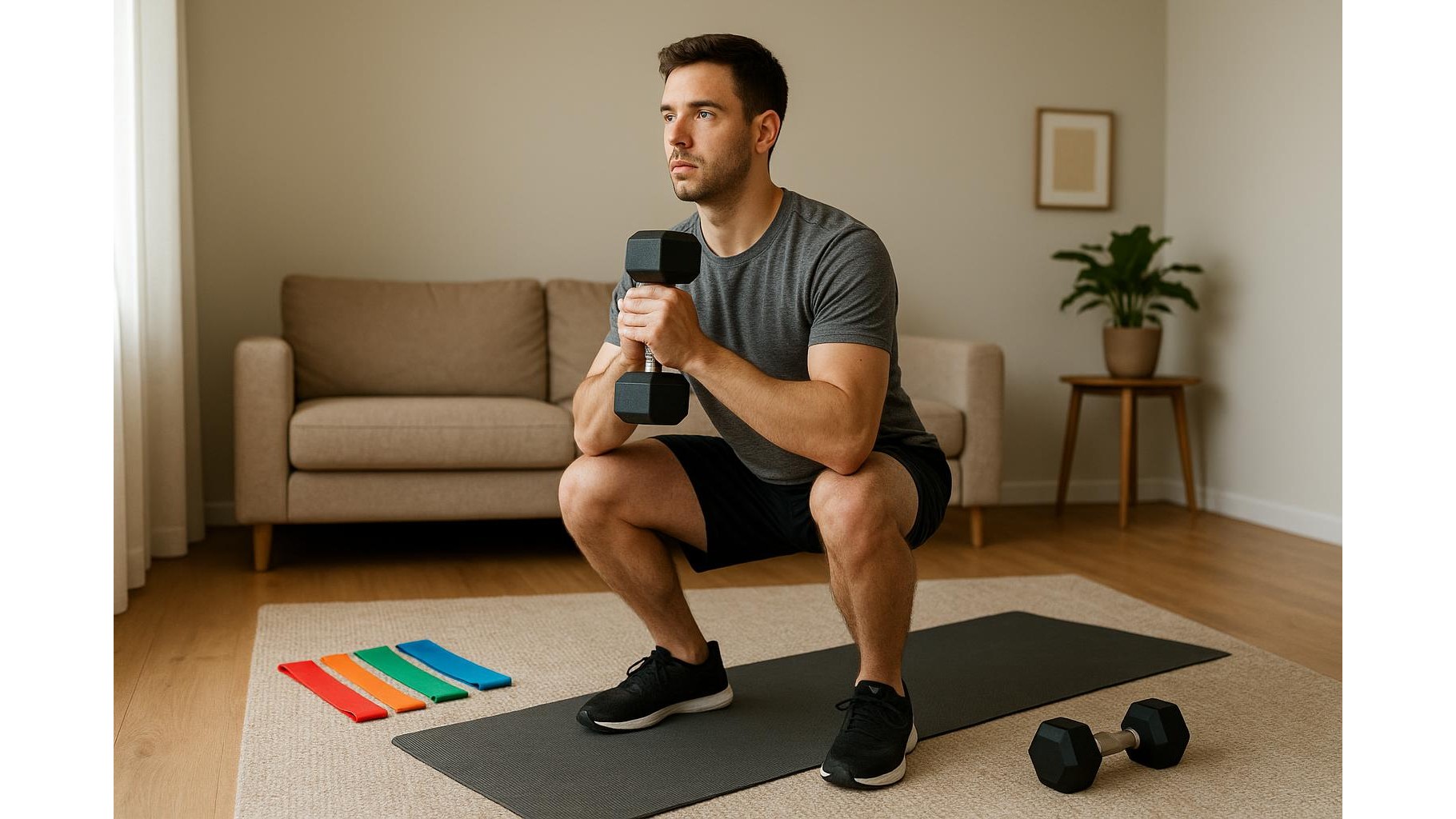
To run this pyramid session, you only need two tools: a pair of dumbbells and a set of resistance bands with different tension levels. Adjustable or medium‑weight dumbbells (for many people, 5–12 kg per hand) work well, allowing you to load push, pull and leg exercises without needing multiple pairs. A mixed pack of loop bands or tube bands gives you light, medium and heavy options so you can scale every exercise. Choose dumbbell weights that let you complete at least 10 controlled reps with good form, and bands that feel challenging around rep 12–15. If you are a beginner, it is better to start too light and climb the pyramid smoothly than to overload and break your form early.
40‑minute full‑body pyramid: structure and rep scheme
This home full‑body workout uses a simple time‑efficient structure. After a 5‑minute warm‑up (marching in place, arm circles, bodyweight squats), you will perform three main blocks: lower body, upper body push/pull, and core/conditioning. Each block follows the same rep pyramid: 8–10–12–10–8, with about 45–60 seconds rest between sets. Pick one dumbbell move and one band move per block and alternate them. For example, in the lower‑body block you could pair dumbbell goblet squats with banded glute bridges. Move up the pyramid (8–10–12), then down (10–8). If you are short on time, stop after the top set of 12 and reduce rest periods to 30–40 seconds to stay within 40 minutes including warm‑up and a brief cool‑down.
Exercise selection and scalable progressions
For lower body, use dumbbell goblet squats and reverse lunges, plus banded glute bridges or banded squats. For upper body pushing, choose dumbbell floor presses or overhead presses, combined with banded push‑ups or band chest presses anchored in a doorway. For upper body pulling, go for one‑arm dumbbell rows supported on a chair and band rows wrapped around a sturdy post. Finish with core and conditioning using dumbbell Russian twists, banded dead bugs or standing Pallof presses, and band‑resisted marches. Beginners can shorten the pyramid to 6–8–10 reps or use lighter bands, while intermediates can climb to 10–12–14 reps, increase dumbbell load, or turn the final round into a time‑based finisher, for example 30 seconds per move with minimal rest.
Safety, pacing and how to keep progressing
To get the most from this pyramid workout at home, focus on controlled tempo and solid technique. Keep 1–2 reps in reserve on each set so you do not hit failure too early in the pyramid. If your form breaks, repeat the same rep level next session or drop the load slightly. Track your sessions, noting which dumbbells and bands you used at each step of the pyramid; aim to improve one variable at a time: either add a small amount of weight, move to a stronger band, or reduce rest by 5–10 seconds. Train this routine 2–3 times per week, leaving at least one rest day in between. Over a few weeks you should notice improvements in strength, muscular endurance and overall workout tolerance, all with minimal equipment in your home space.
With just basic dumbbells and resistance bands, pyramid training lets you turn a small area of your home into a purposeful, progressive training studio. The ascending sets build volume and confidence, while the descending side lets you finish strong without dragging out the session. By selecting simple compound exercises, adjusting the height of the pyramid, and tracking your loads and rest, you can create a repeatable 40‑minute routine that grows with you from beginner to intermediate and beyond.