If you spend hours in the saddle but skip strength work, you’re leaving watts on the road and putting extra stress on your joints. A structured home strength workout for cyclists can improve leg power, core stability and knee protection without needing a full gym. This 45‑minute routine uses simple bodyweight moves, plus optional small equipment like resistance bands, and is designed to fit easily around your weekly riding.
Why cyclists need strength training at home
Cycling is a repetitive, mostly seated movement that can create muscle imbalances over time: strong quads, but relatively weaker glutes, hamstrings and core. That imbalance often shows up as knee pain, lower‑back niggles and reduced sprint and climbing power. A focused home strength workout addresses these gaps by loading the muscles and ranges of motion that your bike doesn’t fully challenge. Building strength in your hips and trunk improves how you track your knees over the pedals and stabilise the bike during hard efforts. Just two 45‑minute sessions per week can significantly improve pedalling efficiency, sprint kick and resilience on long rides, while also reducing your risk of overuse injuries.
The 45-minute strength routine: structure and warm-up
Plan this 45-minute cycling strength workout on non‑consecutive days, such as Tuesday and Friday, away from your hardest rides. Start with a 5–8 minute warm‑up: 2 minutes of marching or easy spinning on a turbo, then dynamic moves like leg swings, hip circles and bodyweight squats. The main session is built around three blocks: lower‑body power, core stability and knee/hip control. Work in circuits, performing 2–3 sets of each exercise with 45 seconds of work and 15 seconds to change position, resting 60–90 seconds between circuits. Choose a resistance that lets you move with control but feels challenging in the final reps. If you’re new to strength training, begin with just one or two sets and focus on perfect technique before adding volume or load.
Lower-body power: squats, hinges and single-leg work
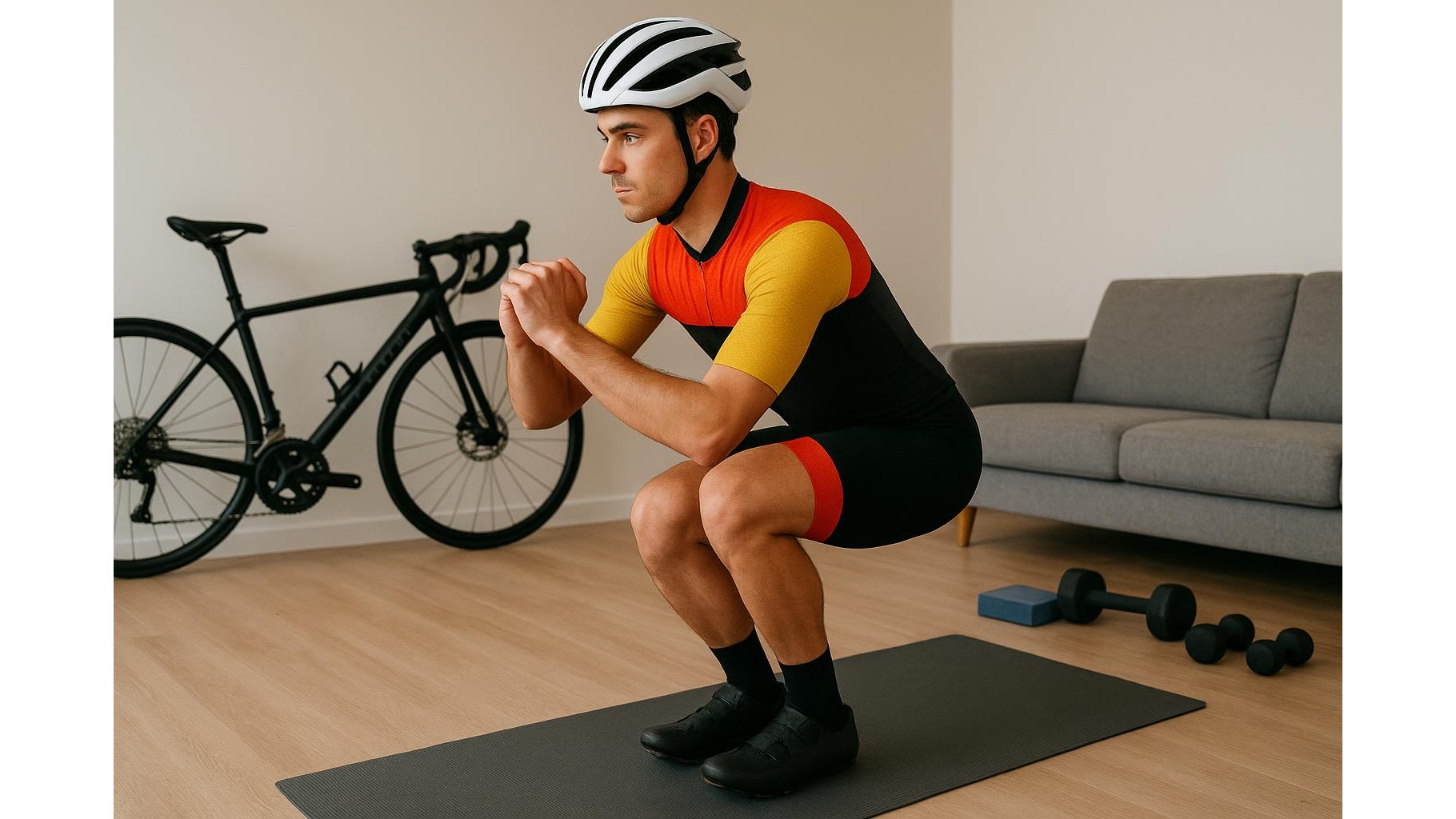
The goal of this block is to translate into better climbing strength and sprint power. Start with bodyweight squats or goblet squats: 3 sets of 10–12 reps, keeping knees tracking over toes and weight through mid‑foot and heel. Follow with a hip hinge pattern such as Romanian deadlifts using a backpack loaded with books, 3 sets of 8–10 reps, to strengthen glutes and hamstrings that drive each pedal stroke. Finish with single-leg exercises that mimic cycling demands: reverse lunges or Bulgarian split squats, 2–3 sets of 8–10 reps per leg. Single‑leg work challenges balance and highlights left–right discrepancies, helping you smooth out your power profile and stabilise the knee over the pedal spindle.
Core stability for better control on the bike
A strong, enduring core lets your legs push harder while your upper body stays quiet. Build this with an anti‑movement focus rather than endless sit‑ups. Start with front planks: 3 sets of 20–40 seconds, maintaining a straight line from shoulders to heels without sagging. Add side planks for lateral stability, 2–3 sets of 15–30 seconds per side, which is crucial for out‑of‑saddle efforts. Include dead bugs or bird dogs, 2–3 sets of 8–10 controlled reps per side, coordinating opposite arm and leg. These exercises teach you to brace your trunk while your limbs move – exactly what happens when you’re sprinting, cornering or climbing out of the saddle. Over time, you’ll feel less upper‑body fatigue on long rides and find it easier to hold aero positions.
Protecting your knees and joints with mobility and control
To keep your knees healthy, you need strong supporting muscles and adequate mobility at the hips and ankles. Add a focused 10‑minute block at the end of your session. Include slow step‑downs from a low step or stair, 2–3 sets of 8 reps per leg, controlling the descent to train your quads and hip muscles to guide the knee in line. Combine this with glute bridges, 2–3 sets of 12–15 reps, squeezing at the top to activate the posterior chain that unloads the knees when you ride. Finish with mobility: a hip flexor stretch, calf stretch and gentle quad stretch, holding each for 30–45 seconds per side. Consistently pairing strength with flexibility improves joint tracking, reduces post‑ride tightness and helps ward off common overuse issues around the patella and IT band.
Weekly plan and progression for cyclists
Integrate this home strength workout for cyclists around your key sessions so it enhances, rather than disrupts, your training. A simple layout: Monday easy ride, Tuesday strength, Wednesday steady or intervals, Thursday rest or light spin, Friday strength, weekend longer rides. In the first 3–4 weeks, keep loads moderate and focus on mastering technique and tolerating the new stimulus. After that, progress by adding a third set to major lifts, slightly increasing resistance or extending plank holds by 5–10 seconds. Every 4th week, reduce volume by about a third to absorb gains. Track how the routine affects your riding: smoother pedalling, better standing climbs and fewer knee niggles are signs you’re building the power and joint resilience that will carry you through longer, harder rides.
By building a consistent 45-minute home strength routine into your week, you’ll support your knees, reinforce your core and unlock more usable power on the bike. With smart exercise selection and steady progression, you can develop a stronger, more resilient body that handles training load better, recovers faster and keeps you riding comfortably for seasons to come.