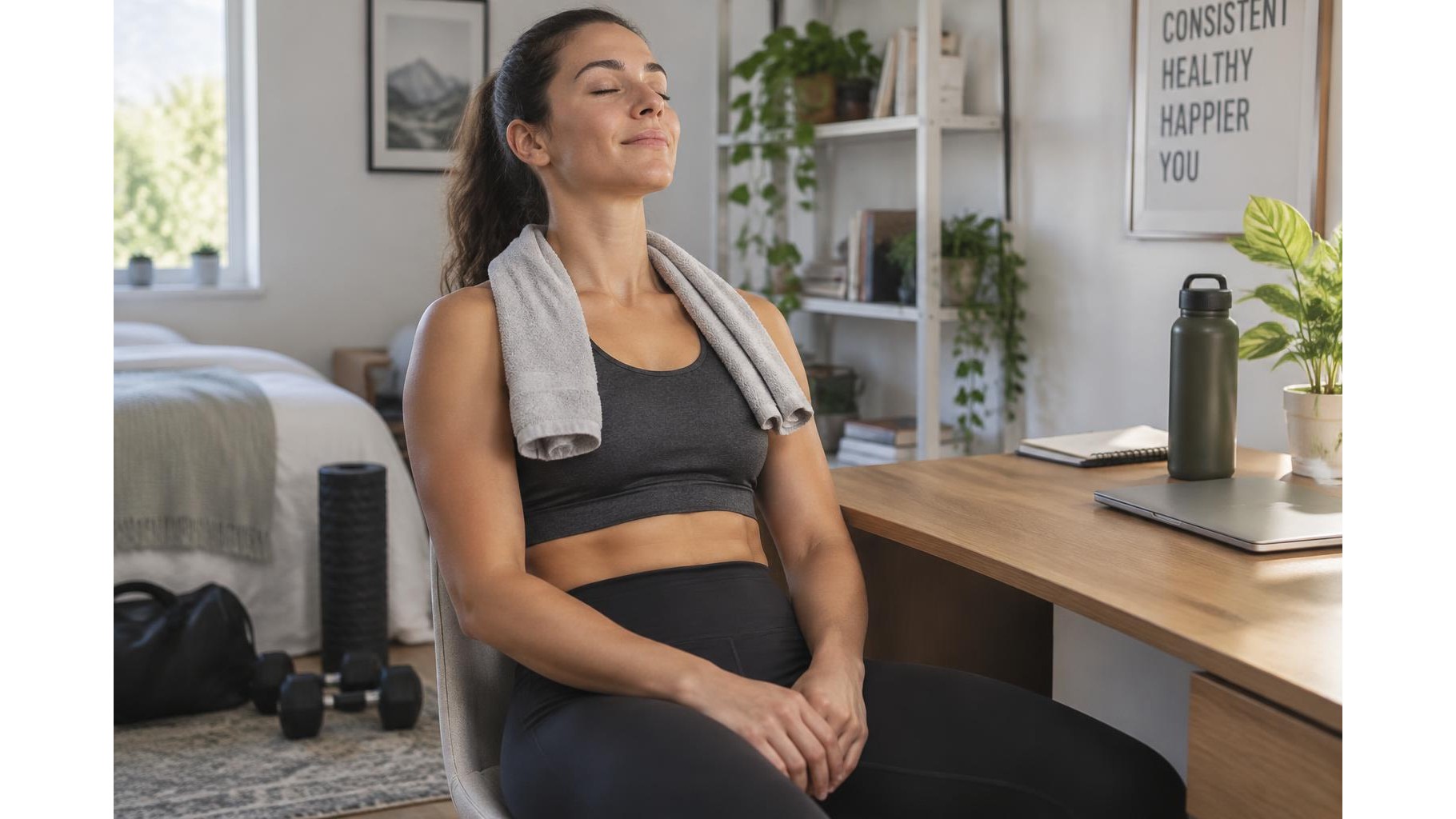
Long hours at a screen can leave your shoulders creeping upwards, your head drifting forward and your jaw quietly clenched. Add a workout, and that familiar tightness may feel even more noticeable. This short neck and jaw reset is designed to help you pause and move comfortably—not to force a stretch or treat an injury. Find a supported seat, take a few minutes, and keep every movement within an easy range.
Settle your breathing first
Sit with your feet resting on the floor and your back supported if that feels comfortable. Let your hands rest loosely on your thighs. Breathe in gently through your nose, then allow a slightly longer, unforced exhale. Repeat for five or six breaths, without holding your breath or trying to breathe as deeply as possible. Notice whether your shoulders can soften as you breathe out. The aim is simply to reduce rushing and bring your attention back to your body. If focusing on breathing feels uncomfortable, return to your normal rhythm.
Make small, easy neck movements
Keep your chin level and slowly turn your head a little to the right, then return to the centre and repeat to the left. Move only as far as feels smooth; there is no need to reach an end point. Next, gently tip one ear towards its shoulder while keeping both shoulders relaxed, return to centre, and change sides. Try three repetitions in each direction. Avoid circling the head, pulling on it with your hands, or bouncing into a stretch. Stop if a movement causes pain, dizziness, tingling or a sense of instability.
Unclench the jaw without stretching it
Let your lips rest together or slightly apart, with your teeth comfortably separated. Place the tongue lightly behind the upper front teeth and allow the jaw to hang loose. Take two or three calm breaths in this position. If it feels easy, open your mouth a small amount and close it slowly, keeping the movement smooth and pain-free. Repeat a few times, without pushing the jaw wide or trying to make it click. The goal is awareness and ease, not a deep jaw stretch. If you have a jaw condition or recent dental treatment, follow advice from your clinician instead.
Add a shoulder and posture check
Gently lift both shoulders towards your ears, then let them drop as you exhale. Repeat two or three times without squeezing or forcing a large movement. Afterwards, notice whether your head feels balanced over your torso. You do not need to hold a rigid “perfect” posture; simply adjust your screen, chair or training setup if you have been staying in one position for a long time. A brief walk or a change of position can be more comfortable than trying to correct your posture with effort. Keep the sequence relaxed, especially after a demanding session.
Keep it gentle and know when to seek advice
This reset should feel comfortable during and afterwards. Use a smaller range, fewer repetitions or stop altogether if symptoms increase. Do not use it to push through a recent injury, severe pain or symptoms that are new and unexplained. Seek professional advice if neck or jaw discomfort persists, repeatedly returns, limits everyday activity or does not improve with sensible changes. Get urgent medical help for concerning symptoms such as sudden severe pain, weakness, numbness, loss of coordination, or neck pain following a significant injury. A physiotherapist, dentist or doctor can help identify the right next step.
In summary, a few slow breaths, small neck turns and a relaxed jaw check can offer a simple pause after screen-heavy work and training. Keep movements gentle and comfortable, take breaks from prolonged positions, and seek professional guidance for persistent or worrying symptoms.