Building a serious home gym in a small space often starts with one decision: which adjustable dumbbells can actually replace a full rack of fixed weights? Multi-grip adjustable systems promise barbell-like versatility in a compact footprint, but not all designs feel or perform the same. In this guide we look at how to choose a set that truly mimics multiple pairs, focusing on handle design, adjustment mechanisms, weight range and safety features so you can lift heavy and train hard at home without compromises.
Why multi-grip adjustable dumbbells beat a full rack at home
Traditional fixed dumbbells are great in commercial gyms but quickly become impractical at home. A full rack from 2 kg to 30 kg in 2 kg jumps requires huge floor space and a big budget. Modern multi-grip adjustable dumbbells concentrate dozens of pairs into one compact handle, giving you everything from light weights for rehab and isolation work to heavy loads for presses, rows and leg training. Because you can switch grip styles—neutral, pronated, semi-supinated—on one tool, you can also simulate the feel of different dumbbell shapes. This versatility is ideal for small apartments or garage gyms where every centimetre and every pound spent has to work hard.
Handle shapes and grips: comfort and joint safety
The first thing to evaluate in an adjustable set is the handle shape. Look for contoured or slightly ergonomic handles with a secure but not overly aggressive knurling; this balances grip security with long-session comfort. Multi-grip designs that allow both straight and neutral grip positions are especially joint-friendly, letting you rotate the wrist to find a pain‑free angle for presses, curls and rows. A moderate handle diameter suits most hand sizes, while rubberized sleeves can help if you train without chalk. Pay attention to plate or block clearances around the hand: bulky housings too close to your wrist can limit range of motion in exercises like hammer curls and overhead triceps extensions.
Adjustment mechanisms: speed versus robustness
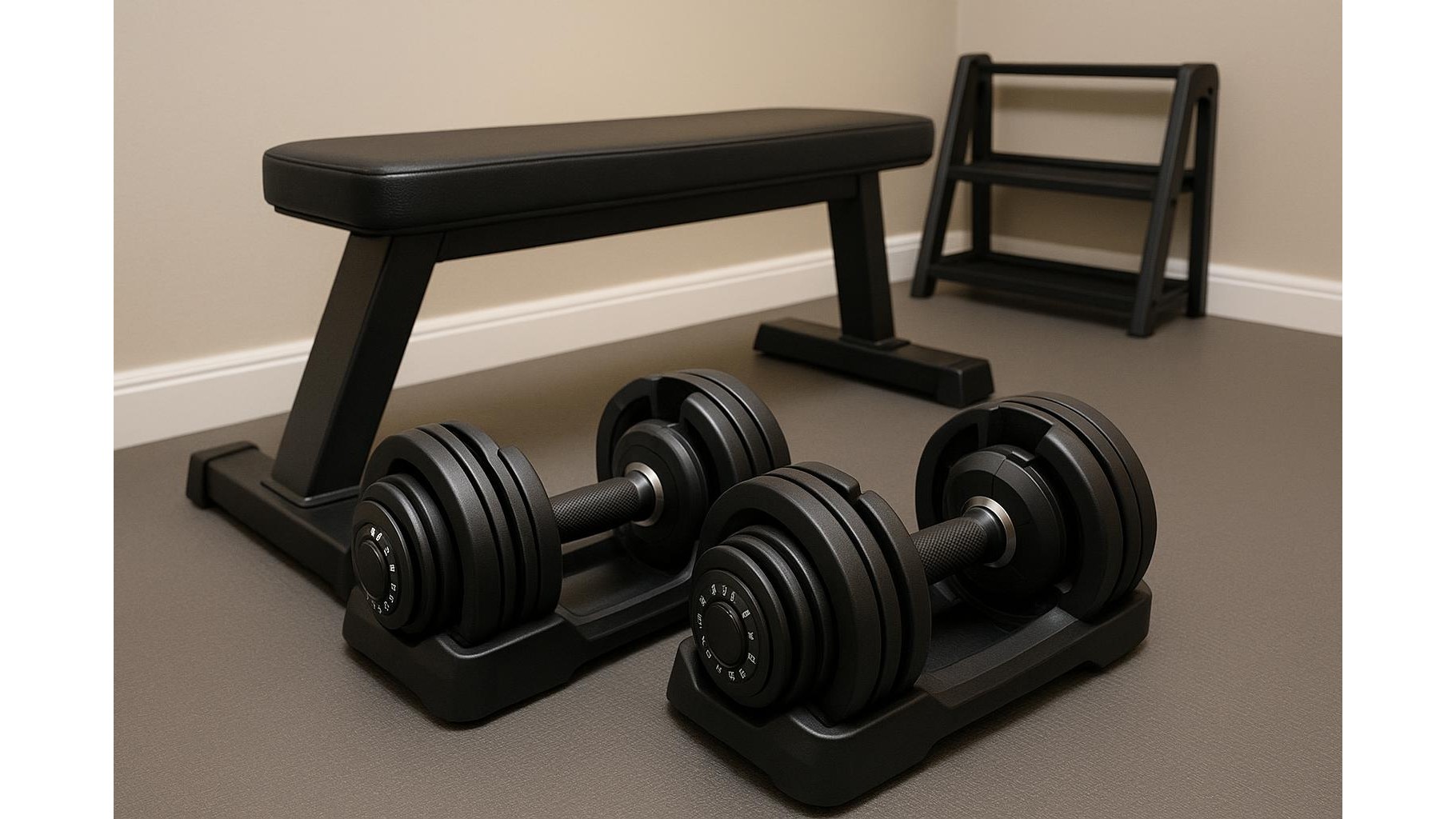
The adjustment mechanism is what makes or breaks an adjustable dumbbell. Dial-based systems are the fastest: you turn a selector on the side and the handle locks onto the desired plates. These are great for supersets and circuits where you must change weight in seconds. Pin- or peg-based systems, where you slide a pin into the desired slot, tend to feel more mechanical but are often viewed as very robust. Plate-loaded handles that use collars are the slowest but have the simplest engineering—ideal if you prioritise longevity over speed. Whichever style you choose, check that weight markings are clear in both kilograms and pounds, and that weights lock with an audible and tactile click so you know the setting is secure before every lift.
Choosing the right weight range and increments
To truly replace a full rack, your adjustable dumbbells need an appropriate weight range and increment size. For most home users, a single handle that spans roughly 2–25 kg (5–55 lb) per hand will cover hypertrophy and general strength work. Stronger lifters might aim for 30–40 kg per hand for heavy presses and rows. Small jumps of 1–2 kg support progressive overload and make it easier to fine‑tune loads for isolation movements and rehab. Larger jumps of 4–5 kg are acceptable for big compound lifts like dumbbell bench or goblet squats, but can feel too steep for shoulders or arms. When comparing products on Amazon, read the spec sheet carefully: some sets advertise a high “max weight” but only reach it with awkward add‑ons that compromise balance or grip.
Safety features and space-saving design for home gyms
Because you will likely train alone at home, safety is critical. Prioritise dumbbells with solid locking systems that can’t be accidentally released mid‑set, reinforced cradles or stands that keep the handles stable while you adjust, and wide, flat bases so the weights don’t roll. A compact footprint lets you slide a pair under a bench or into a corner, freeing floor space for floor work and conditioning. Consider also noise and impact: rubber-coated plates or well‑fitted blocks reduce clatter when you set the weights down. Finally, check maximum load ratings and user reviews for long‑term durability—especially around moving parts—so your investment in a home gym remains safe and reliable for years.
In summary, a good pair of multi-grip adjustable dumbbells can genuinely replace a full rack if you choose carefully. Focus on comfortable handles, a fast and trustworthy adjustment mechanism, a weight range that matches your strength goals with sensible increments, and robust safety features that inspire confidence when you lift alone. With the right set, you can run a complete strength programme—from warm‑up to heavy compound lifts—using minimal space while maximising versatility and training consistency in your home gym.