Taller trainees often struggle to make standard home workouts fit their bodies. Low ceilings, long limbs and awkward joint angles can turn classic moves into joint-stressing contortions. This 45-minute, full-body plan is built specifically for the tall athlete at home, using only resistance bands and yoga blocks. You will load every major muscle group safely while respecting your leverages, posture and limited vertical space.
Why tall bodies need a different home workout
Being tall is a huge advantage in many sports, but it also changes how you should train. Longer femurs and arms amplify torque on hips, knees and shoulders, especially in cramped home environments. Overhead pressing into a low ceiling or sinking too deep into squats can irritate joints instead of building strength. This plan swaps risky patterns for joint-friendly movement that keeps resistance in safe ranges. Resistance bands provide ascending tension that matches the way tall lifters produce force, while yoga blocks fine-tune range of motion and support better alignment without needing big machines or tall racks.
Warm-up: open long chains and wake up the core
Spend 8–10 minutes preparing tall-friendly ranges of motion. Start with banded pull-aparts and band dislocates to open tight shoulders, using a wider grip to suit long arms. Add tall-kneeling banded rows, focusing on pulling elbows slightly down instead of flaring out, protecting the shoulders. For hips, use yoga blocks under your hands in a half-kneeling hip flexor stretch so your spine stays neutral instead of collapsing forward. Finish with slow band-resisted dead bugs to engage your anterior core and keep your long torso stable, which is crucial before loading hinge and squat patterns.
Main strength block: lower body built for long levers
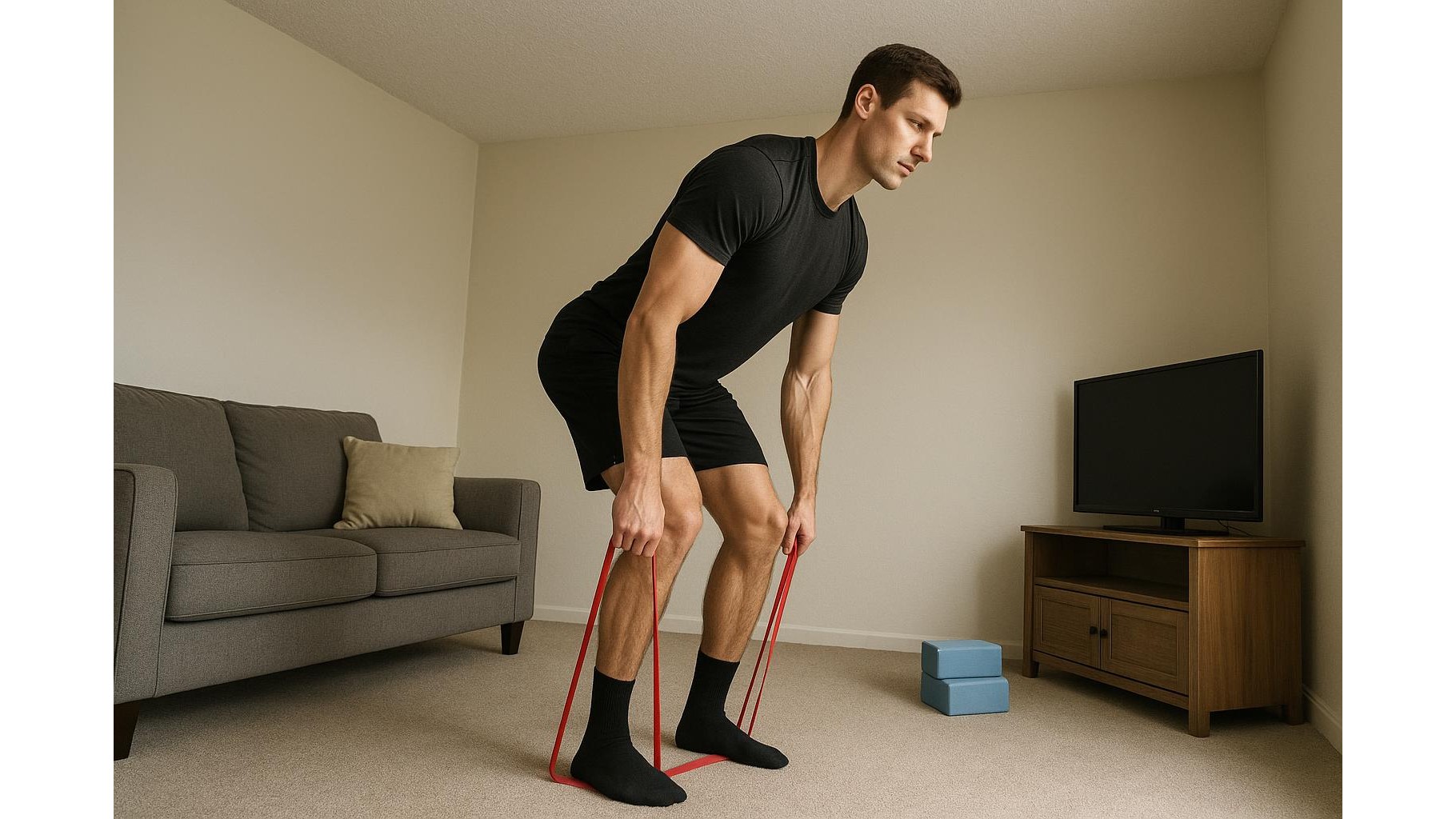
Train your lower body for 18–20 minutes using 2–3 controlled sets per move. Start with band-resisted Romanian deadlifts, looping the band under your feet and over your hips to bias the glutes and hamstrings while keeping the bar-path-free setup ideal for long arms. Use yoga blocks as depth markers for a hip-dominant hinge, so you avoid rounding at the bottom. Next, perform block-elevated banded split squats: front foot on a block, band under the front foot and over the shoulders. This shortens the working range, making it knee-friendly for tall trainees. Finish with banded lateral walks in a hip hinge, maintaining tension on the band the whole time to build hip stability and glute med strength that taller athletes often lack.
Upper body focus: horizontal patterns over risky overhead
With low ceilings and long arms, overhead work can feel sketchy. Prioritize horizontal pushing and pulling for safer, stronger shoulders. Perform banded push-ups by anchoring the band across your upper back and looping the ends under your palms; place hands on yoga blocks if your wrists need a friendlier angle. Pair this with a tall-kneeling band row, anchoring the band at door-handle height and driving elbows toward your back pockets. Add banded face-pulls with a split stance to strengthen the upper back and rotator cuff, keeping the band line slightly below eye level to avoid shrugging. These moves build a powerful upper back and chest without the overhead grind that punishes tall frames.
Core and posture: owning your long spine
Core work for tall athletes should stabilize, not just burn. Use yoga blocks between the knees or hands to create tension and clean alignment. Start with dead-bug variations: block between your knees, band around your feet for light resistance as you extend one leg at a time. Follow with a tall-kneeling Pallof press, band anchored to the side, pressing straight out without letting your ribs flare. Finish with a low-ceiling-friendly alternative to planks: block hand taps in a high plank, alternating one hand to a block placed under your chest. Focus on keeping hips still and spine long to train anti-rotation and anti-extension, crucial for taller torsos under load.
Across this 45-minute tall athlete strength plan, you have hit every major muscle group using only resistance bands and yoga blocks, while respecting your height, limb length and training space. By emphasizing controlled ranges, smart leverage and horizontal patterns, you get stronger without grinding your joints or the ceiling. Repeat this routine two to three times per week, progressively increasing band tension or total sets, and you will turn the typical tall-lifter disadvantages into a mobile, powerful frame built entirely in your home gym.