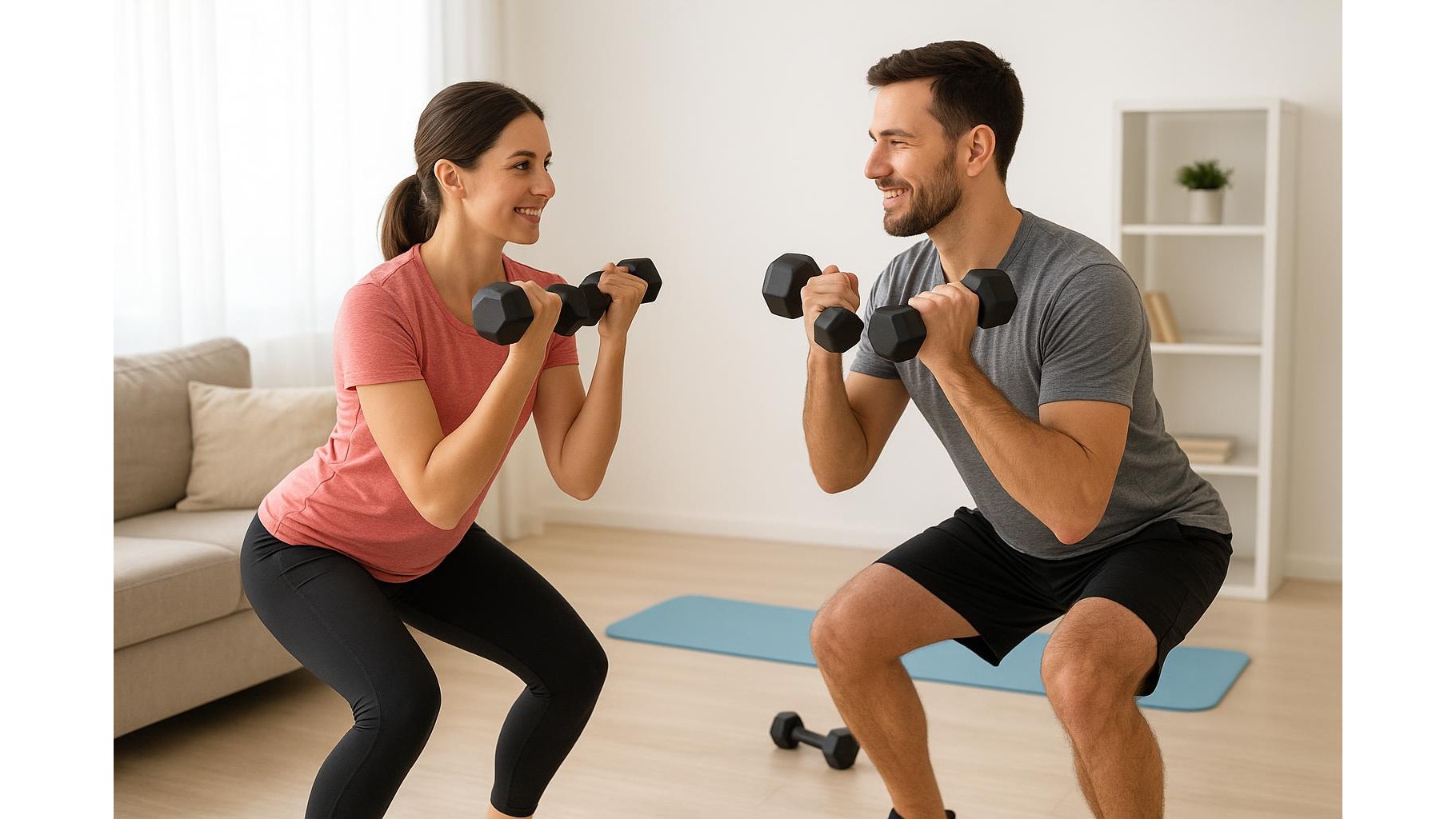
Working out together at home can turn fitness into quality time. This 40‑minute partner strength workout uses just a pair of dumbbells and bodyweight, combining mirrored sets, assisted reps and playful challenges. You and your partner will alternate pushing and pulling, share time‑under‑tension, and motivate each other through a full body routine that fits into any living room.
Setting up your space and choosing your dumbbells
Before you start, clear a 2×2 m area so you can both move safely side by side or facing each other. Ideally you’ll have a pair of dumbbells in a moderate weight that allows 10–15 controlled reps. If you have multiple pairs, pick a lighter set for shoulder and core work and a heavier set for legs and rows. Place a mat or carpet underfoot for comfort, and keep water nearby. Agree on your training structure: you’ll perform 40 seconds of work and 20 seconds of rest per exercise, rotating roles so one person often mirrors or assists the other.
[h2]Warm-up and partner activation circuit[/h2]
Begin with a 5‑minute partner warm‑up to prime your muscles and coordination. Stand facing each other and perform bodyweight squats in sync for 45 seconds, focusing on bracing your core and driving your knees out. Next, move into alternating reverse lunges with a hand tap: when your right leg goes back, tap your partner’s right hand at the bottom of the lunge to encourage balance and posture. Finish with 30 seconds of high‑knee runs on the spot while your partner counts aloud, then swap counting duties. This dynamic warm‑up elevates your heart rate and gets you used to moving together as a unit.
Lower body power: synced squats and assisted lunges
The first strength block targets glutes and quads. Both partners hold one dumbbell each in front rack position and perform goblet squats together: 3 sets of 12 reps, lowering for 3 seconds and driving up powerfully. Count the reps out loud to maintain tempo. Next, try assisted Bulgarian split squats. Partner A sets up in a split stance with rear foot elevated on a chair, holding one or two dumbbells. Partner B stands beside them offering a light hand support at the wrist or shoulder to help with balance as A lowers for 10–12 reps. Swap sides and roles. This combo builds unilateral stability while reinforcing communication and trust.
Upper body push & pull: mirrored presses and rows
For the upper body, you’ll pair pushing and pulling moves to keep the session balanced. Sit back‑to‑back on the floor, each holding a dumbbell in each hand. Perform seated shoulder presses for 10–15 reps, feeling your partner’s posture against yours to keep your spine tall. Then stand facing each other in a partial squat, hinge at the hips, and perform bent‑over rows in unison. To add challenge, Partner A rows while Partner B holds an isometric row at the top, then swap every 5 reps. This mirrored work ensures both partners train at a similar intensity while respecting individual strength levels.
Core and stability: anti-rotation and passing drills
Core training is where partner workouts truly shine. Sit facing each other with knees bent, heels lightly touching, holding a single dumbbell. Perform Russian twist passes: Partner A twists to one side, taps the dumbbell on the floor, twists back to center and passes it to Partner B, who repeats. Continue for 40 seconds, rest 20, then reverse direction. Follow with a high‑tension plank with dumbbell pull-through: both partners hold a high plank facing each other, with one dumbbell between you. Partner A drags the dumbbell across their body with the opposite hand while Partner B holds firm, resisting rotation; then B pulls it back. This teaches anti‑rotation strength and tightens the entire midsection.
Finisher and cool down: playful challenges
Wrap up with a 5‑minute partner finisher to leave your heart rates high and smiles wide. Try EMOM (every minute on the minute) sets: in minute one, perform 10 dumbbell thrusters each, then high‑five and rest with the remaining time. Minute two, hold a wall sit side by side while passing a dumbbell back and forth at chest height. Alternate these two minutes for a total of four rounds. Finish with a slow cool down: seated hamstring stretches facing each other, gentle quad stretches using your partner for balance, and deep breathing while seated back‑to‑back. This helps you downshift from training mode and reinforces the sense of teamwork.
By combining full body dumbbell exercises with partner‑based challenges, this 40‑minute routine turns your living room into an effective and enjoyable home gym. With only a pair of dumbbells and some floor space, you and your partner can build strength, coordination and accountability. Repeat this workout two or three times per week, track your progress, and adjust weights or tempo as you grow stronger together. Consistency and communication are your most powerful training tools—use them, and your shared fitness journey will thrive.