A well-designed home workout for scoliosis should build strength and mobility without aggravating your spine. This 45-minute, equipment-light session is organised to support core stability, unilateral strength and gentle mobility, using simple tools you can keep in your living room. Always check with your doctor or physiotherapist before starting if you have any history of back pain or surgery.
Set up your scoliosis-safe home workout space
For a safe scoliosis-friendly home workout, start by preparing your space. Clear an area where you can lie fully stretched out on the floor and move your arms freely. A supportive, non-slip exercise surface is essential to protect your spine during floor work, side planks and kneeling moves. Wear comfortable clothing that allows you to move through spinal mobility drills, and keep water nearby. This routine focuses on alignment and control over intensity, so think “slow, precise and pain-free” rather than max effort. If any movement causes sharp or increasing pain, stop immediately and modify or skip that exercise.
Warm-up: gentle mobility and breath (10 minutes)
Begin with 10 minutes of gentle mobility to prepare your spine and surrounding muscles. In standing, perform slow shoulder rolls, arm circles and side steps to increase circulation. Move into cat-cow on all fours, focusing on segmental movement of the spine rather than forcing range. Follow with a controlled child’s pose, side-bending your hips towards right and left heels to gently open the convex and concave sides of your curve. Finish with diaphragmatic breathing: lying on your back with knees bent, one hand on your belly and one on your chest, inhale through the nose expanding the lower ribs, then exhale slowly through pursed lips. This breath pattern helps reduce tension and supports better core activation later in the session.
Core stability and anti-rotation work (10 minutes)
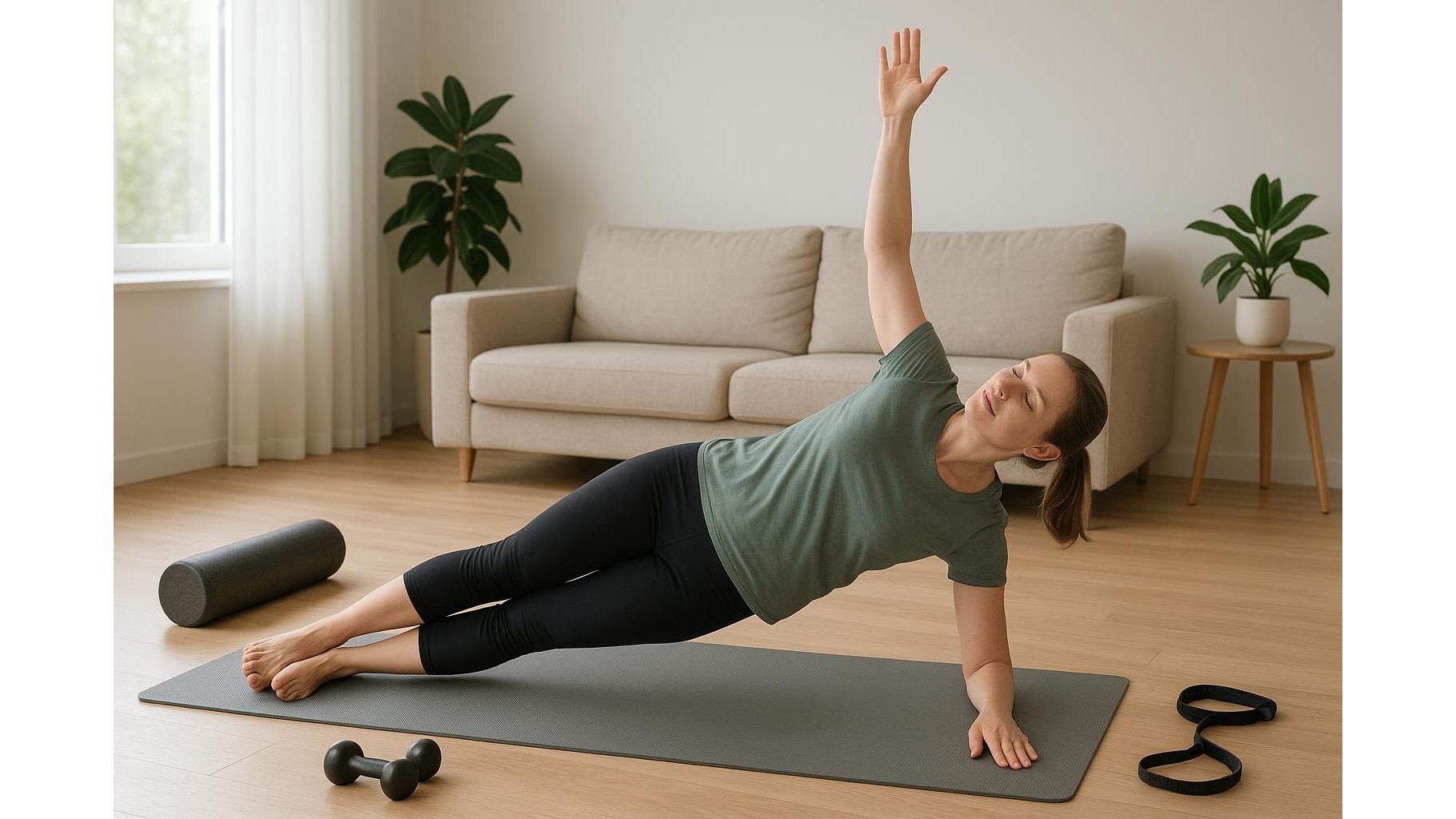
The core section emphasises stability and anti-rotation rather than crunching or aggressive twisting, which can be problematic for some scoliosis patterns. Start with dead bug variations: lying on your back, arms above shoulders and knees above hips, slowly extend opposite arm and leg while keeping your ribcage heavy and spine neutral. Follow with a modified side plank from knees, holding for 20–30 seconds per side while actively lifting the underside of your waist. Add bird dog on all fours, reaching opposite arm and leg long without letting your pelvis tilt or rotate. Aim for 2–3 sets of each exercise, resting as needed. Focus on even engagement across both sides of your trunk, using your breath to maintain control.
Unilateral lower-body strength (10–12 minutes)
Next, build unilateral lower-body strength to reduce asymmetries that can contribute to compensations around a scoliotic spine. Begin with supported split squats, lightly holding a chair or wall for balance, paying attention to knee tracking and upright posture. Follow with hip hinges or Romanian deadlifts using bodyweight or a light household object held close to your body, emphasising glute and hamstring engagement rather than lower back strain. Add single-leg glute bridges if comfortable, or stay with standard bridges if balance or discomfort is an issue. Keep rep ranges moderate (8–12 per leg), moving slowly and stopping 1–2 reps before fatigue to maintain alignment and avoid compensating with your lower back.
Upper-body alignment and postural strength (8–10 minutes)
This segment targets postural strength and upper-back endurance, key areas for anyone managing scoliosis. Perform wall slides by standing with your back against a wall, gently tucking your ribs, and sliding your arms up and down like a goalpost, trying to keep wrists and elbows in light contact with the wall. Follow with prone T and Y raises lying face down on your mat, lifting your arms only a few centimetres off the floor and focusing on drawing your shoulder blades down and together without overarching your lower back. Finish with isometric rows using a towel looped around a sturdy post or do simple scapular squeezes in standing. Two sets of 10–15 controlled reps per exercise will help reinforce open, upright posture.
Cool-down and daily mobility habits (5 minutes)
End your 45-minute home workout with a short cool-down to signal your nervous system to relax. Use gentle hamstring stretches (seated or lying with a strap), comfortable hip flexor stretches and relaxed side bends within a pain-free range. Revisit diaphragmatic breathing for a couple of minutes, noticing how your ribs move and where you might hold tension. Treat this cool-down as a chance to scan your body and note any asymmetries or areas that feel particularly tight or weak. Over time, you can adjust your routine to give a little extra attention to those regions. Consistency matters more than perfection: performed three to four times a week, this scoliosis-friendly home routine can improve strength, mobility and confidence in moving with your unique spine.