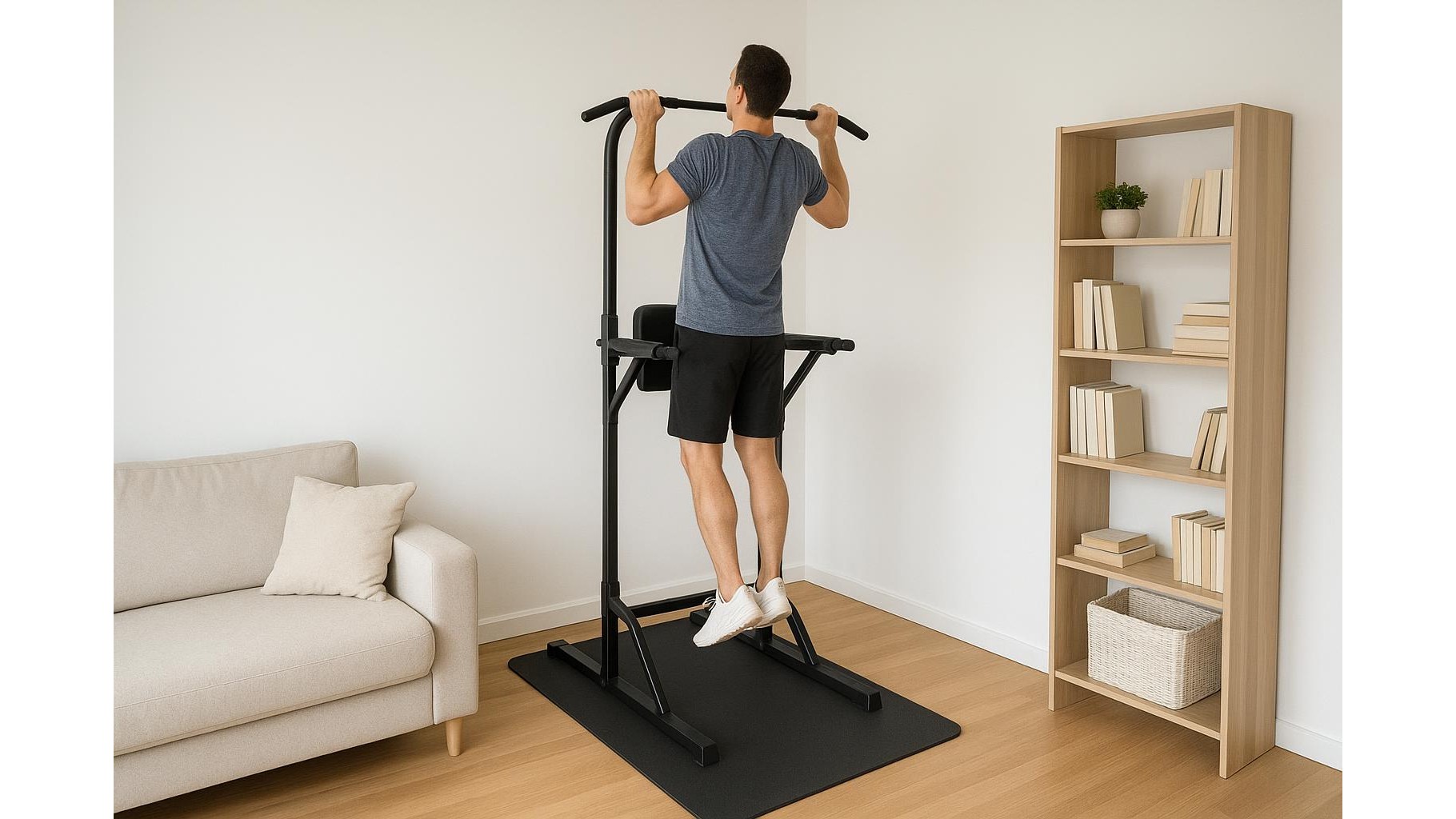
Setting up a compact home gym in a small flat is easier than ever, but finding a foldable power tower that handles pull-ups, dips and leg raises without wobbling can be tricky. In this guide we walk through what really matters when choosing a space‑saving pull up and dip station for typical home floors, so you can train safely without drilling into walls or ceilings.
Space, folding size and ceiling height
The first step is to measure your space carefully. A compact foldable power tower should fit your training area when open, and tuck away easily when folded. Check three dimensions: footprint, height and folded depth. As a rule of thumb, you want at least 20–30 cm of clearance around the base to move freely and avoid hitting walls during pull-ups and leg raises. For ceiling height, add your own height with arms fully extended plus a few centimetres: in most UK flats with standard ceilings (around 2.4 m), a tower of 200–220 cm works well. If you are very tall, prioritise models with a slightly lower bar but angled handles to keep pull-ups comfortable.
Stability on home floors without drilling
Because you are not bolting the station to the floor, the base design and weight distribution become critical. Look for a wide H- or U-shaped base with non-slip rubber feet to grip laminate, wood or tiles. Cross-bracing between the uprights reduces side-to-side sway during dips. A heavier frame (even on a foldable unit) usually improves stability, but make sure it is still moveable by one person. Pay attention to user reviews that mention rocking or tipping when performing explosive pull-ups. On very smooth surfaces, placing a thin rubber mat under the tower can further reduce movement and protect your flooring.
Handle layout for pull-ups, dips and leg raises
A good compact tower should still offer enough grip options to cover your main exercises. For pull-ups, check the width of the top bar: a straight bar with slight angling on the sides is usually more versatile than heavily curved designs, especially in tight spaces. Foam or rubber padding improves comfort and reduces slipping when your hands get sweaty. For dips and knee raises, look for parallel bars that are not too wide for your frame; adjustable-width arms are ideal but rare on foldable units, so check stated dimensions against your shoulder width. Well-padded back and arm cushions make leg raises and hanging knee raises much more comfortable, encouraging longer sets.
Weight capacity, materials and build quality
To train safely at home, verify the tower’s maximum user weight and how solid the structure feels. For most adults, a minimum rating of 120 kg gives a good safety margin; heavier trainees or those who use weighted vests should look for 150 kg or more. Solid steel tubing with reinforced joints and quality welds is essential, especially where the legs meet the uprights. Avoid models with lots of plastic connectors in load-bearing areas. While foldable designs need hinges and locking pins, these should be sturdy and simple to operate. The finish also matters: a powder-coated frame resists sweat and rust better, extending the life of your home pull up station.
Folding mechanism, portability and daily usability
Since you are choosing a folding power tower for a small apartment, the folding mechanism must be practical enough to use frequently. Check how many steps it takes to fold and unfold, and whether tools are needed. Ideally, you should be able to collapse the station in under a minute and move it solo. Slim folded depth lets you store it behind a door, next to a wardrobe or along a wall. Consider noise as well: smooth joints and rubber feet reduce clattering when you set up early in the morning or late at night. Finally, think about your routine—if folding is awkward, you may leave the tower open permanently, so ensure the open footprint still allows you to live comfortably around it.
Choosing the right compact foldable power tower comes down to matching your room size, ceiling height and training style with a stable, well-built frame that does not require drilling. Prioritise stability, weight capacity and comfortable grips over gimmicks, and pay attention to folded dimensions and ease of use. With a thoughtful choice, you can perform effective pull-ups, dips and leg raises in even the smallest home gym corner and fold the station away when you are done.