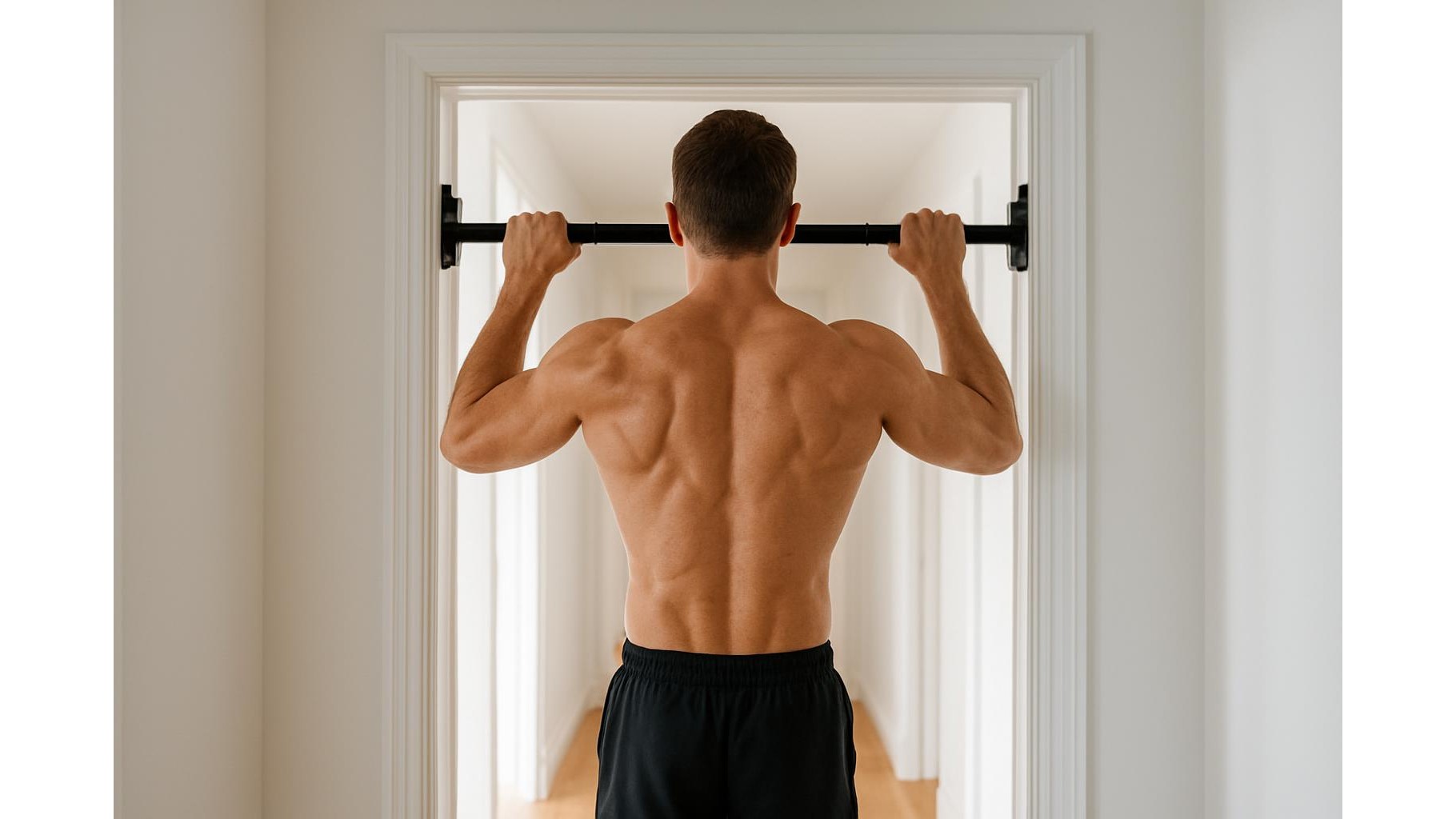
Building serious upper-body strength at home is absolutely possible with just one piece of equipment: a doorframe pull-up bar. With smart exercise selection, tempo control and progressions, you can challenge your back, biceps, shoulders and core in a focused 40-minute session. Below you’ll find a structured routine that works for both beginners and advanced lifters, plus tips on choosing and safely using a high‑quality pull-up bar in a standard doorway.
Choosing a safe and sturdy doorframe pull-up bar
The cornerstone of this workout is a solid, reliable doorframe pull-up bar. Look for a model with multiple grip options (wide, neutral and close) and protective pads to avoid damaging your frame. A common and popular style is an over-the-door, lever-based bar with angled handles and foam grips, rated for at least 100 kg. Make sure it fits standard UK door widths and that it can be easily removed and stored. Before each session, check that the bar is firmly seated and that the frame is not cracked or loose. Train with controlled reps—no wild kipping—so that both the bar and your shoulders stay safe.
Warm-up and activation (5–8 minutes)
Before hitting heavy pull-ups, take 5–8 minutes to prepare your shoulders and core. Start with 1–2 minutes of arm circles, shoulder rolls and band pull-aparts if you have a light resistance band. Then move to 2 sets of 10–15 scapular pull-ups on the bar: hang with straight arms and focus on pulling your shoulder blades down and together without bending the elbows. Finish with 2 sets of 20–30 seconds of dead hangs to decompress the spine and open the shoulders. This brief activation work improves grip, keeps your joints happy and helps you feel more stable once the real sets begin.
Main pull-up block: back and biceps focus
The first main block targets your lats and biceps. Perform 4 rounds, resting 60–90 seconds between sets. Beginners can alternate assisted pull-ups with negatives; advanced users focus on strict reps. For beginners: 6–8 assisted pull-ups (use a chair under your feet) followed immediately by 3–5 slow negative pull-ups, lowering for 3–5 seconds. Advanced athletes aim for 6–10 strict pull-ups or chin-ups using different grips each set. Emphasise a full stretch at the bottom and a tight squeeze between the shoulder blades at the top. Quality of movement beats quantity—stop 1–2 reps before failure to maintain form.
Horizontal and core variations using the bar
Next, turn your door bar into a tool for horizontal pulling and core training. If your bar can be mounted low (between the uprights), set it around hip height; if not, you can lie under the bar with your heels on the floor and hands gripping the bar from underneath. Perform 3 sets of 8–12 inverted rows, keeping your body straight like a plank. Then move into 3 sets of 10–15 hanging knee raises or leg tucks to challenge your abs and hip flexors. For advanced users, progress to straight-leg raises or L-sit holds. Keep your ribcage stacked over your pelvis and avoid swinging to make your core do the work.
Shoulders, grip and finisher (total 40 minutes)
To round out the 40-minute session, add a block focused on shoulders and grip endurance. Use the top position of the pull-up to perform 3 sets of 10–15 seconds of isometric holds with your chin over the bar, squeezing your upper back. Then switch to 3 sets of mixed-grip dead hangs (palms facing opposite directions) for 20–40 seconds to build crushing grip strength and forearm endurance. If you still have energy, finish with 2–3 “ladder” sets: do 1 pull-up, rest 10 seconds, 2 pull-ups, rest 10 seconds, and so on until your form breaks down. This simple finisher massively boosts time under tension without needing extra equipment.
Putting it all together and weekly progression
Run this home upper-body workout 2–3 times per week, leaving at least one rest day between sessions. In the beginning, keep total volume modest and focus on consistent technique: controlled negatives, full range of motion and active shoulders. Each week, aim to add 1–2 total reps across your sets or extend your hang and hold times by 5 seconds. Over time, you can introduce more advanced variations: archer pull-ups, towel grip pull-ups for extra forearm work, or explosive reps for power. With nothing more than a doorframe pull-up bar and 40 focused minutes, you can build a strong, defined back, powerful arms and a rock-solid core without setting foot in a commercial gym.