A solid home workout does not have to be loud, high-impact or packed with gear. This 30‑minute, posture‑focused routine uses nothing but a clear wall and a sturdy doorframe to train your whole body with isometric holds, controlled push–pull strength and deep core stability. It is perfect for small spaces, shared apartments and late‑night sessions when you want to move, strengthen and realign without disturbing anyone.
Set up your wall and doorframe safely
Before you start, choose a solid internal or external wall with enough space to stand an arm’s length away and raise your arms freely. Check that the surface is not slippery and that you can place your feet flat in socks or bare feet without sliding. For the doorframe, make sure it is sturdy, well‑fixed and not loose; avoid glass panels or decorative frames. Stand inside the frame, gently press your hands against the sides and test light pushes and pulls to feel how much force it can safely handle. Clear any obstacles so you can step forward, back and sideways without tripping. These two simple checks turn any small room into a quiet, effective home gym zone.
Warm‑up: wake up posture and joints
Begin with 5 minutes of low‑key movement to prepare your joints and improve body awareness. Stand facing the wall, feet hip‑width apart, and perform wall‑assisted cat–cow: hands on the wall at chest height, gently round your upper back away from the wall, then extend your spine and open your chest toward it. Next, do slow wall slides: back, hips and head lightly touching the wall, raise and lower your arms like a goalpost, keeping ribs down and neck relaxed. Finish with doorframe shoulder openers: stand in the frame, forearms on each side, step one foot through and breathe as you open the chest. Move slowly, stay under your pain threshold and focus on long exhales to relax overactive muscles before the main set.
Main block: wall pushes for quiet upper‑body strength
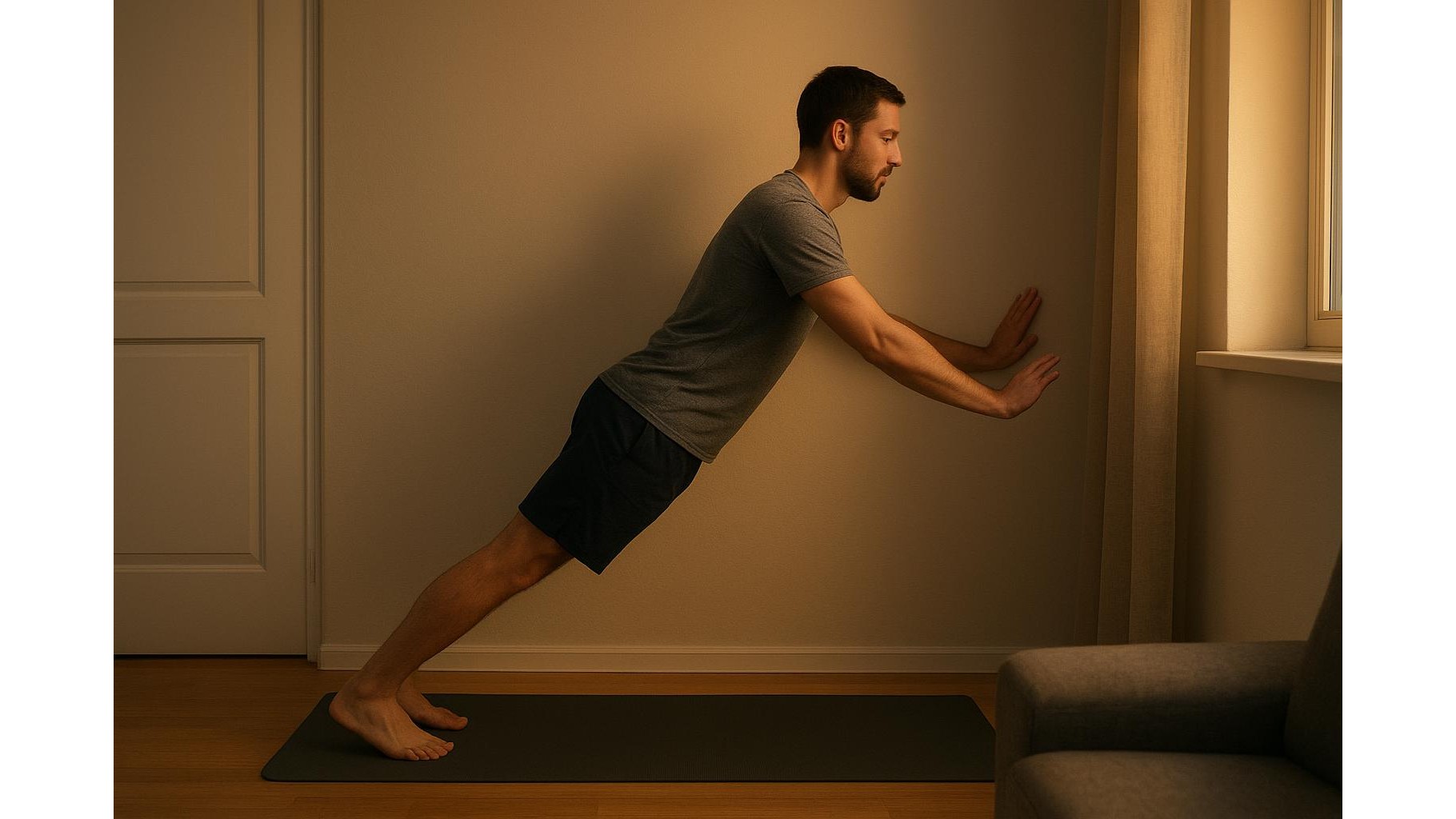
The first strength block targets chest, shoulders and triceps while reinforcing better scapular control. Set up for wall push‑ups: hands on the wall slightly wider than shoulders, body in a straight line from heels to head. Inhale as you bend your elbows and bring your chest toward the wall, exhale as you push away, spreading your shoulder blades. Aim for 3 sets of 10–15 slow reps. Follow with isometric wall presses: stand side‑on to the wall, elbow bent at 90 degrees, and push the back of your arm into the wall at 60–70% effort for 15–20 seconds, then switch sides. These quiet presses train stabilizers around the shoulder without joint strain and help counter rounded‑shoulder posture from desk work.
Doorframe pulls and anti‑rotation core work
To balance the pushing work, use the doorframe for gentle pulling strength and rotational control. Stand inside the frame, feet staggered, hands gripping the sides at about rib height. Lean your body weight back slightly, keeping your body straight, then exhale as you pull your chest toward the frame, squeezing your shoulder blades together. Perform 3 sets of 8–12 controlled reps, focusing on the mid‑back. Next, train anti‑rotation: stand side‑on, both hands clasped around one side of the frame at chest height. Step out so your arms are straight in front of you and the frame tries to pull you inward. Hold your torso square for 20–30 seconds, resisting the twist with your obliques, then change sides. This builds a strong, quiet core that supports the spine in daily movement.
Lower body strength and alignment using the wall
The wall becomes a powerful tool for leg strength and knee‑friendly conditioning. Start with classic wall sits: back against the wall, walk your feet forward and slide down until your hips and knees are roughly at 90 degrees, knees tracking over mid‑foot. Hold for 20–45 seconds, rest and repeat 2–3 times. To wake up glutes and improve alignment, do single‑leg wall hinges: face away from the wall with one foot lightly touching it behind you, hinge at the hips as if closing a drawer with your backside, then stand tall and squeeze the glute. The wall gives you immediate feedback if you sway or lose balance, encouraging a more stacked, upright posture. Keep movements slow, avoid bouncing and prioritize joint comfort over depth.
Cool‑down: reset posture and breathing
Finish with 5 minutes focused on postural reset and calm breathing so your nervous system associates strength work with relaxation, not tension. Lie on the floor with your calves resting on the wall, knees at about 90 degrees, and let your lower back settle neutrally. Take 8–10 slow breaths, expanding into your sides and back. Then perform wall angels: lying or standing with your spine lightly against the wall, slide your arms in a snow‑angel motion, staying within a pain‑free range. End in a gentle chest opener in the doorframe, supporting your forearms on the sides and allowing the front of the shoulders to lengthen. This simple sequence locks in the postural benefits of the session and leaves you feeling grounded, taller and ready to move through the rest of your day.