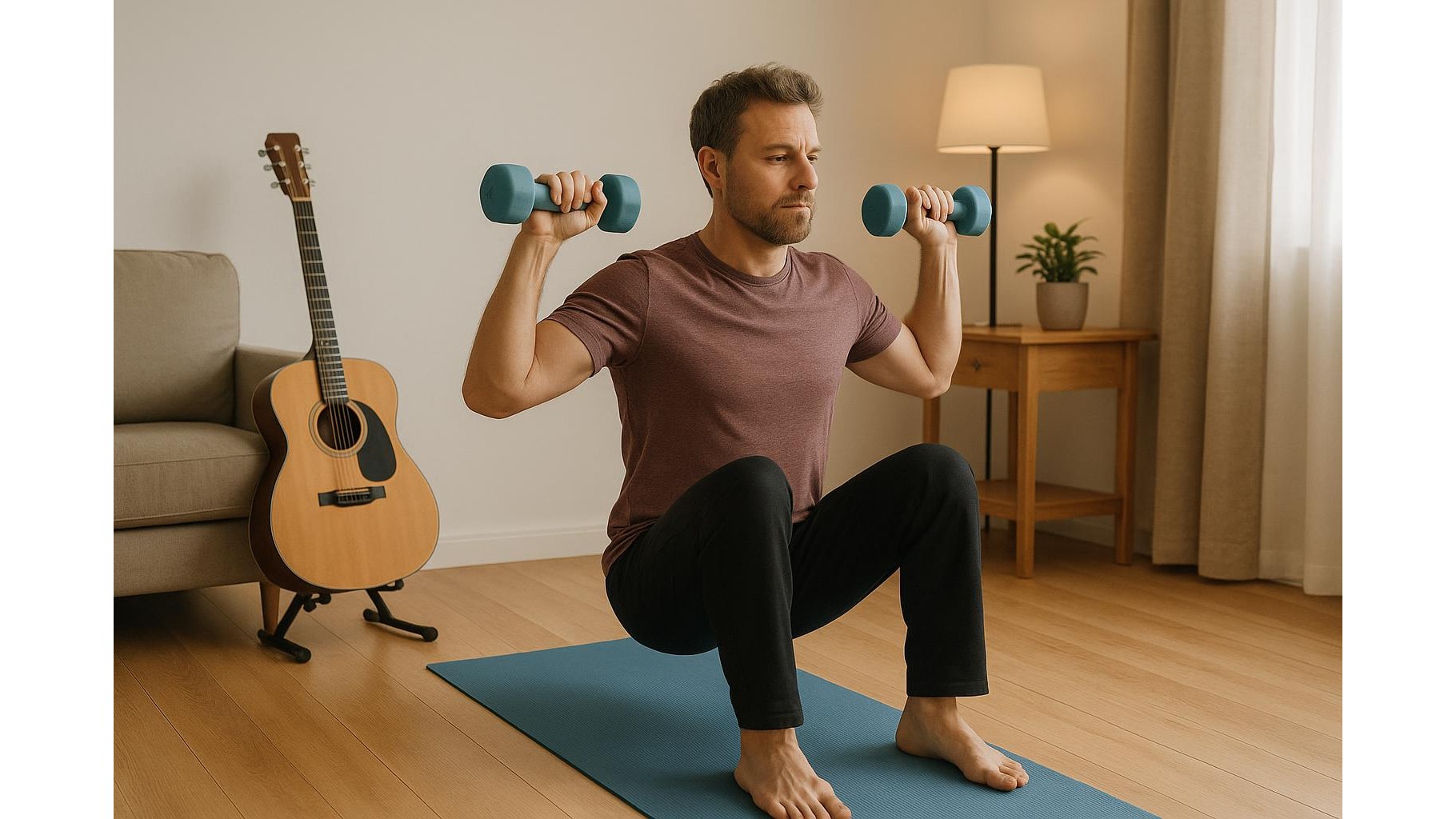
Spending hours with a violin, guitar, piano or computer can slowly wear down your body. Tight shoulders, aching wrists and a stiff lower back are common among musicians and heavy computer users. A structured, 30-minute home strength routine can build resilience, improve posture and protect the joints you rely on most, with minimal equipment and no need for a full gym.
Set up your space and equipment
For this routine you only need a few pieces of simple home gym equipment. Use a light pair of dumbbells or even water bottles, plus a sturdy chair or bench and a yoga mat. Aim to train three times per week, leaving at least one rest day between sessions. Warm up for 3–5 minutes with gentle arm circles, neck rolls and cat–cow movements on the floor. Keep the focus on control rather than speed: each repetition should feel smooth and pain-free. If any movement triggers sharp pain or numbness, stop and modify or skip that exercise.
Posture reset: upper back and shoulder blades
Good posture starts with strong upper-back muscles that balance all the forward-reaching you do when playing or typing. Begin with 2 sets of 12–15 wall slides: stand against a wall, elbows and wrists touching the wall if possible, and slowly slide your arms up and down like a goalpost, keeping ribs down. Follow with 2 sets of 12 prone Y raises on the floor or a bench: lie face down, arms overhead in a Y shape, and gently lift your arms, squeezing your shoulder blades down and together. Finish the block with 30–45 seconds of band pull-aparts or a towel pull, opening the chest and teaching the shoulders to sit back and down.
Shoulder stability for safer playing
To protect the shoulder joint during long rehearsals or computer sessions, you need strong rotator cuff and scapular muscles. Perform 2 sets of 12–15 side-lying external rotations: lie on your side, elbow against your ribs, forearm across the stomach, then rotate the forearm upward with a light dumbbell, keeping the elbow pinned. Pair this with 2 sets of 10–12 elevated push-ups on a bench or table, focusing on pushing the ground away and protracting the shoulder blades at the top. Move slowly and avoid shrugging towards the ears; imagine creating space between shoulders and neck to reduce tension commonly felt by violinists, guitarists and pianists.
Wrist and forearm resilience
Musicians and computer users are prone to wrist pain, tendinitis and forearm tightness. Strengthening the small muscles around the wrist can increase endurance and reduce strain. Sit on a chair with your forearm resting on your thigh, palm up, holding a light dumbbell. Perform 2 sets of 15 wrist curls, then flip the forearm palm down for 2 sets of 15 reverse wrist curls. Add 2 sets of 10–12 radial and ulnar deviations (moving the dumbbell side to side like a hammer) to target the lateral forearm. Finish with 30–60 seconds of gentle finger extension work by opening the hand against light resistance (for example, using a rubber band) to balance all the gripping involved in instruments and keyboard use.
Lower-back friendly core and hips
Long hours sitting or standing to play can overload the lower back. Building a stable core and strong glutes helps offload the spine. Start with 2 sets of 8–10 glute bridges: lie on your back, knees bent, and lift your hips while squeezing the glutes, not the lower back. Follow with 2 sets of 20–30 seconds of a dead bug hold: lying on your back, arms and legs in tabletop, slowly lower opposite arm and leg while keeping the lower back gently pressed towards the floor. Add 2 sets of 10–12 bird-dogs on hands and knees, extending opposite arm and leg without arching the back. These controlled movements teach your trunk to stay stable while limbs move, mimicking real playing postures.
Stretching and recovery for longevity
To round out your 30-minute routine, spend 5–7 minutes on targeted stretching and breathing. Hold a gentle pectoralis stretch in a doorway for 30 seconds per side to counteract rounded shoulders, then kneel into a hip flexor stretch to relieve tension from sitting. Finish with a simple child’s pose on the mat, focusing on slow nasal breathing to downshift your nervous system. Consistent, moderate strength training paired with daily micro-breaks during practice sessions can dramatically reduce discomfort and improve your control over the instrument. Over weeks, you should feel more stable, less fatigued and better able to focus on music instead of pain.
This short, structured home routine is designed to fit easily between rehearsals or work sessions, while addressing the key problem areas for modern musicians and computer users. With just a few simple exercises for posture, shoulder stability, wrist strength and core support, you can build a stronger, more resilient body that supports your art and your work for the long term.