
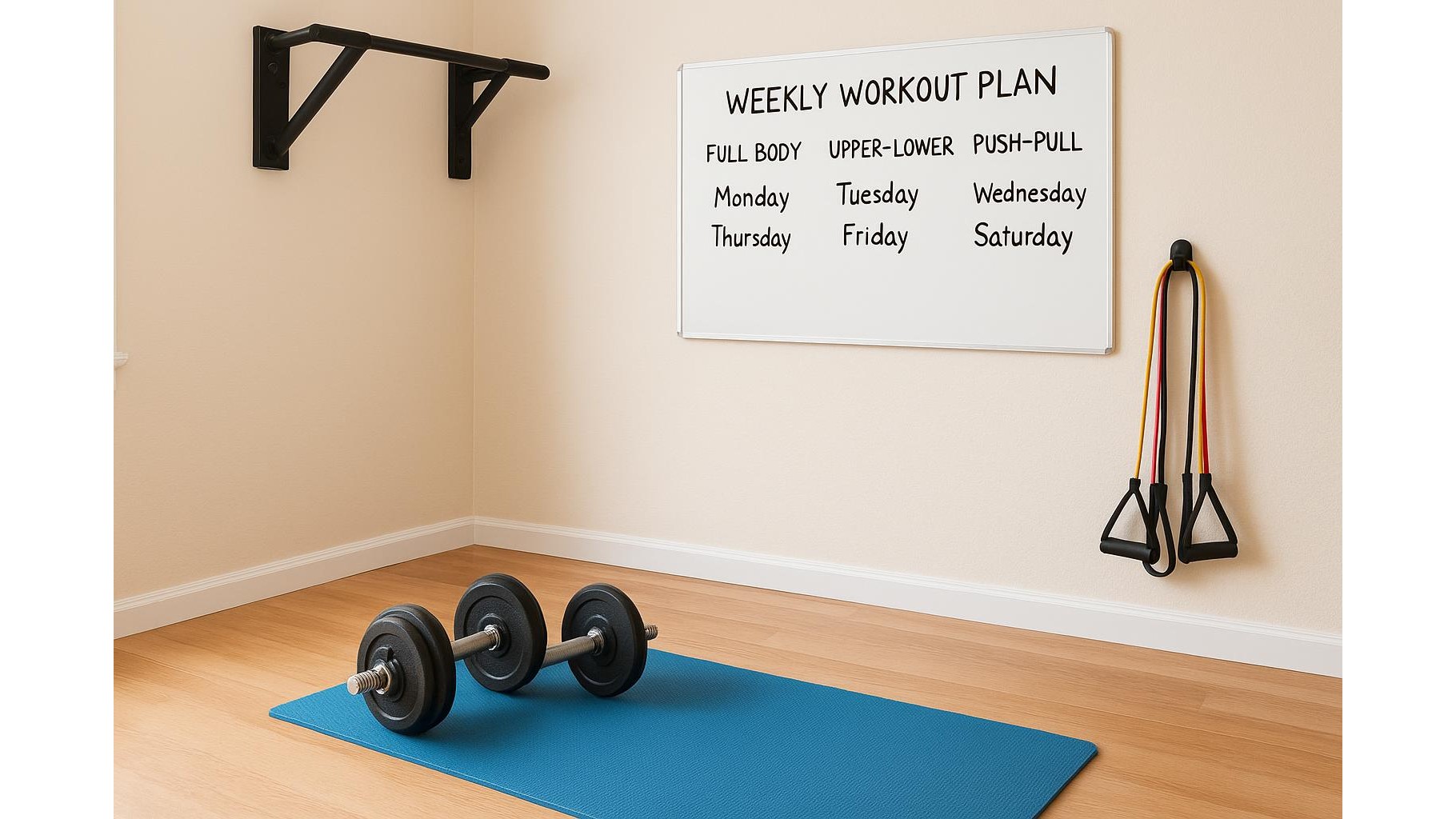
Designing your home workout week can feel confusing. Should you train your full body every session, or use a split routine like upper–lower or push–pull? The right choice depends on your schedule, equipment and experience. Here’s how to pick a clear, effective structure you can actually stick to at home.
Full body: simple and powerful for busy schedules
A full body workout trains all major muscle groups in one session. At home, this works brilliantly with minimal gear. Focus on 4–6 compound moves: squats or lunges, hinges (deadlifts/hip thrusts), pushes (push‑ups/presses), pulls (rows), plus core. For beginners or anyone with only 2–3 days per week, full body is usually best. Example 3‑day template: Day A – squat, push‑up, row, plank; Day B – hinge, overhead press, inverted row or band pull, anti‑rotation core. Alternate A/B sessions across the week and add reps, sets or resistance over time.
Upper–lower split: step up your weekly volume
An upper–lower split divides training into upper body days and lower body days. This is ideal once you can train 4–5 times per week or want more volume per muscle. Example 4‑day template: Mon – Upper: push‑ups, one‑arm row, overhead press, curls, triceps; Tue – Lower: squats, Romanian deadlifts, lunges, calf raises, core; Thu – Upper: incline push‑ups/dips, band rows, lateral raises, curls, triceps; Fri – Lower: single‑leg squats, hip thrusts, hamstring bridge, core. This structure lets intermediates hit each muscle 2x per week while keeping workouts 40–60 minutes at home.
Push–pull (with legs): minimal gear, maximal recovery
A home‑friendly push–pull split groups all pushing moves (chest, shoulders, triceps, quads) on one day and pulling moves (back, biceps, hamstrings, glutes) on another. It suits 3–4 weekly sessions and works great with bands, rings and dumbbells. Example 3‑day template: Day 1 – Push: push‑ups, overhead press, Bulgarian split squats, side planks; Day 2 – Pull: rows, hip hinge, leg curl or Nordic regressions, curls; Day 3 – Full body: a lighter mix of squats, rows, presses and core. Alternate heavy and lighter days to manage fatigue, especially when training in a small home space with limited equipment.
How to choose: beginners vs intermediates
If you’re a beginner with 2–3 days available, choose full body: fewer decisions, more practice of key lifts, faster skill and strength gains. Once you’re consistent and can handle 4+ days, move to upper–lower or push–pull for extra volume and variety. Consider your joints and recovery: if you get sore easily, keep one full body or lighter technique day in any split. Home training success is less about the “perfect” structure and more about hitting each muscle 2–3x per week with progressive overload.
Putting it together: 3–5 day sample weeks
Use these examples to build your own plan: 3‑day beginner: Mon Full body A, Wed Full body B, Fri Full body A (next week start with B). 4‑day intermediate: Mon Upper, Tue Lower, Thu Upper, Fri Lower. 5‑day mixed: Mon Push, Tue Pull, Thu Lower, Fri Upper, Sat short Full body technique/conditioning. Keep 4–8 hard sets per muscle group per week to start, then gradually add volume. Track reps, sets and load so every week you do a little more.
Choosing between full body, upper–lower and push–pull splits at home comes down to time, experience and recovery. Start simple, aim for consistency, and only add complexity when you truly need more stimulus. With a clear weekly structure, even a small home gym can deliver serious strength and muscle results.









