
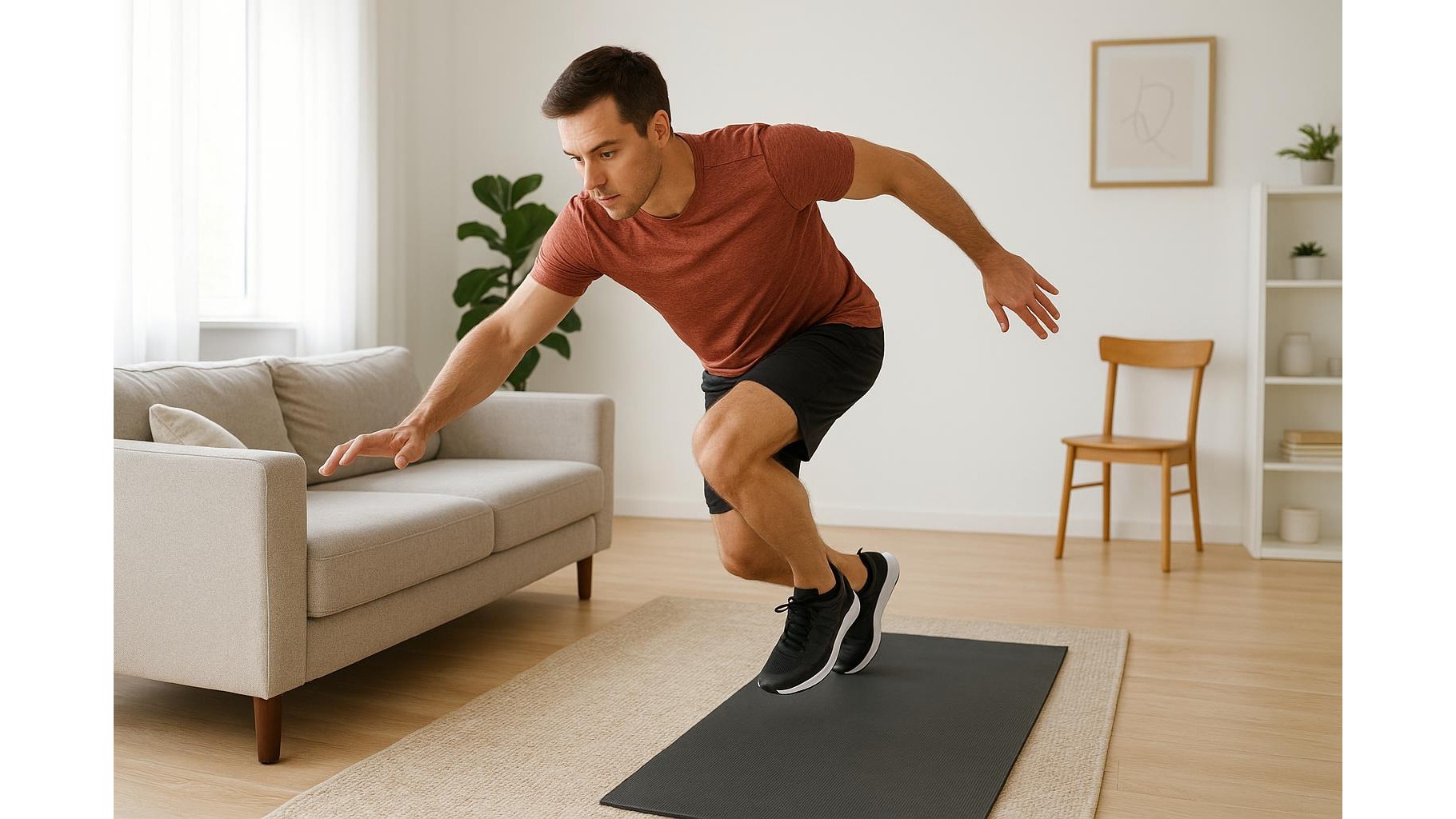
If you love the idea of parkour but don’t have access to a specialised gym, this 30-minute parkour-inspired home workout lets you explore agility, balance and strength using nothing more than your bodyweight and everyday furniture. With playful, low-impact drills and a strong focus on control, you’ll learn how to move around your living room more fluidly while staying safe and joint-friendly.
Set up your safe parkour-inspired training zone
Before you start jumping around, take five minutes to create a safe training zone. Clear the floor of clutter and anything that can roll or slide, like small mats or toys. Choose a sturdy sofa, a solid chair, and, if possible, a clear wall section. Test every surface with gentle pressure and small movements before committing to bigger actions. Train in sports shoes for traction, and use a firm rug or exercise mat to protect your joints during bodyweight exercises. Keep your movements controlled and quiet: if you hear heavy thuds, you’re probably landing too hard. This environment-first approach lets you enjoy a parkour-style home workout without risking damage to your body or your furniture.
Balance drills using chairs, sofa edges and narrow lines
Parkour athletes rely on exceptional balance and proprioception. Recreate this at home by using edges and lines. Stand on the edge of a sturdy step or the base of your sofa and practice single-leg stands for 30–45 seconds per side, keeping your core tight and eyes focused on a fixed point. Progress to heel-to-toe walks along a narrow line on the floor (for example, a strip of tape), staying as silent and controlled as possible. Add gentle reaches with your arms or turn your head side to side to challenge your stability. These simple drills wake up your stabilising muscles around the ankles, knees and hips, building the foundation you need for more dynamic agility training.
Controlled jumps and soft landings on household targets
Next, bring in low-impact, controlled jumps to mimic parkour precision work. Choose a clear patch of floor and set small visual targets, like cushions or taped squares. Practice two-foot jumps forward, sideways and diagonally, always focusing on quiet, soft landings with knees tracking over toes and hips pushed slightly back. Think of your legs as springs: absorb the landing, then stabilise for two seconds before moving again. You can jump from the floor onto a slightly raised but stable surface, such as a low step, then step down one foot at a time. This style of training conditions your quads, glutes and calves while training accuracy and body awareness, without the high impact of outdoor concrete landings.
Vault-style movements using the back of a sofa and sturdy chairs
Vaults are a signature of parkour, but at home you’ll focus on low, controlled, strength-based versions. Position a sturdy chair or the arm/back of a robust sofa so you can place your hands on it without it wobbling. Start with step-throughs: hands on the surface, jump or step your feet from one side to the other, landing softly. Keep your shoulders stacked over your hands and your core braced. Progress to a low “lazy vault” pattern by placing one hand on the surface, stepping one leg over, then bringing the trailing leg through, mimicking the fluid motion you see in parkour but at a much gentler intensity. These vault-style drills build upper-body and core strength while teaching you to transfer your weight smoothly over obstacles.
Wall and sofa drills for strength and coordination
To round out your home parkour routine, add wall and sofa drills that develop whole-body strength. Wall-supported squats or isometric wall sits train your quads and glutes with minimal movement, ideal if you need a joint-friendly option. For your upper body, use the edge of the sofa or a stable coffee table for incline push-ups, lowering your chest with elbows tucked at roughly 45 degrees. Combine these with mountain climbers or slow, controlled knee drives with hands on the sofa to activate your core and hip flexors. Linking these moves together in short circuits (for example, 30 seconds on, 15 seconds off) creates a 30-minute agility and strength routine that feels like a playful parkour session, even though you never leave your living room.
By turning everyday furniture into a safe playground, this parkour-inspired home workout helps you build balance, coordination, controlled jumping and functional strength in just 30 minutes. Stay mindful of your environment, progress gradually, and keep the focus on quiet, precise movement. Over time you’ll not only feel stronger and more agile, but you’ll also start to see your home as a creative training space where every edge, line and surface offers a new way to move.









