Turn your everyday kitchen into a surprisingly effective home gym. With nothing more than solid counters, sturdy chairs and stable walls, you can build a balanced, 30-minute full body bodyweight workout that is kind to your joints and your neighbours. This kitchen strength circuit focuses on controlled movements, time under tension and strategic rest, so you get a serious training effect without equipment noise or impact.
Setting up your kitchen mini gym
Before you start, clear some floor space around your kitchen counter and make sure you have one or two stable chairs that do not roll or wobble. Test the counter by leaning your bodyweight into it for incline push-ups; it should feel rock solid. Place a chair near a wall so you can use both for supported squats and step-ups. If you have a basic exercise mat or even a folded towel, use it to protect your hands and knees on hard tiles. Keep a glass or bottle of water nearby and set a timer for 30 minutes so you can move efficiently through the circuit.
[h5][/h5]
The 30-minute kitchen strength circuit structure
This full body bodyweight workout uses a simple circuit format: 40 seconds of work, 20 seconds of rest, moving from one kitchen-based exercise to the next. Aim for 3 rounds with 2–3 minutes of rest between rounds. A sample circuit looks like this: 1) Incline counter push-ups for chest, shoulders and triceps; 2) Chair supported squats for legs and glutes; 3) Chair step-ups for single-leg strength and balance; 4) Wall sit for an isometric leg burn; 5) Counter plank hold or wall plank for core stability; 6) Optional: kitchen towel rows anchored around a sturdy handle for upper-back engagement. Work quietly and with control so the session stays neighbour-friendly.
Upper body: push-ups and holds using the counter
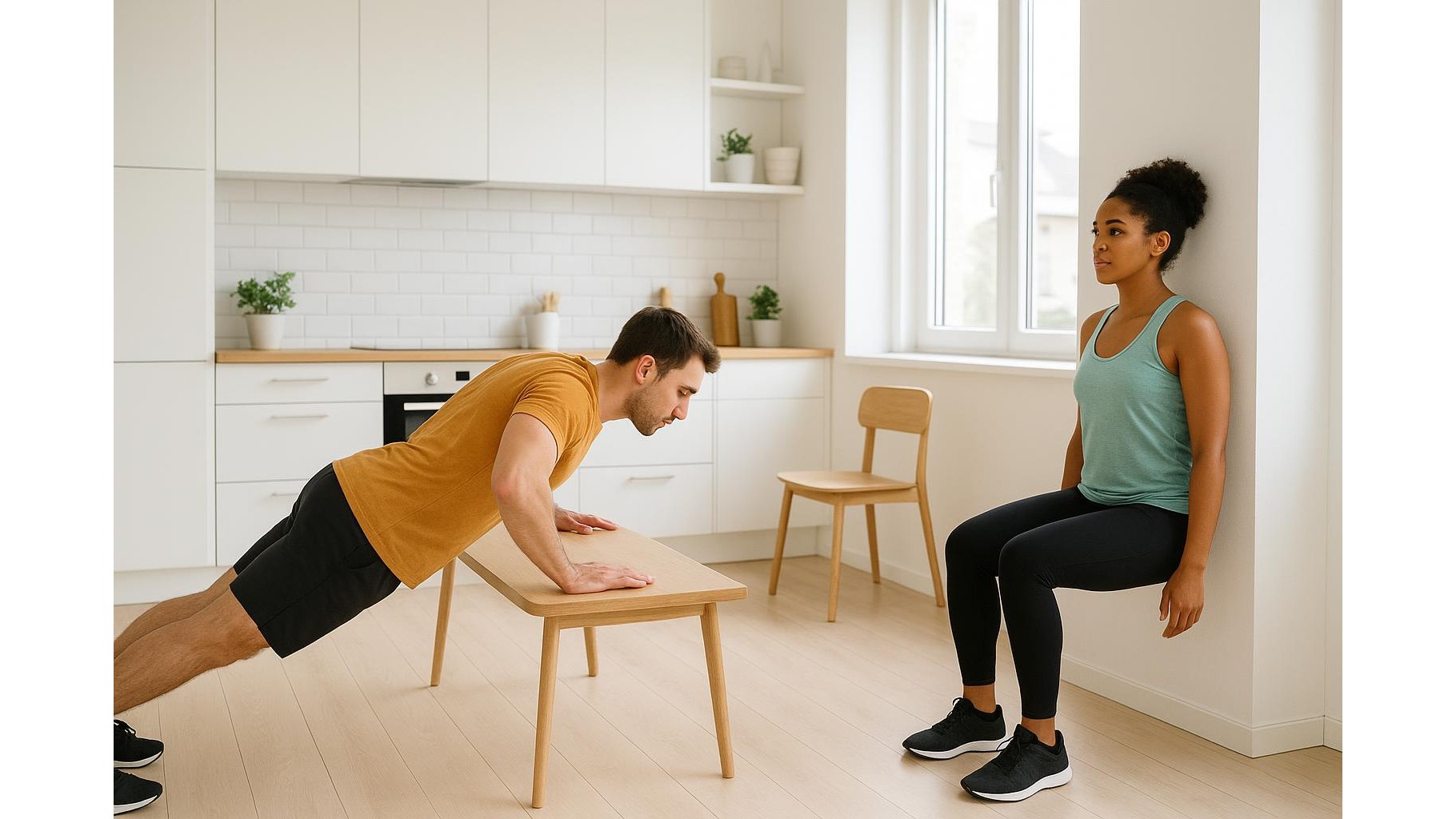
The kitchen counter is ideal for scalable push variations. For beginners, start with incline push-ups: hands on the counter, body in a straight line, lower your chest toward the edge and push away. The higher the surface, the easier the movement, making this perfect if floor push-ups feel too intense. To increase difficulty, step your feet further back or progress to decline push-ups by placing your feet on a low chair and hands on the floor. You can also add isometric counter holds: lean into the counter at a mid-push-up position and hold for 20–30 seconds to build static strength without any noise or impact.
Lower body: chairs and walls for strong, quiet legs
For the lower body, combine chair squats, step-ups and wall sits. Start with supported squats: stand in front of a chair, lightly hold the counter or chair back for balance, sit your hips back to tap the seat, then drive through your heels to stand. Beginners can keep the range of motion shallow; advanced trainees can hover just above the seat. Use a sturdy chair for step-ups, driving through the lead foot to stand tall and controlling the way down. Finish the leg block with a wall sit: slide your back down the wall until your knees are about 90 degrees and hold. This isometric hold is completely silent but delivers a serious quad and glute burn.
Core and posture: walls and counters for stability
Your kitchen walls and counters are perfect anchors for core training and posture work. Try a counter plank by placing your forearms on the counter, walking your feet back and holding a straight line from head to heels while bracing your midsection. Beginners can stand more upright; advanced trainees can progress to a floor plank or add slow counter shoulder taps to challenge stability. For posture, stand with your back against the wall and perform slow wall slides, gliding your arms up and down while keeping elbows, wrists and shoulders in contact with the wall. These moves strengthen the upper back and core without any need for equipment or floor space.
By turning your kitchen into a mini home gym, you remove common barriers like space, equipment and noise. This 30-minute kitchen strength circuit hits upper body, lower body and core using only counters, chairs and walls, with simple progressions for both beginners and more advanced home trainees. Keep the movements controlled, focus on quality reps and track your rounds week by week. With consistency, your ordinary kitchen will quietly become the place where you build extraordinary everyday strength.