Tennis and padel demand fast changes of direction, explosive rotation and rock‑solid shoulders. This 40‑minute home strength workout uses only resistance bands and dumbbells to build the specific power, stability and leg strength you need to hit harder, move quicker and stay injury‑free without leaving your home gym.
Warm‑up and shoulder activation
Start with 5–7 minutes of dynamic mobility to prepare your joints for the demands of racket sports. Perform arm circles, leg swings and torso rotations, then move into banded shoulder activation. Attach a light band to a door handle and do 2 sets of 15–20 external rotations per arm, focusing on slow control to engage the rotator cuff. Follow with band pull‑aparts and band dislocates to open the chest and improve scapular control. This phase primes your shoulders and upper back for the repetitive overhead actions common in tennis and padel serves, smashes and high volleys.
Upper‑body strength for serves and smashes
This block targets pressing and pulling patterns that transfer directly to your serve and overhead shots. Perform 3 sets of 8–12 reps each with 45–60 seconds rest. Start with single‑arm dumbbell floor press to build unilateral pushing strength and trunk stability; keep the non‑working hand on your core to feel the engagement. Pair this with a one‑arm band row, pulling towards your hip to mimic the scapular movement of a forehand. Add a set of Y‑T band raises for 12–15 reps to reinforce lower‑trap activation and postural endurance, helping you maintain a strong, upright upper body during long rallies.
Rotational power for forehands and backhands
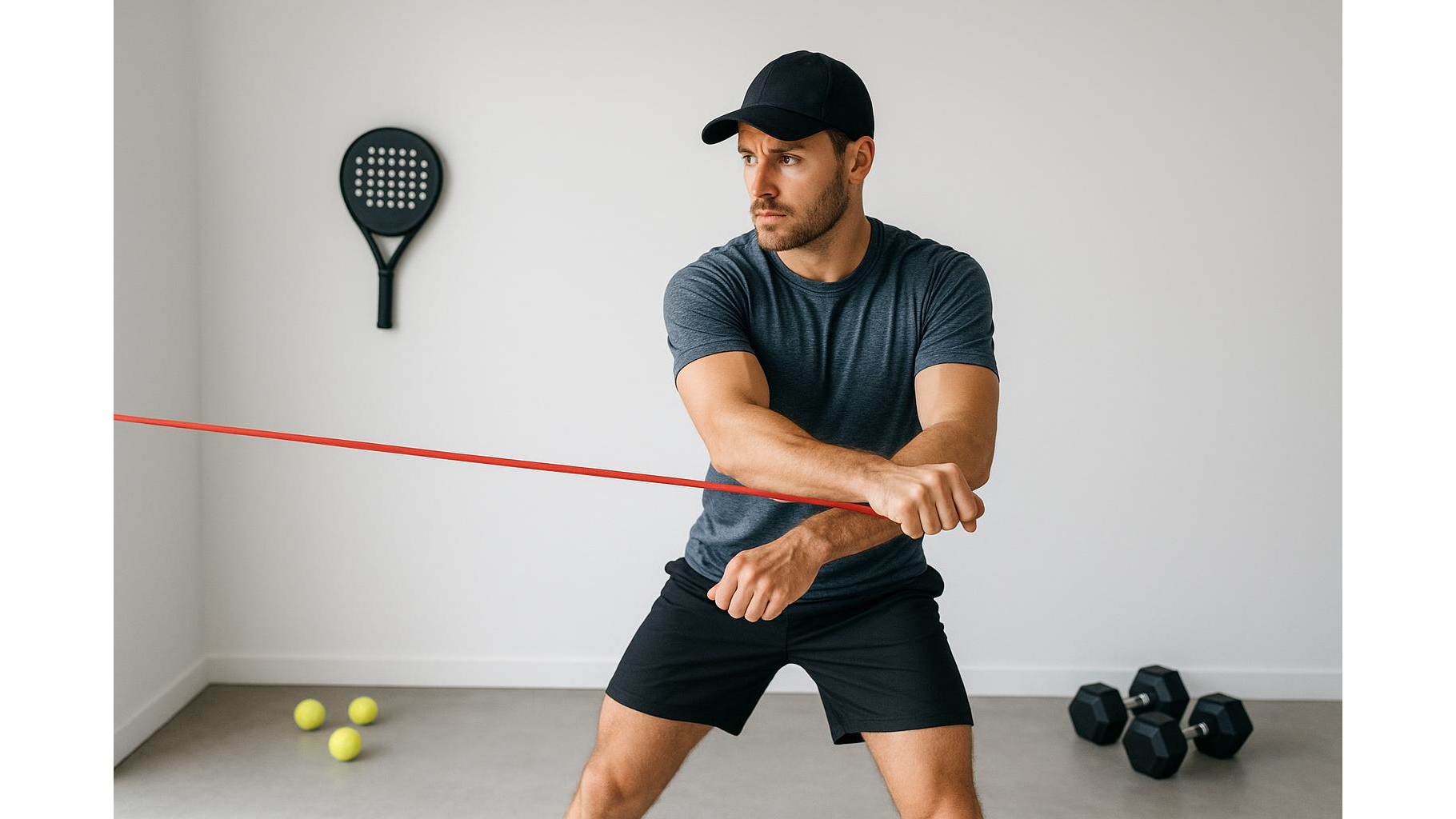
Rotational strength is the engine behind your groundstrokes. Anchor a medium band at chest height and perform standing band rotations for 3 sets of 10–12 reps per side, pivoting through the hips and driving from the rear foot. Follow with dumbbell Russian twists on the floor, 12–15 reps per side, keeping the chest proud and range controlled to avoid lumbar strain. To further integrate hips and core, add half‑kneeling band presses across the body, pressing from a low hip position to simulate the load‑and‑explode mechanics of an aggressive forehand or padel bandeja. Focus on speed in the concentric phase while staying strict with technique.
Lower‑body strength and change of direction
Strong legs underpin every sprint, lunge and recovery step on court. Begin with dumbbell goblet squats for 3 sets of 8–10 reps, emphasizing depth and knee alignment over the middle toes. Move to reverse lunges holding dumbbells, 8–10 reps per leg, to build unilateral strength and hip stability that carry over to wide balls and low volleys. Finish the block with lateral band walks, 12–15 steps each direction, to target the glute medius and improve lateral push‑off. Minimal rest (30–45 seconds) between exercises will also challenge your game‑specific endurance, mirroring the repeated efforts of match play.
Shoulder stability, prehab and cool‑down
Close the session with controlled stability and recovery work to keep your shoulders and elbows healthy. Perform 2 sets of 12–15 banded face pulls, focusing on pulling the band towards the forehead and squeezing between the shoulder blades. Add banded internal rotations to balance the rotator cuff, matching the volume of your external rotations from the warm‑up. Finish on the floor with dumbbell arm bars using a very light weight, holding the arm vertical while rotating the torso to reinforce scapular stability. Cool down with gentle stretches for hip flexors, hamstrings, pecs and forearms, holding each for 20–30 seconds while breathing deeply.
This home strength workout for tennis and padel players delivers targeted gains in shoulder stability, rotational power and lower‑body strength with only bands and dumbbells. Performed 2–3 times per week alongside your on‑court practice, it can help you hit heavier shots, move more efficiently and reduce injury risk, all within a compact 40‑minute routine that fits easily into a busy schedule.