If you spend most of your day sitting, chances are your hamstrings, glutes and upper back are tight, weak, or simply “asleep”. The good news: you don’t need a full gym to wake them up. With just a pair of long resistance bands and a sturdy chair, you can build a powerful 35‑minute routine that restores your posterior chain, improves posture, and gives your hips and back the pulling work they rarely get at a desk. Below you’ll find a simple, step‑by‑step home workout you can follow today.
Why your posterior chain needs a rescue plan
Hours of sitting put your body into a permanent “front‑side” position: hip flexors get short, chest rounds forward, and the muscles that should extend your hips and hold you upright – the glutes, hamstrings, and upper back – switch off. Over time this can lead to a tight lower back, cranky knees, and that classic hunched‑over desk posture. A smart home routine should reverse that pattern with more pulling and hip‑hinge work, not just endless push‑ups and crunches. Long resistance bands are perfect here: they’re joint‑friendly, create constant tension, and let you load the hips and back safely, even in a small space.
Gear check: what you need (and how to choose it)
For this routine you only need two things: a sturdy chair that won’t slide, and a basic set of loop resistance bands. Look for a pack that includes multiple resistance levels so you can scale exercises for your hamstrings, glutes, and back without changing the plan. Longer loop bands make it easy to set up rows, presses and hip hinges without door anchors, which is ideal for renters or anyone training in a living room. When browsing on Amazon, focus on thick, layered latex or fabric‑reinforced bands rather than ultra‑thin “freebie” bands: they last longer and provide smoother tension through the entire range of motion.
Warm‑up: switch on hips and upper back (5 minutes)
Start with 5 minutes to wake everything up. Begin with 60 seconds of gentle cat‑camel movements on all fours to mobilise the spine, followed by 10–12 bodyweight hip hinges, pushing your hips back as if closing a car door with your glutes. Next, loop a light band around both wrists, extend your arms in front of your chest and perform 15–20 band pull‑aparts, squeezing the shoulder blades together to fire the upper back. Finish with 10–12 glute bridges on the floor, pausing for two seconds at the top to reinforce that strong, locked‑out hip position you’ll use in the main circuit.
Main circuit: 20‑minute posterior‑chain focus
Set a timer for 20 minutes and cycle through the following four moves with minimal rest. Aim for 8–12 repetitions per exercise and 3–4 total rounds, adjusting band resistance as needed:
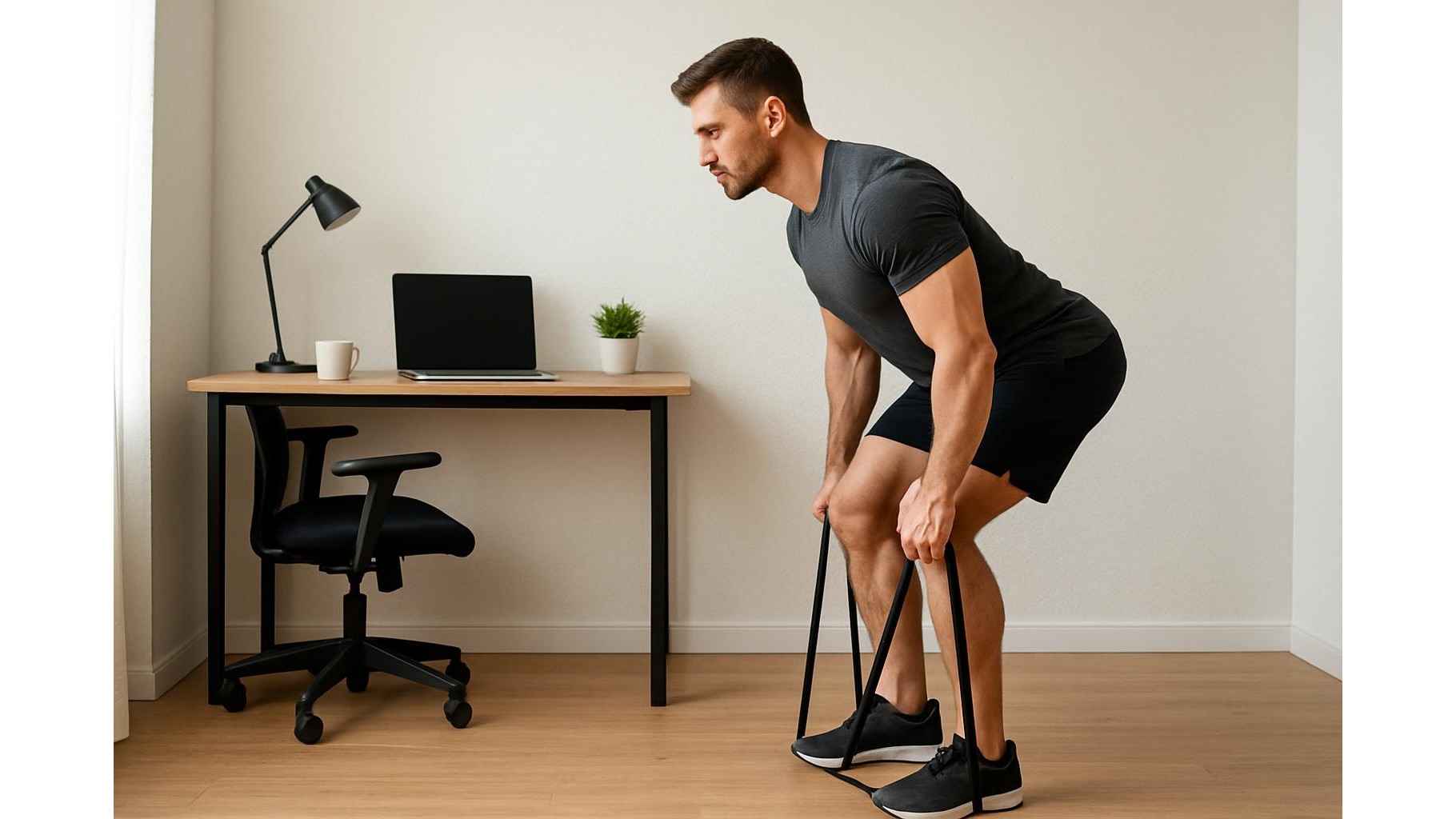
- Banded Romanian deadlift with chair support: Stand on the band with feet hip‑width, hold the ends, and hinge at the hips with a soft knee bend. Use the chair back for balance if needed. Focus on feeling a stretch in the hamstrings and driving up through the glutes.
- Seated band row: Sit on the chair, loop the band around your feet, and pull towards your ribcage. Keep your chest tall and squeeze your shoulder blades together to target the upper back and rear delts.
- Banded glute bridge: Place the band just above your knees, lie on your back with feet close to the chair, and push the knees out as you lift your hips. This lights up the glute medius and adds lateral stability.
- Banded good morning: Loop the band around your shoulders and under your feet, then perform a controlled hip hinge. This reinforces hip‑dominant movement without overloading the lower back.
Accessories and variations to keep progress coming
Once the basic pattern feels solid, you can tweak volume and resistance instead of reinventing the workout every week. Increase band thickness on Romanian deadlifts and good mornings for more hip‑hinge strength, or add a slower three‑second lowering phase on glute bridges to build control. If your upper back is a weak link, insert extra sets of seated rows or band pull‑aparts between rounds. Desk workers who feel particularly stiff through the front of the hips can elevate their feet on the chair during bridges to increase range of motion, or add a single‑leg variation for more unilateral glute work without any extra equipment.
Cool‑down: locking in mobility and posture (5–10 minutes)
Finish with 5–10 minutes of focused mobility so the new tension patterns actually stick. Use a light band to perform gentle assisted hamstring stretches on the floor, keeping the knee slightly bent to protect the sciatic nerve. Follow with a child’s pose variation, walking the hands to each side to open the lats and upper back, then a simple chest opener: stand in a doorway, place forearms on the frame, and lean forward until you feel a stretch across the chest. Aim to breathe slowly and deeply throughout. Done consistently two to three times per week, this 35‑minute resistance band home workout can transform your “sleepy” posterior chain into a strong, active support system for your spine, hips and everyday posture.
In summary, this short, equipment‑light routine gives you exactly what most home programs miss: targeted posterior‑chain training with plenty of pulling and hip‑hinge work. With only resistance bands and a chair, you can reduce back tightness, wake up your glutes and hamstrings, and build a stronger foundation for everything else you do – from lifting in the gym to simply walking away from your desk without pain.