Spending long hours sitting can leave your core weak and your posture slumped. The good news: you do not need a gym full of machines to rebuild a stronger midline. With nothing more than a stable chair, you can train your abs, back and postural muscles in just 30 minutes, right in your living room or home office. This routine is joint-friendly, beginner-friendly and perfect for desk workers who want to feel taller, more stable and less stiff by the end of the day.
Table of contents
How to set up your space and choose the right chair
For this home chair workout, any sturdy, non‑wheeled chair without armrests works best. Place it on a non‑slippery surface so it will not slide when you lean or press against it. Wear comfortable clothing that lets you move freely and, if possible, train barefoot or in flat shoes to improve balance and foot stability. Keep a water bottle nearby and, if you have one, a small cushion or folded towel to place on the seat when you perform seated or supported exercises. Before you start, do a short warm‑up: gentle marching on the spot, some arm circles and a few slow spinal rolls to wake up your posture muscles.
Segment 1 – Seated core activation and posture reset
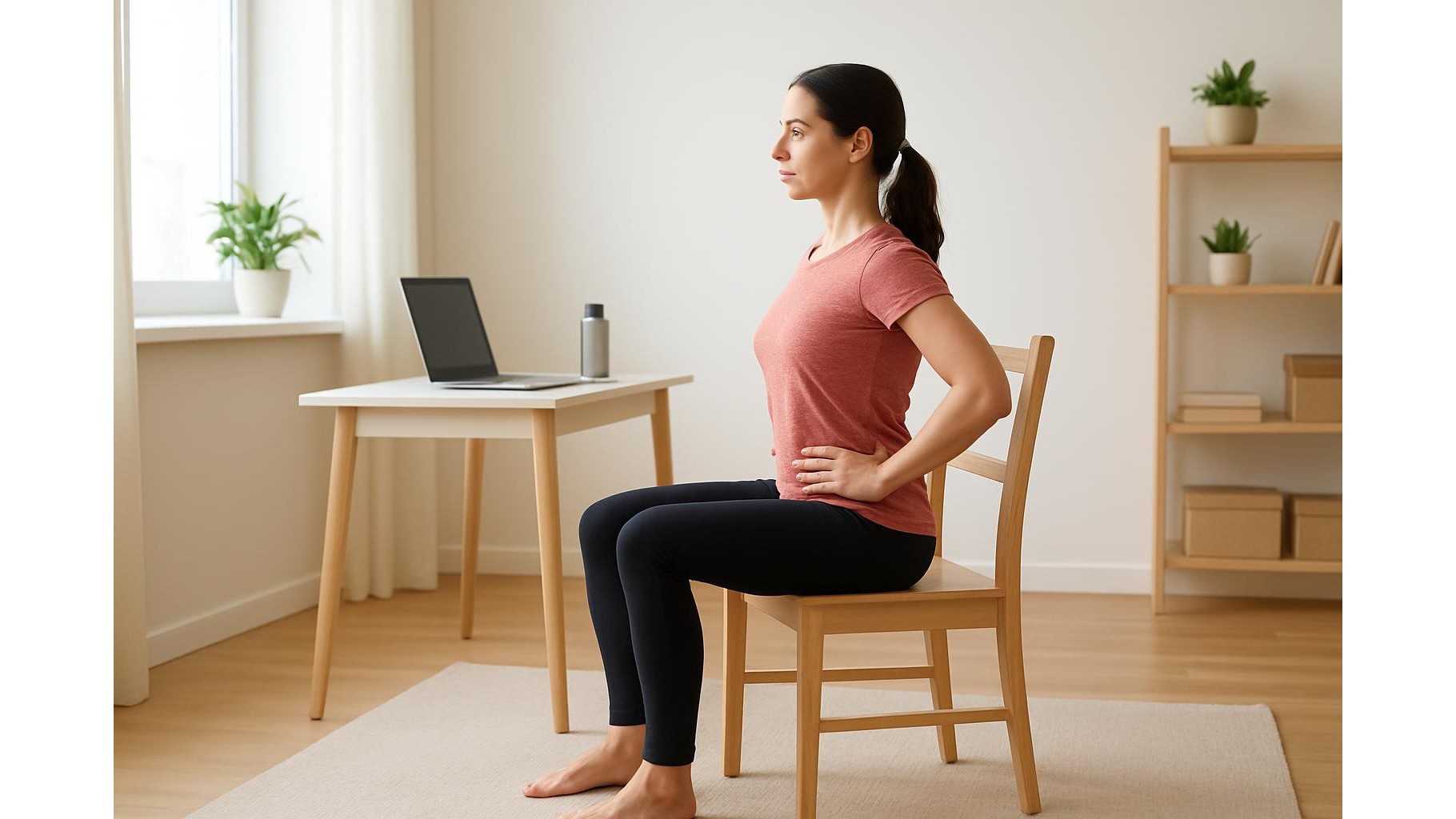
Begin with 5–7 minutes of gentle core activation while seated. Sit tall on the front edge of the chair, feet under knees and hip‑width apart. Imagine a string pulling the crown of your head up. From here, practise diaphragmatic breathing: inhale through the nose, letting your ribcage expand, then exhale and lightly brace your midsection as if preparing for a poke in the belly. Add seated pelvic tilts, slowly rolling your hips to flatten and then arch the lower back, staying pain‑free. Finish with 10–12 reps of seated marches, lifting one knee at a time while keeping your torso tall and steady, to teach your trunk to stabilise during movement.
Segment 2 – Supported planks and anti‑slouch drills
Now move into 8–10 minutes of trunk strengthening with the chair as support. Stand behind the chair, place your forearms on the backrest and walk your feet back into a high inclined plank. Keep shoulders over elbows, ribs tucked and glutes gently engaged; hold for 20–30 seconds, rest and repeat 3 times. This angle reduces wrist and low‑back stress compared to floor planks. Then sit again and perform seated Y‑raises: arms lifted diagonally into a Y‑shape while you squeeze the shoulder blades down and back, combating rounded desk posture. Do 2–3 sets of 10 slow reps, focusing on controlled movement rather than weight.
Segment 3 – Chair‑based rotations for a stable, mobile spine
Rotational control is key for a resilient midline. Sit tall with your hands lightly holding the sides of the chair. Keeping your hips still, slowly rotate your ribcage to the right, pause, then to the left for 8–10 reps each side. Imagine lengthening through the spine rather than cranking the twist. Next, cross your arms over your chest and perform seated anti‑rotation holds: rotate a few degrees to the right, then resist as if someone is gently trying to pull you further. Hold 10–15 seconds and switch sides. These small, precise movements strengthen the obliques and deep spinal stabilisers without the strain of big, fast twists, making them ideal for beginners and anyone with a sensitive lower back.
Segment 4 – Hip hinges, glute work and posture‑friendly standing moves
Stronger glutes and hips help your core and posture last all day. Stand with the back of your legs lightly touching the chair seat. With a long spine, push your hips back into a gentle hip hinge, sliding your hands down your thighs, then return to stand by driving through your heels. Perform 2–3 sets of 8–12 reps, moving slowly. Use the chair back for light support if needed. Follow with sit‑to‑stands: sit down under control and stand up without using your hands when possible; this mimics a squat while keeping the range of motion joint‑friendly. Finish with standing calf raises, one or both hands resting on the chair for balance, to support better alignment from the feet up.
Segment 5 – Cool‑down, stretch and daily posture habits
Use the final 5 minutes to cool down and reinforce good posture habits. Sit tall and perform gentle neck stretches, tilting your ear toward one shoulder, then the other, without pulling. Add a seated chest opener: interlace your fingers behind your back (or hold the chair seat), gently drawing the shoulders down and back. Finish with a few slow, deep breaths in your tall seated position, memorising how an aligned spine feels. To lock in the benefits of this 30‑minute chair workout, sprinkle micro‑sessions into your day: every hour, take 60 seconds for seated marches, shoulder blade squeezes or a few hip hinges. Over time, these small, consistent habits build a stronger, more upright posture that carries into every movement you make at home and at work.
This simple chair‑based core and posture routine proves you do not need crunch marathons or complex equipment to build a stronger midline. By combining seated activation, supported planks, rotational control and hip‑focused moves, you train the entire trunk in a safe, scalable way. Repeat this 30‑minute session two to four times per week, adjust the holds and reps to your level, and you will notice better alignment, less stiffness and more confidence in how you sit, stand and move throughout your day.