
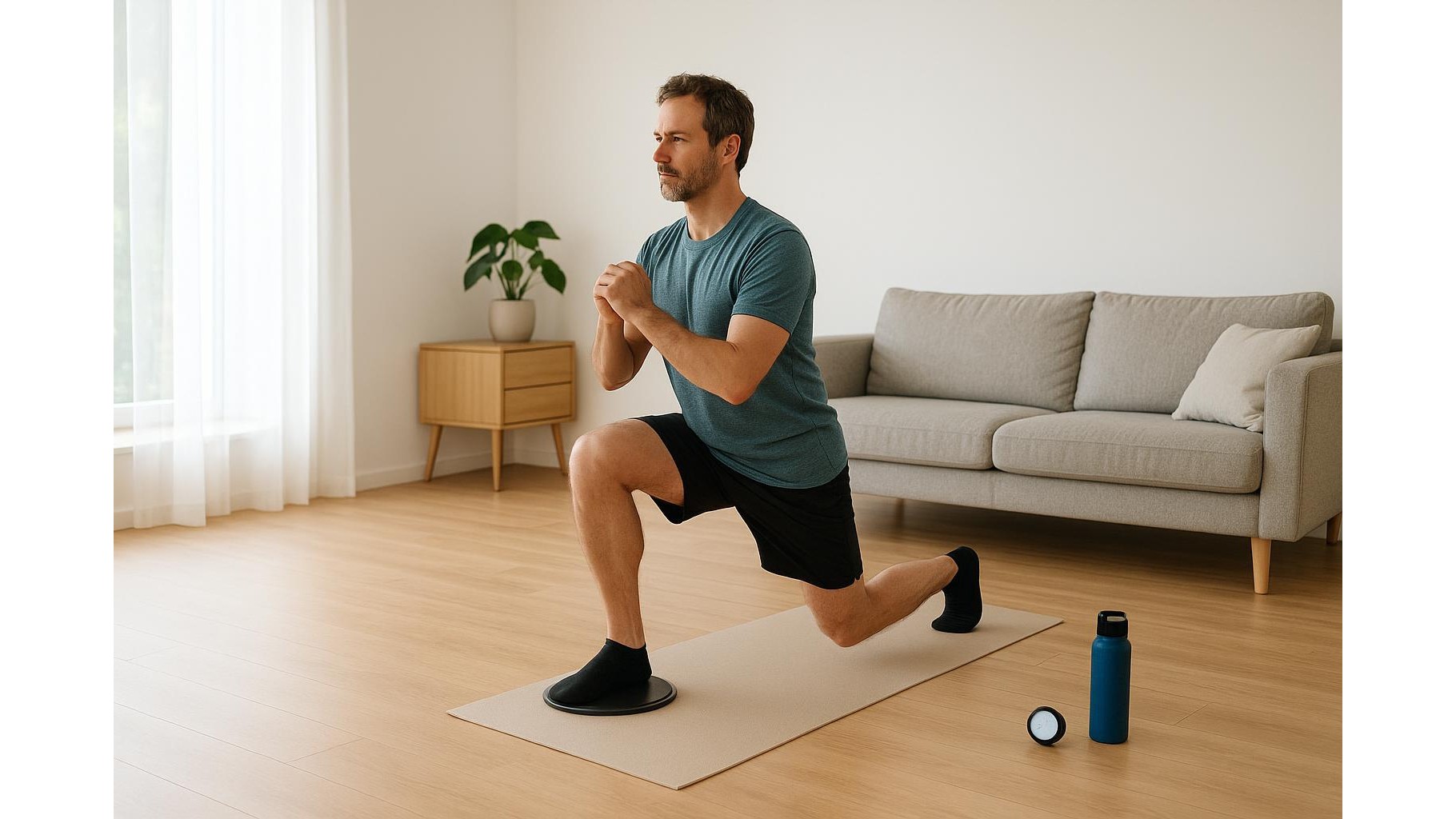
If you have a smooth floor and a pair of furniture sliders or even just thick socks, you already own a compact home gym. This 30-minute full body strength circuit targets legs, glutes, core and shoulders using controlled sliding movements that challenge your stability without heavy weights. Below you’ll find a simple structure with beginner and intermediate progressions, plus low-impact options that are friendly for neighbours and apartment living.
What you need and how to warm up
To follow this session you just need a smooth surface (wood, tile or laminate) and something that slides easily, such as furniture sliders or thick cotton socks. If you choose furniture sliders, pick a pair designed with a soft foam top and a smooth plastic base so your feet stay secure while you move. Clear your space of obstacles and keep a mat nearby for kneeling or core work if you prefer. Start with a 5-minute warm up: march in place, hip circles, bodyweight squats and arm circles. Focus on activating the glutes and core so they are ready to control the extra instability created by the sliders.
Lower body focus: lunges, curls and lateral slides
The first block targets legs and glutes. Place one foot on the slider and perform reverse lunges: slide the back foot straight behind you, bend both knees, then pull forward using the front leg. Beginners can reduce the depth and use a wall or chair for support, while intermediates slow down the eccentric (lowering) phase to build strength. Next, try hamstring curls from a glute bridge: lie on your back, heels on the sliders, lift hips and slowly slide heels away, then pull them back under you. Finish with lateral slides, keeping one foot planted and sliding the other out to the side, driving back through the heel to return. All of these moves are low-impact, quiet and perfect for shared walls.
Core strength: body saws, mountain climbers and tucks
Sliding exercises are ideal for building a strong core because they demand constant tension and control. Start in a forearm plank with both feet on sliders and perform body saws: gently glide your body backwards and forwards, keeping shoulders over elbows and ribs pulled in. For beginners, limit the range of motion to keep the lower back comfortable. Intermediates can progress to slider mountain climbers in a high plank, smoothly drawing one knee at a time towards the chest, or both knees together for tuck-ins. The key is slow, controlled movement rather than speed, which keeps noise low and protects your joints while deeply engaging the abdominals and hip flexors.
Shoulders and upper body: push variations and reaches
To hit the shoulders and upper body, move to slider push-up variations. From a high plank, place each hand on a slider. Beginners can work from the knees, sliding one hand slightly forward as you lower into a push-up, then sliding it back as you press up. Intermediates can try alternating slide-out push-ups, reaching one hand diagonally out to the side while keeping the core braced. You can also perform kneeling shoulder slides against a wall: kneel, forearms on sliders against the wall, and gently slide arms overhead, feeling the shoulder blades rotate upward. These movements create time under tension without jolting or impact, so they are considerate for neighbours below.
How to structure the 30-minute circuit
To turn these drills into a focused 30-minute home workout, use a simple circuit format. Perform 40 seconds of work followed by 20 seconds of rest for each exercise, cycling through one lower body move, one core move and one upper body move. Beginners can complete 3 rounds with a full 2-minute break between circuits, while intermediates aim for 4 rounds with shorter breaks. Keep your breathing steady and focus on quality reps over quantity. If something feels too intense, shorten the range of motion or remove the sliders and perform the same pattern with static feet or hands. This makes the session scalable for different fitness levels and energy days.
To wrap up, spend 3–5 minutes on gentle stretches for hamstrings, hip flexors, chest and shoulders. The consistent instability from the sliders means your stabiliser muscles will have worked hard even if the workout felt low-impact and quiet. With minimal equipment and a small footprint, this full body strength circuit with furniture sliders is an efficient way to build strength in your legs, glutes, core and shoulders at home. Repeat it two to three times per week, progressing by slowing the tempo, increasing rounds or experimenting with new sliding variations as your control and strength improve.









