
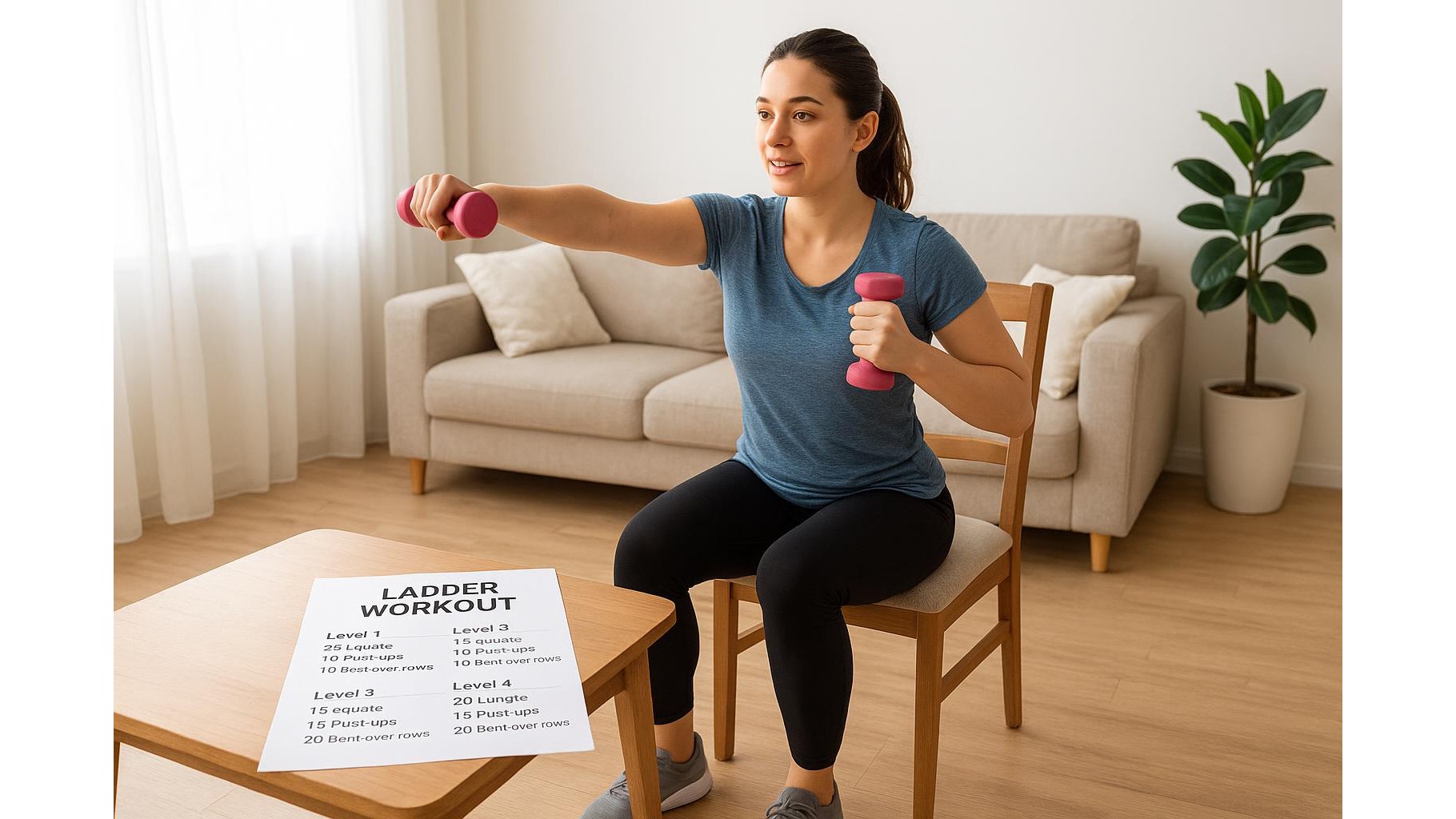
Looking for a simple way to train your entire body at home without fancy machines? This 30‑minute ladder workout blends gentle strength training and mobility drills using only a chair, a light pair of weights and your own bodyweight. It is designed for true beginners who want to build confidence, improve posture and move better in everyday life.
Why a ladder workout works for beginners
The ladder format means you gradually increase and decrease repetitions, like climbing up and down a staircase. This structure is ideal for beginners because it is scalable: you can stop at a lower “rung” if you get tired, or climb higher on days you feel stronger. It also keeps your brain engaged so the 30 minutes pass quickly. In this routine, you will perform a sequence of strength and mobility moves for 3, 6 and 9 reps, then back down. Rest is flexible: take 30–60 seconds whenever breathing or form start to slip.
Minimal equipment: what you really need
You do not need a full gym to get results. For this home ladder workout, set up a sturdy chair (no wheels), a light pair of dumbbells (1–4 kg / 2–8 lb each, or water bottles) and some floor space. Wear comfortable clothes and flat shoes or go barefoot if safe. Keep water nearby. If you have joint issues, add a folded towel or mat for extra cushioning. Remember: lighter weights and perfect form are better than heavy weights and sloppy technique.
The 30‑minute full body strength and mobility ladder
After a 3‑minute warm‑up (march in place, arm circles, hip circles), cycle through these exercises in order: chair sit‑to‑stand (legs and glutes), incline wall push‑ups (chest and arms), bent‑over dumbbell rows (upper back), standing overhead press (shoulders), cat‑camel on hands and knees (spine mobility), hip circles (hips) and ankle rolls. Do 3 reps of each move, rest briefly, then 6 reps of each, then 9. If you still have time and energy, go back down: 6 reps of each, then 3. Move smoothly, focus on breathing and keep every rep controlled.
Form tips and easy modifications
Good form keeps home strength training safe and effective. In the chair sit‑to‑stand, keep your knees in line with your toes and lean slightly forward from the hips as you stand. For wall push‑ups, place hands at chest height and step your feet closer to make it easier or further away to make it harder. If overhead pressing bothers your shoulders, switch to a front raise, lifting weights to shoulder height only. For mobility moves, stay in a pain‑free range. If getting on the floor is difficult, you can perform cat‑camel with hands on a countertop and gentle spine rounding.
Progression, frequency and recovery
To build consistent progress, perform this full body ladder routine two or three non‑consecutive days per week. When it starts to feel easy, add another rung (for example 3–6–9–12) or slightly increase your weights. You can also shorten rest periods or add an extra mobility drill such as arm swings or gentle torso rotations. Prioritize recovery: aim for 7–9 hours of sleep, drink water regularly and do light walking on non‑training days. Mild muscle soreness is normal, sharp joint pain is not—if something hurts, reduce range of motion or skip that move.
This simple 30‑minute home workout proves you do not need a crowded gym to train your whole body. With a chair, light weights and a clear ladder plan, you can build strength, stability and mobility in the same session. Start with conservative rungs, focus on quality reps and track small improvements over time. In a few weeks, climbing your stairs, carrying groceries and standing up from the sofa will already feel easier—and that is the real goal of beginner‑friendly home fitness.









