
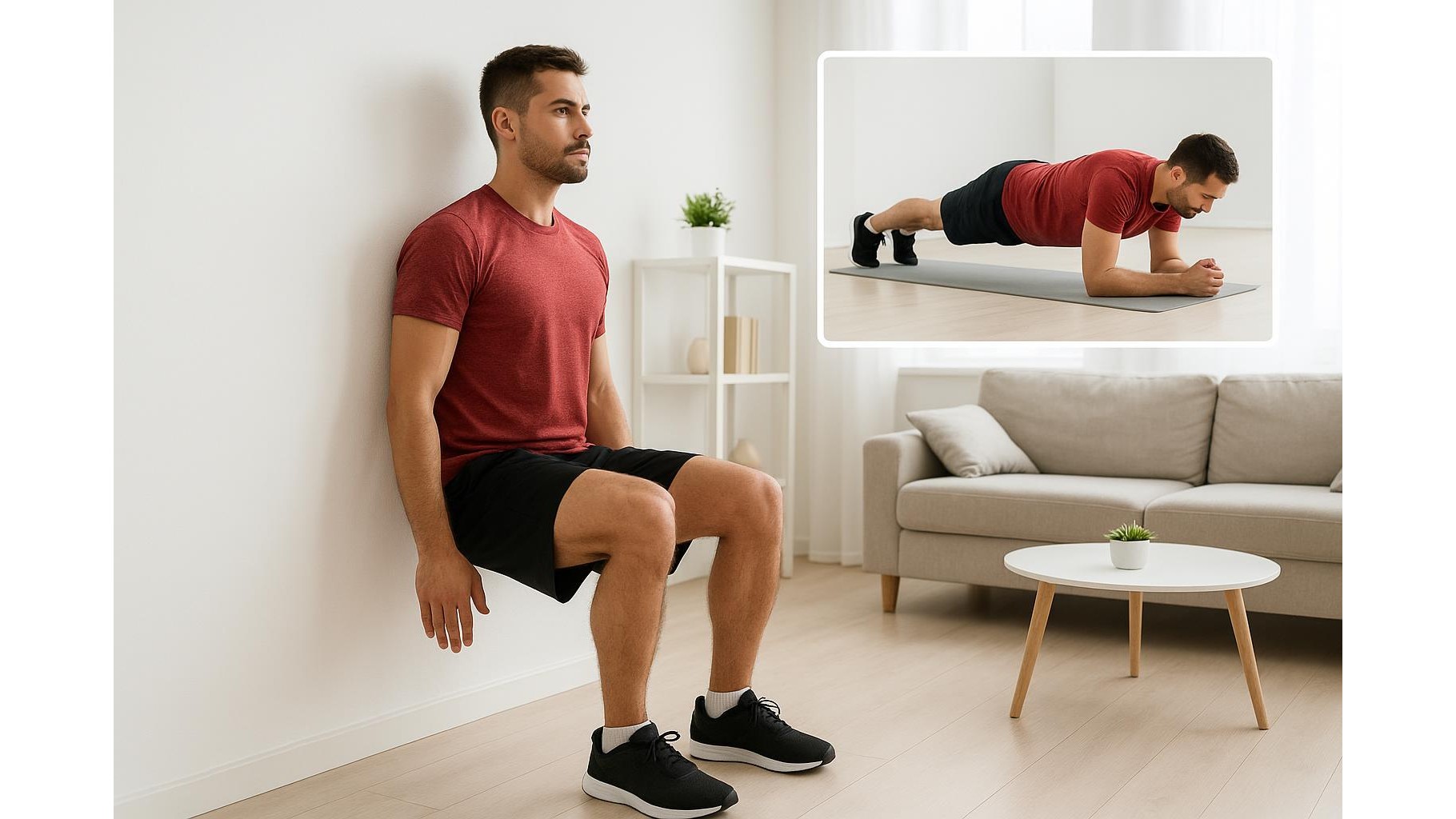
Building a stronger lower body and rock-solid core at home does not have to be complicated. With just two classic bodyweight moves, the wall-sit and the plank, you can create a focused four-week plan that fits into any schedule and any room. This progressive challenge is designed for home athletes who want better endurance, posture and stability using zero equipment, plus clear beginner and advanced variations to keep every level engaged.
Why wall-sits and planks are a powerful combo
The magic of combining wall-sits and planks is that together they train nearly your entire body without moving an inch. Wall-sits target the quadriceps, glutes and calves, improving lower-body endurance, knee stability and mental toughness. Planks hit the deep core muscles that support your spine, including the transverse abdominis and obliques, while also challenging shoulders and glutes. Because both are isometric holds, they are joint-friendly, ideal for small spaces and apartments, and easy to scale up or down simply by changing hold time or body position. For home athletes juggling work and family, this makes them a sustainable backbone for a four-week progressive plan focused on quality rather than complexity.
Week 1: Learning perfect form and building consistency
In week one, the priority is mastering technique and building a daily habit. Start with a wall-sit where your back is flat against the wall, feet about hip-width apart and slightly forward, knees bent roughly to a 90-degree angle if comfortable. Beginners can stay higher, at a 120-degree angle to reduce knee stress. Hold 3 sets of 20–30 seconds with 30–45 seconds rest. For the plank, set up in a straight line from head to heels, elbows under shoulders, glutes squeezed and ribs pulled down so the lower back does not sag. Start with 3 sets of 15–25 seconds. Train 3–4 non-consecutive days this week. Focus on controlled breathing: inhale through the nose, exhale slowly through the mouth to keep tension without holding your breath.
Week 2: Progressive overload with longer holds
In week two, you will increase time under tension to challenge your muscles and cardiovascular system. Aim for 4 sessions this week. For wall-sits, try 3–4 sets of 35–45 seconds, keeping your chest tall and weight evenly distributed across the feet, with knees tracking in line with the toes. For planks, progress to 3–4 sets of 25–35 seconds, maintaining a strong core brace throughout. If this feels easy, move your feet closer together or add a gentle alternating leg lift while keeping the hips level. This progression keeps the plan effective without adding any extra equipment, and it lays the foundation for serious lower-body and core endurance in the second half of the four-week challenge.
Week 3: Advanced variations for stronger home athletes
By week three, intermediate and advanced home athletes can introduce tougher variations while beginners simply keep increasing their hold times by 5–10 seconds per set. For the wall-sit, advanced trainees can try a single-leg wall-sit: start in a regular position, then extend one leg slightly in front, holding for 10–20 seconds each side within a 30–45 second set. This lights up the glutes and challenges hip stability. For the plank, advanced options include a plank with shoulder taps (from a high plank, tap each shoulder while resisting hip rotation) or a side plank added as an extra set each side. Across 4 weekly sessions, aim for 4–5 sets in total, mixing regular planks and side planks to challenge the entire core while still respecting your recovery.
Week 4: Peak challenge and mini test day
In week four, you will reach the peak of this four-week wall-sit and plank challenge. For most home athletes, the goal is 45–60 second wall-sits for 4–5 sets and 35–45 second planks for 4–5 sets on three training days. On the fourth day, perform a simple test workout: after a thorough warm-up, hold a single max-effort wall-sit (stop if form breaks or you feel pain) and a single max-effort plank, with full recovery between the two. Record your times and compare them with week one to see how much your endurance has improved. This test not only tracks progress, it also builds confidence and mental resilience, showing you that disciplined, focused training with just your bodyweight can produce meaningful gains.
Tips to stay safe, motivated and consistent
To get the most from this plan, treat each session like a serious appointment. Schedule your home workouts at the same time of day when possible and use a simple timer or app to track holds accurately. If you feel knee discomfort in wall-sits, reduce the depth, step your feet slightly further forward or shorten the hold time until your strength improves. For planks, remember that a shorter, perfectly braced plank is better than a long, sagging hold. Pair this challenge with light daily walking, adequate hydration and enough protein to support recovery. Over four weeks you will build better posture, greater core stability and impressive lower-body endurance—proof that even with zero equipment, any room can become your personal training space.
After completing this four-week challenge, you should notice stronger legs, a more stable core and improved confidence in your ability to train effectively at home. Keep the habit alive by repeating the cycle with slightly longer holds, adding other bodyweight moves like squats or glute bridges, or using these wall-sits and planks as a quick conditioning finisher after any workout. With a simple structure, progressive difficulty and no need for equipment, this programme can stay in your toolbox year-round as a reliable way to stay fit, focused and consistent in your own space.









