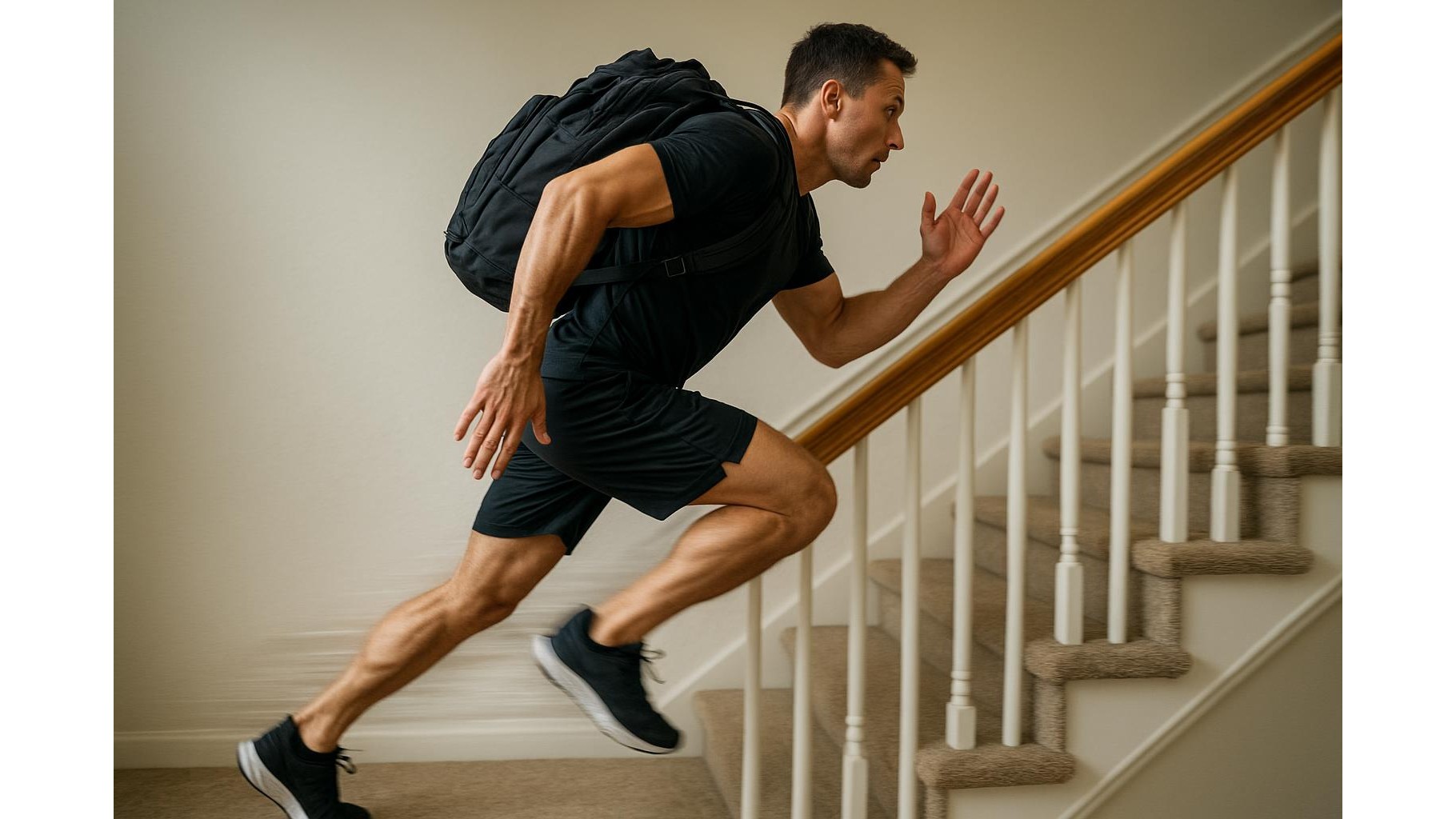
Training for explosive power and athletic speed does not require a professional gym. With nothing more than a safe home staircase and a solid backpack loaded with books or bottles of water, you can build the kind of acceleration, coordination and strength that transfers to almost any sport. This structured routine turns your stairs into a mini performance lab, using plyometrics and strength training to boost power in a very small space.
Why stairs and a backpack are perfect power tools
Your staircase is essentially a built‑in plyometric box. Each step forces you to produce force quickly, which is exactly what you need for better sprinting, jumping and
Warm‑up and safety on the staircase
Before you start any stair workout, spend 5–8 minutes on a dynamic warm‑up. Focus on ankle mobility, light calf raises, hip circles and easy step‑ups to increase blood flow. Make sure the staircase is dry, well lit and free of clutter. Wear shoes with good grip and tighten the backpack straps so the load stays close to your body. Begin every new exercise at low intensity to groove the pattern before going explosive. Respect fatigue: when your landings get noisy or sloppy, stop the set to protect your joints.
The explosive stair protocol for speed and power
Build your home plyometric routine around short, powerful bursts followed by generous rest. A simple structure is 3–4 sets of 10–20 seconds of work with 60–90 seconds of rest. Sample block: fast single‑step stair runs, double‑step bounds, and lateral step‑overs. Focus on quick ground contact, tall posture and driving your arms. Quality beats quantity: every rep should feel snappy, not like conditioning. Keep total plyometric time under about 10 minutes per session to prioritise power development over endurance.
Backpack strength moves to build a powerful engine
After the jumps and sprints, use the weighted backpack for slower, controlled strength training. Load the bag with books or water bottles, then perform stair marches, reverse step‑downs and Bulgarian split squats using a lower step for support. Aim for 3–4 sets of 8–12 reps per leg, keeping your knee tracking over your toes and your torso upright. These moves build the glutes, hamstrings and quads that drive explosive power while also reinforcing joint stability around the knees and hips. Progress by adding a bit of weight or an extra set each week.
Coordination, rhythm and core engagement
Stair training is also excellent for coordination and core stability. Add drills like high‑knee stair climbs, cross‑over step‑ups and backward marches with a light backpack load. Move smoothly, focusing on rhythm, arm‑leg synchronisation and quiet foot contacts. Keep your midsection braced so the backpack does not sway; this teaches your core to transfer force efficiently from the lower to the upper body. By mixing these drills with your power work, you build not only strength but also the movement quality that defines real‑world athleticism.
Weekly structure and progression at home
To get results, train this staircase and backpack workout 2–3 times per week, with at least one rest day in between sessions. Start with a lighter backpack and fewer total sets, then slowly progress by increasing load, adding a set, or introducing a slightly more complex drill—not all at once. Listen to your joints, especially ankles, knees and lower back, and keep your warm‑up and cool‑down consistent. Over a few weeks you will notice faster acceleration on the stairs, better balance and a more powerful push‑off in every step, all built in the simplest possible home gym.
This minimalist approach to home power training proves you do not need machines or special gear to become more explosive. By turning your staircase into a controlled plyometric platform and your backpack into a versatile resistance tool, you train speed, strength and coordination in a compact, repeatable routine. Stick to thoughtful progressions, prioritise movement quality, and your home will quietly become the place where your athleticism takes off.