
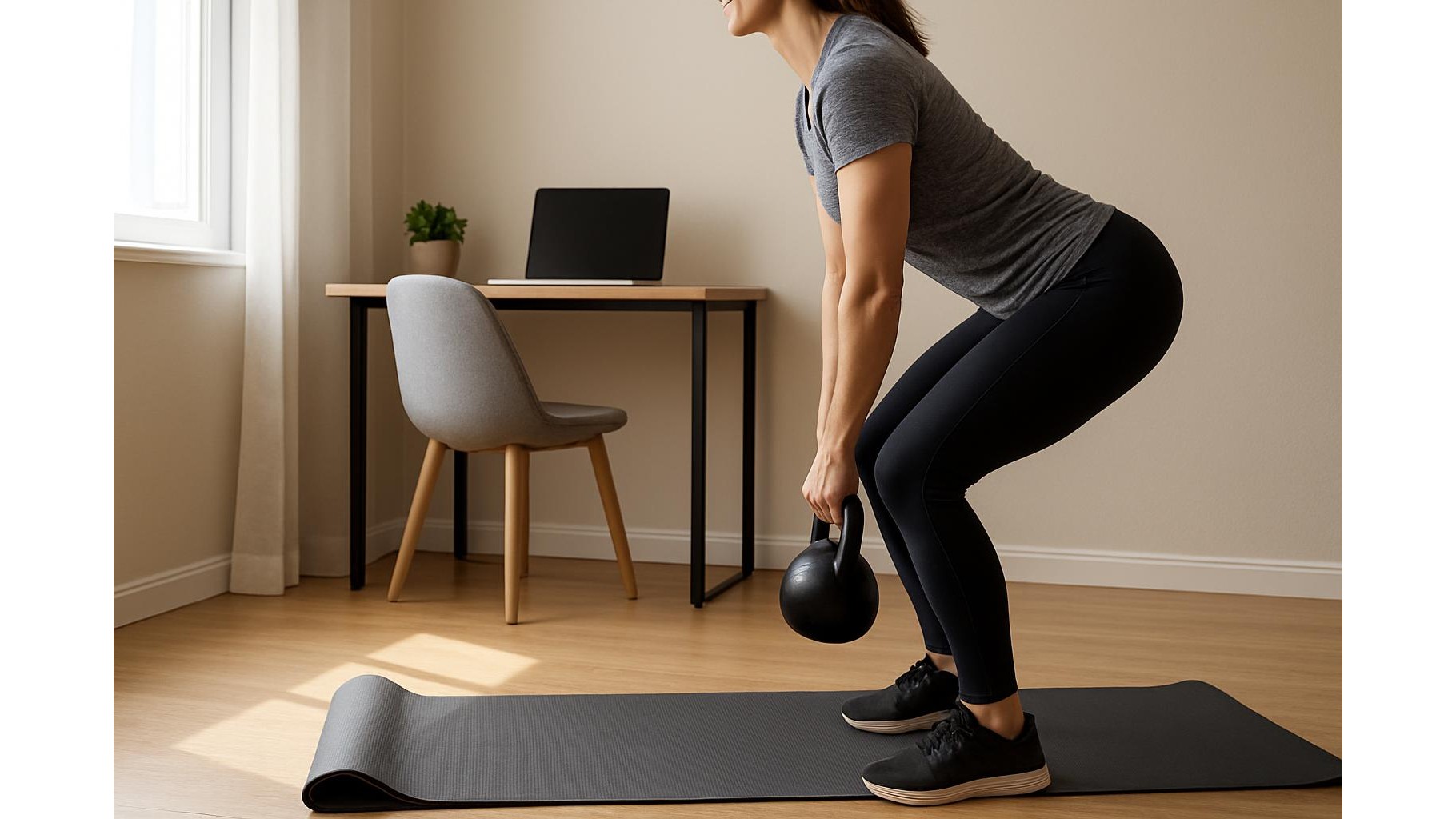
If you spend your day hunched over a laptop, your hips, shoulders and lower back probably feel like they are made of concrete. A simple 30-minute kettlebell mobility flow at home can undo hours of sitting, build real-world strength and wake up your core with just one bell and a mat. This session blends mobility drills, kettlebell strength moves and gentle conditioning so you finish looser, more energised and ready to tackle the rest of your day.
Why home workers need kettlebell mobility
Long hours at a desk lock your body into the same position: rounded shoulders, tight hip flexors and a sleepy core. Over time, this steals your strength, reduces your range of motion and makes even simple movements feel stiff. A kettlebell mobility flow targets the weak points created by desk work: it opens the hips, frees the thoracic spine and reactivates the glutes and core. Unlike static stretching, kettlebell patterns such as hinges, lunges and carries create strength at end range, teaching your body to own new positions instead of just visiting them for a few seconds.
Choosing the right kettlebell for your flow
For most home workers, one moderate bell is enough to unlock the whole session. Look for a kettlebell that is heavy enough to feel challenging on deadlifts, but light enough for overhead work and flows. A typical range is 8–12 kg for beginners and 12–16 kg for those with more experience. A good example is a vinyl-coated or cast-iron kettlebell with a smooth, wide handle that allows a secure, two-handed grip and comfortable swings. When you shop, prioritise a flat base for stability between sets, clear weight markings and a durable coating that protects both the bell and your floor during long-term home use.
Warm-up: reset the hips, shoulders and spine
Before grabbing the bell, spend 5–7 minutes on focused mobility. Start on the mat in a half-kneeling hip flexor stretch with side reach to open the front of the hips and lengthen the obliques. Follow with cat–cow and thread-the-needle to mobilise the thoracic spine and shoulders. Add bodyweight deep squats, pausing at the bottom to gently pry the knees out with your elbows, and perform a set of glute bridges to wake up the posterior chain. The goal of this warm-up is to move slowly, breathe deeply and gradually increase your range of motion so that, when you introduce the kettlebell, your joints are primed rather than shocked.
The 30-minute kettlebell mobility flow
The core of this session is a continuous kettlebell flow that cycles through five movements: deadlift, swing, halo, front rack reverse lunge and half-kneeling press. Work for 40 seconds, rest for 20 seconds and move to the next exercise. After all five, rest for 90 seconds and repeat the circuit 3–4 times. The deadlift and swing unlock the hips and train a strong hinge pattern; the halo circles around your head to open the shoulders and upper back; the front rack lunge adds single-leg strength and balance; the half-kneeling press integrates hip stability with shoulder control. Keep the weight smooth and controlled, focusing on breathing and quality of movement rather than chasing fatigue.
Technique cues and regressions for desk-bound bodies
Stiff home workers often struggle with positions like deep hip hinges or overhead presses, so smart regressions keep the flow safe and effective. If your hamstrings feel tight, start with elevated deadlifts, placing the bell on a yoga block or step to reduce range of motion. For swings, practice Romanian deadlifts first to engrain the hinge. If shoulder mobility is limited, perform halos chest-height only, and swap the half-kneeling press for a neutral-grip floor press where your upper arm rests on the ground each rep. Focus on a long spine, packed shoulders and a tight midsection on every movement. Prioritising clean technique over ego weight lets you progress steadily while protecting your joints.
Cool-down and making it a habit
Finish with 3–5 minutes of down-regulation. Use the same kettlebell as a counterweight for deep squat holds, gently rocking to open the ankles and hips. Add a long hip flexor stretch, a lying spinal twist and some relaxed diaphragmatic breathing to cue your nervous system that work is done. Aim to perform this 30-minute kettlebell mobility flow two to three times per week, ideally after your working day. Over a few weeks, you should notice smoother hip motion, less neck and shoulder tension and better posture at your desk. With just one bell and a mat, you transform your home office into a small but powerful home gym that keeps you mobile, strong and ready to move.









