
Training at home with resistance bands is a smart way to build strength without overloading your joints. If you have sensitive knees, heavy squats and high-impact moves can feel risky or downright painful. This 40‑minute, beginner-friendly, full body workout uses only light to medium bands and focuses on control, balance, and joint-friendly positioning so you can get stronger while keeping knee stress low.
Warm-up and setup for happy knees
Before you start pulling on bands, spend 5–7 minutes waking up your muscles and lubricating your joints. March lightly in place, roll your shoulders, and gently circle your ankles and hips. Finish with slow, supported hip hinges: stand tall, feet hip-width, hands on a chair or countertop, push your hips back with a soft bend in the knees, then stand tall again. Keep your weight in your heels and avoid deep bends. Choose a light band and check that your training area is clear so you can focus fully on smooth, pain-free movement.
Upper body strength with minimal leg load
Start with 10–12 reps per move, 2 sets, resting 30–45 seconds between sets. For seated band rows, sit on a sturdy chair, loop the band around your feet, and hold the ends. Sit tall, pull your shoulder blades back and down, then draw your elbows toward your ribs. Keep your knees bent and relaxed. Next, try standing chest presses by looping the band around your back or a doorknob at chest height, stepping one foot slightly forward for balance, and pressing your hands straight out. Keep your stance shallow and knees soft, not bent deeply, to protect your joints.
Lower body work that spares the knees
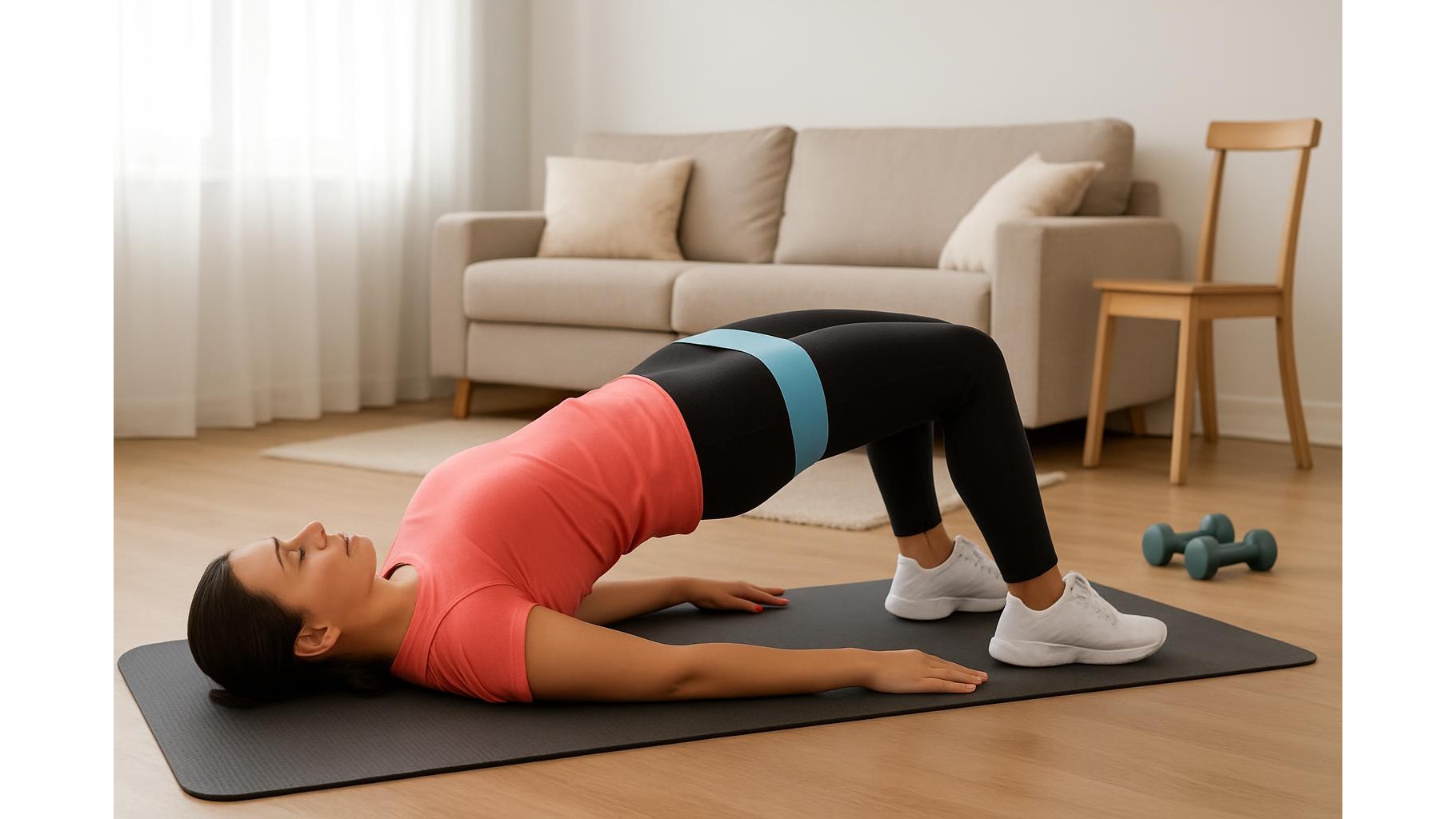
For the lower body, the focus is on the hips and glutes, not deep knee bending. Use a loop band above your knees for glute bridges on the floor or on a couch. Lie on your back, feet flat and hip-width, push your knees slightly out into the band, and lift your hips until your body forms a straight line from shoulders to knees. Squeeze your glutes, not your lower back. If getting to the floor is uncomfortable, perform hip thrusts with your upper back supported against a sofa, feet under your knees, lifting hips up and down in a small, controlled range.
Core and stability for better knee support
A strong core helps your knees by improving overall alignment. For a gentle but effective option, try dead bug with band: lie on your back, loop a light band around both hands, and hold it above your chest with arms straight. Lift your legs into tabletop. Press the band up while slowly lowering one heel toward the floor, then return and switch legs. Keep your lower back gently pressed toward the floor. Follow with standing anti-rotation holds: anchor the band at chest height, stand side-on to the anchor, hold the band with both hands at your chest, and step out to add tension. Press your hands straight out and hold without letting your torso twist. This trains the core to stabilize the hips and knees.
Gentle conditioning and regressions
To finish, add 5–8 minutes of low-impact conditioning. Try band-resisted marches: place a light loop band around your feet, stand tall, and slowly march in place, lifting one knee at a time only as high as is comfortable. Keep your steps short to avoid pulling on the knee joint. If any exercise causes knee discomfort, reduce your range of motion, use a lighter band, or shift to a seated variation. For example, seated leg extensions with a band under your foot are a good swap for any standing move that bothers your knees.
Putting it all together safely
Combine these exercises into a simple 40‑minute routine: 5–7 minutes warm-up, 20 minutes alternating upper and lower body, 8–10 minutes core and stability, and a short cool-down with gentle stretches for hips, hamstrings, and calves. Aim for 2–3 sessions per week, focusing on slow, controlled reps and pain-free ranges. Over time, you can add sets or slightly stronger bands. With consistent practice, this beginner-friendly resistance band workout will help you build strength and stability at home while keeping your sensitive knees comfortable and supported.









