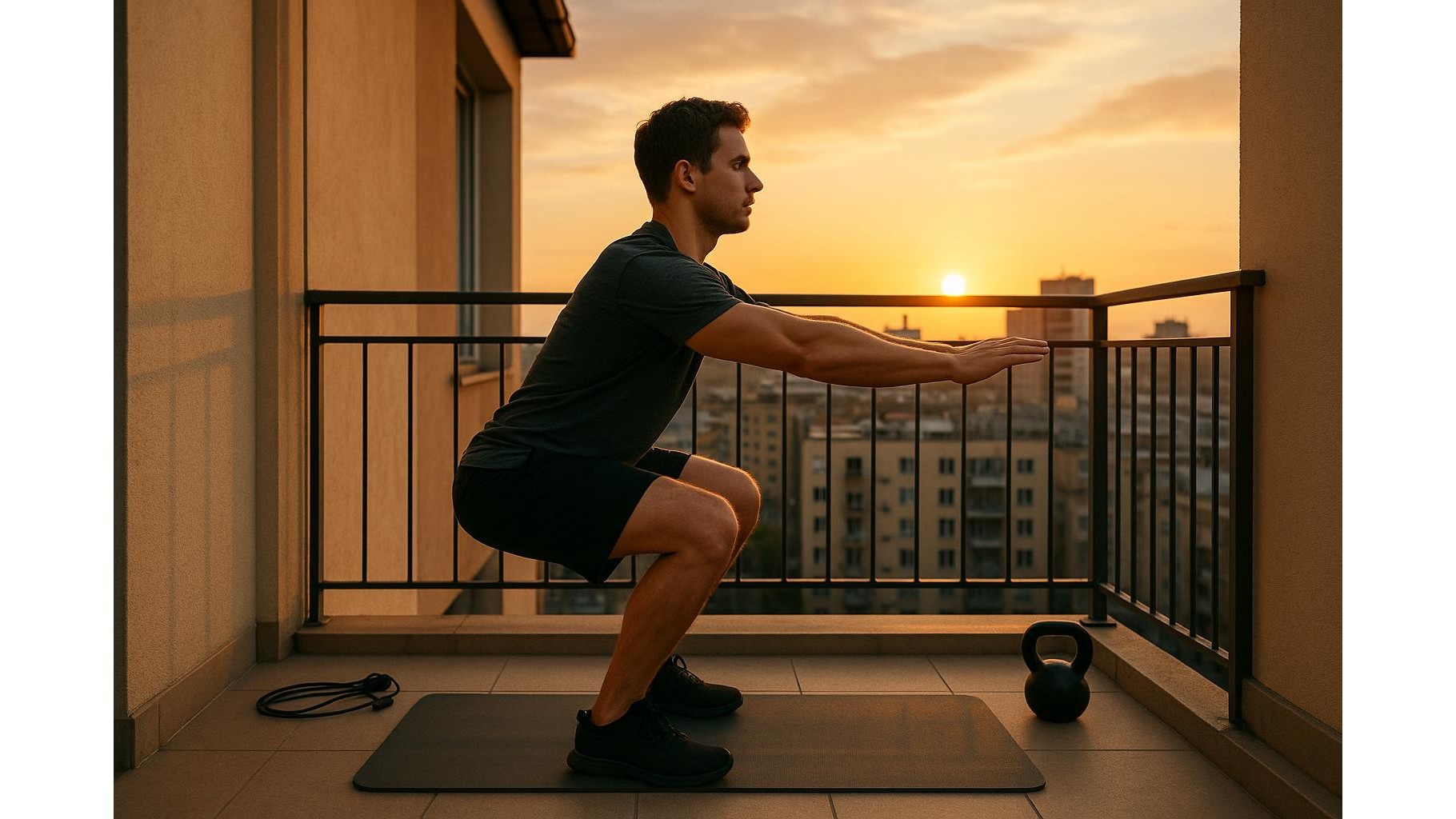
Training on a tiny balcony or terrace can be surprisingly effective. With smart exercise selection and a focus on full body bodyweight workouts, you can build strength, mobility and endurance in just a few square metres. This guide walks you through a balanced routine that is low-noise, low-impact and safe for confined outdoor spaces, with progressions that take you from beginner to intermediate while still enjoying fresh air at home.
Setting up a safe and efficient balcony workout zone
Before starting your balcony strength workout, make safety your priority. Check the balcony floor for stability, remove clutter and ensure you have a non‑slip surface such as a simple exercise mat or textured tiles. Leave enough space to extend your arms without hitting railings or walls. Avoid jumping and heavy dropping movements to minimise noise and impact on neighbours below. If you live in an apartment block, schedule training for reasonable hours and focus on quiet, controlled exercises like planks, slow squats and wall variations. Keep a small towel and water bottle nearby, and if your balcony is exposed, use light layers or a cap for sun and wind protection.
Lower body strength: quiet, controlled leg work
The foundation of balcony training is strong legs and glutes built with low‑impact bodyweight exercises. Start with slow squats, sitting back as if into a chair while keeping your heels on the ground and your knees in line with your toes. Beginners can use the balcony wall or railing lightly for balance, while intermediates progress to split squats and reverse lunges performed in a narrow front‑to‑back stance to save space. Tempo is your friend in tiny areas: try three seconds down, a brief pause, and one second up to increase muscular tension without any jumping. Finish the block with glute bridges on the mat to target the posterior chain while staying completely silent and joint‑friendly.
Upper body pushing: balcony‑friendly chest and shoulder work
For the upper body, you do not need large equipment to train your chest, shoulders and triceps effectively. Use incline and wall push‑ups to manage intensity: place your hands on a stable balcony wall or low windowsill, walk your feet back, and keep a straight line from head to heels. Beginners can stay fairly upright; intermediates simply lower the hand position to increase load. Include narrow‑grip push‑ups to emphasise the triceps and elevated pike push‑ups with hips high to challenge the shoulders. All of these movements are almost silent, require minimal floor space and can be adjusted in difficulty by changing hand placement and body angle rather than adding equipment.
Pulling, core and posture in a small footprint
Balcony spaces often lack anchor points for classic pulling exercises, but you can still strengthen your back and core. Focus on isometric rows using a sturdy railing (only if it is solid and safe) by pulling against it with bent elbows while maintaining a neutral spine, or use slow prone Y and T raises on the mat to wake up the upper back. Combine these with a powerful core circuit:
- Front and side planks with controlled breathing
- Dead bugs for spine‑friendly anti‑extension training
- Slow mountain climbers performed with feet light and hips steady to keep noise low
These movements improve posture for desk workers and add stability to every other exercise in your balcony routine, all while remaining gentle on joints and neighbours.
Programming your full body balcony routine
To turn individual movements into a coherent full body balcony workout, structure your session into simple circuits. For beginners, aim for 2–3 rounds of 8–10 reps each of squats, wall push‑ups, glute bridges and planks, resting 45–60 seconds between exercises. As you move towards intermediate level, progress to split squats, lower‑incline push‑ups, added core variations and longer planks, working up to 3–4 rounds. Train three non‑consecutive days per week to allow recovery. Keep each session to 25–35 minutes so it is easy to maintain as a habit, and log your reps or time‑under‑tension to stay motivated as the numbers slowly increase.
Balcony training proves that you do not need a large home gym to build a stronger, healthier body. With thoughtful exercise choices, attention to safety in confined outdoor spaces and smart progressions, your tiny terrace can become a highly effective full body bodyweight training zone. Stay consistent, move with control, and enjoy the added bonus of fresh air every time you step outside to train.