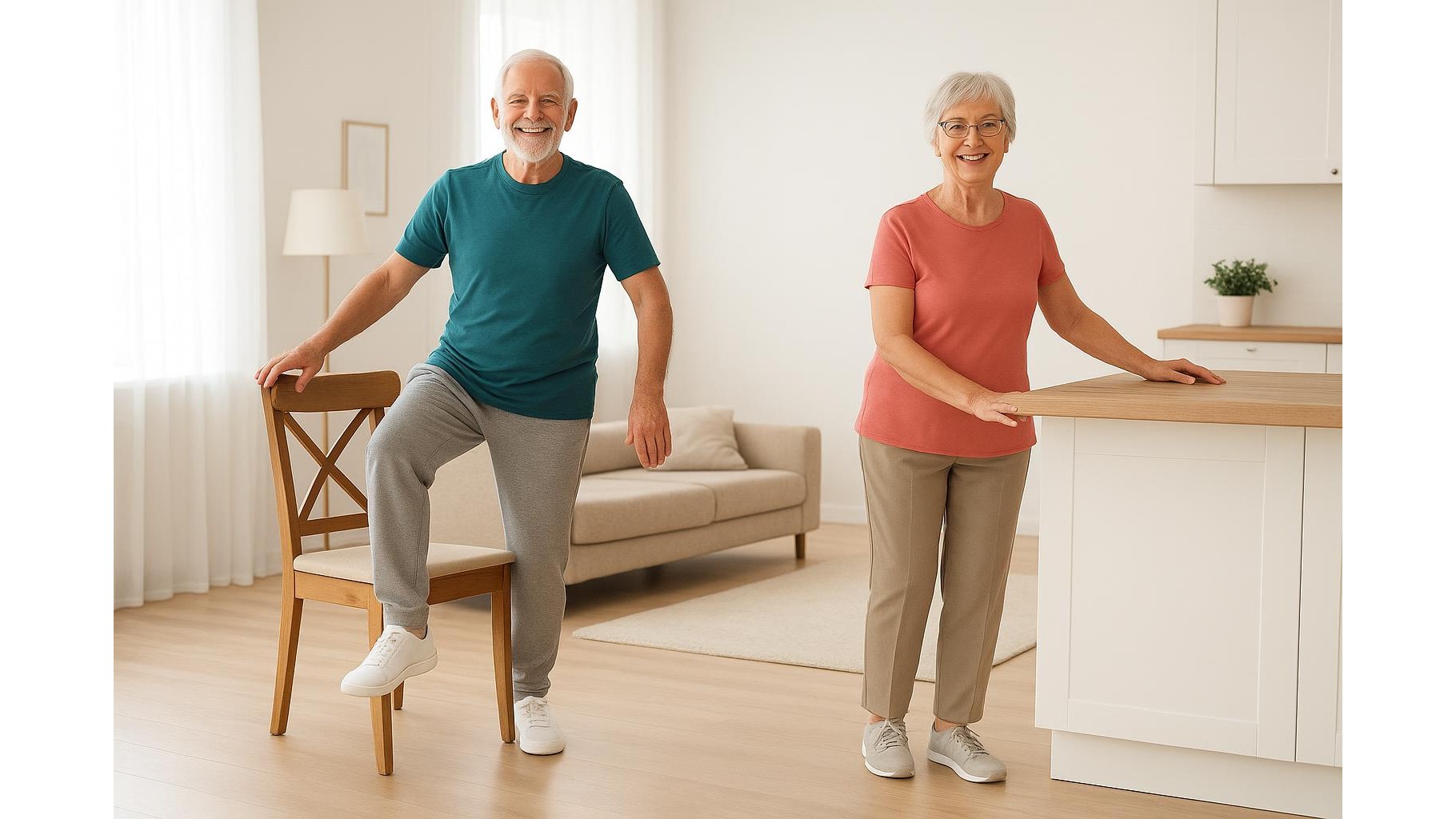
Staying steady on your feet becomes more important with age, and you do not need a gym to work on it. This 30‑minute balance and fall-prevention home workout for seniors uses only everyday items like a sturdy chair, a countertop and a wall. By focusing on slow, controlled movements, you can improve balance, coordination and leg strength safely in your living room or kitchen.
Safe set-up and how to warm up
Before starting any home workout for seniors, prepare your space. Clear the floor of rugs, cables and clutter. Place a sturdy chair with a backrest against a wall so it cannot slide. Stand close to a kitchen countertop or heavy table you can lightly hold for support. Wear flat, closed shoes with non-slip soles. Begin with a 5‑minute warm-up: march in place while holding the back of the chair, gently roll your shoulders, and slowly circle your ankles one at a time while seated. This increases blood flow, loosens stiff joints and prepares your body for balance exercises without sudden strain.
Chair-supported balance drills
The chair is your main “machine” in this fall-prevention workout. Stand behind the chair, lightly holding the backrest with both hands. Start with heel-to-toe stance: place one foot directly in front of the other, heel touching toe, and hold for 20–30 seconds, then switch legs. Progress to single-leg stands by lifting one foot a few centimetres off the floor while keeping your hand on the chair; aim for 10–15 seconds per side. Finally, practice side leg raises: stand side-on to the chair, hold with the nearest hand and slowly lift the outer leg sideways, keeping your body upright. Perform 8–10 repetitions per leg. These movements strengthen the ankles, knees and hips, which are crucial for everyday stability.
Using walls and countertops for stability
Walls and countertops act like fixed gym bars at home. For wall push-ups, stand an arm’s length from a wall, place your hands at shoulder height and width, and slowly bend your elbows to bring your chest toward the wall, then push back. Aim for 10–15 repetitions to build upper-body strength that supports good posture and balance. Next, use the kitchen counter for gentle calf raises: hold the edge with both hands, rise up onto your toes, pause, then lower your heels back down with control for 10–15 repetitions. Finish with counter squats: holding the counter, sit your hips back as if onto a chair, then stand up again, keeping your heels on the floor. Perform 8–10 squats, going only as low as is comfortable for your knees.
Coordination and dynamic balance movements
Improving coordination helps you react quickly if you trip. Stand beside the chair with one hand resting on it. Gently march in place, lifting your knees to a comfortable height while swinging the opposite arm, for 1–2 minutes. Then try toe taps to the chair: place the chair in front of you and lightly tap one foot onto the seat, then switch feet in a slow, rhythmic pattern for 30–60 seconds. For a slightly more advanced option, practice side stepping along the counter, moving sideways for 5–10 steps and then back, always keeping a hand on the surface. These patterns train your brain and body to move together smoothly, reducing the risk of losing balance during daily activities.
Cool-down, breathing and safety tips
End your 30‑minute session with a gentle cool-down. Sit on the chair and perform slow ankle circles, knee extensions (straightening one leg at a time) and light hamstring stretches by sliding one foot forward and leaning slightly over the straight leg. Focus on deep breathing: inhale through your nose for a count of four, hold for two, and exhale slowly through your mouth for six. This helps calm your heart rate and reduce tension. Always move within a pain-free range, avoid holding your breath, and keep at least one support point (chair, wall or counter) available. If you feel dizzy, short of breath or unwell, stop immediately and consult a healthcare professional before continuing.
This simple balance and fall-prevention home workout for seniors shows that you can train effectively using only household furniture. By practising these exercises three to four times per week, you can gradually build leg strength, joint stability and confidence while walking. Combined with regular check-ups and an active lifestyle, these routines can help you stay independent, reduce your risk of falls and move more comfortably in and around your home.