
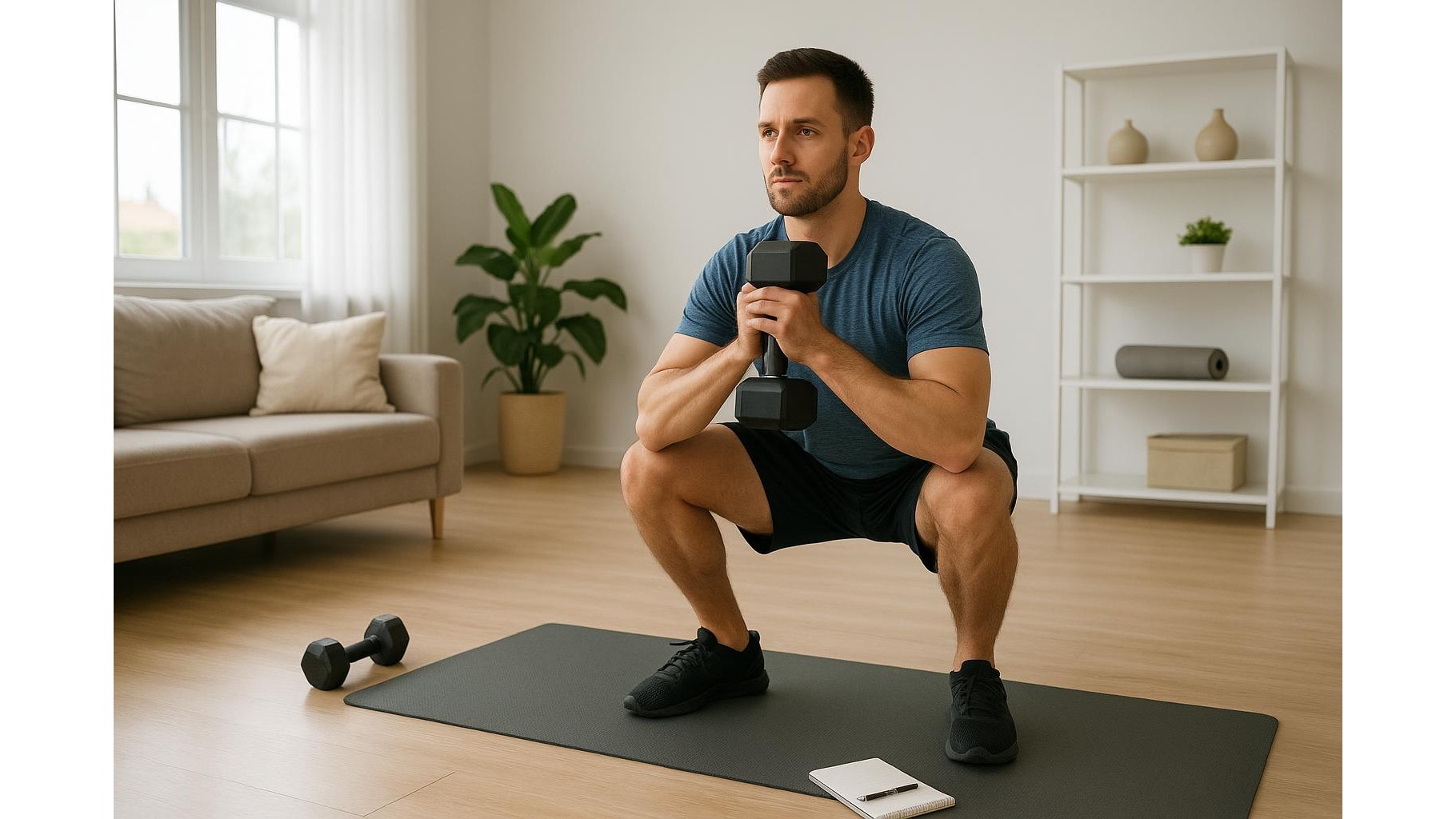
If you train at home, it is easy to lose track of whether you are truly getting stronger. This at-home strength benchmark workout is a simple 30‑minute session you can repeat every eight weeks using only your bodyweight and a basic pair of dumbbells. It covers your full body, gives you clear scoring tables, and offers reset strategies so you can adjust the difficulty and keep progressing in your living room without any machines.
How this at-home strength benchmark works
The workout is built around five movements: goblet squats, push-ups, bent-over rows, hip hinges or RDLs, and a timed plank hold. You will perform each exercise for a set time window, count solid reps, and then compare your score to the tables below. Use a pair of dumbbells that feels challenging but safe for 10–12 reps in a normal workout; this will usually place you in the right load for a benchmark. Perform a thorough warm-up, then complete two rounds of the circuit with 60–90 seconds of rest between exercises so that strength, not fatigue, is being tested.
Exercise sequence and scoring tables
Follow this sequence: 1) Goblet Squat – 60 seconds, 2) Push-up – 60 seconds, 3) Dumbbell Bent-over Row – 60 seconds, 4) Dumbbell Hip Hinge/RDL – 60 seconds, 5) Forearm Plank – max hold, up to 90 seconds. Use controlled tempo and full range of motion; partial or sloppy reps do not count. Here is a simple scoring guide for each strength move (per set):
- Beginner: 8–15 quality reps
- Intermediate: 16–25 quality reps
- Advanced: 26–35 quality reps
- Elite: 36+ quality reps
For the plank, score as: Beginner: 20–40 seconds, Intermediate: 41–70 seconds, Advanced: 71–90 seconds, Elite: over 90 seconds (you can stop at 90). Record your level for each movement and aim to gradually shift categories over time.
Tracking progress every eight weeks
To turn this into a true progress-tracking benchmark, run the session every eight weeks under similar conditions: same time of day, similar sleep and nutrition, and the same pair of dumbbells. Log total reps for each exercise and your plank time. Over time you should see improvements in at least one of three ways: more reps at the same weight, the same reps at a heavier weight, or better movement quality with less fatigue. If you hit the top of the Advanced range for two tests in a row, move up in dumbbell weight by the smallest available increment for the next benchmark.
Reset strategies when you stall
Strength progress is rarely linear, especially in a home gym. If your scores stop improving for two benchmark cycles, apply a reset strategy. First, reduce your working dumbbell weight slightly and focus on perfect form and controlled tempo for one full cycle. Second, add one extra rest day between regular strength sessions in the two weeks before the test so you arrive fresh. Third, if one exercise consistently lags behind, include it twice per week in your normal training with lower volume (2–3 sets of 6–10 reps) to build confidence and technique before the next benchmark.
Adapting the benchmark to your level
This at-home strength benchmark is deliberately flexible. Beginners can shorten each work interval to 40 seconds, rest 90 seconds, and use lighter dumbbells or incline push-ups on a sturdy table or sofa edge. Intermediate and advanced lifters can extend each interval to 75 seconds and reduce rest to 45–60 seconds, or perform single-leg variations such as split squats instead of basic goblet squats. If you only own one dumbbell, perform goblet squats, one-arm rows, and suitcase RDLs, switching sides halfway through the time window. The key is to keep the structure identical each time you test so that your scores truly reflect changes in strength rather than random variation.
Run this 30‑minute full body strength benchmark every eight weeks and treat it like an exam, not just another workout. Warm up well, move with intent, and write down your reps and times. Over the course of a year you will have a clear record of how your bodyweight and dumbbell strength are evolving, where you are strongest, and which areas need more attention. With a consistent plan, a small amount of equipment, and smart reset strategies, your living room can become a reliable testing ground for real, measurable strength gains.









