Training agility at home does not require cones, hurdles or a ladder. With nothing more than a roll of tape and your own bodyweight, you can turn any corner of your living room into a compact footwork zone. In this 30‑minute session you will use simple tape lines on the floor to improve speed, coordination and lower‑body reactivity. The plan includes warm‑up, main drills, regressions for beginners and tips to keep intensity high in a small space.
Setting up your home agility lines
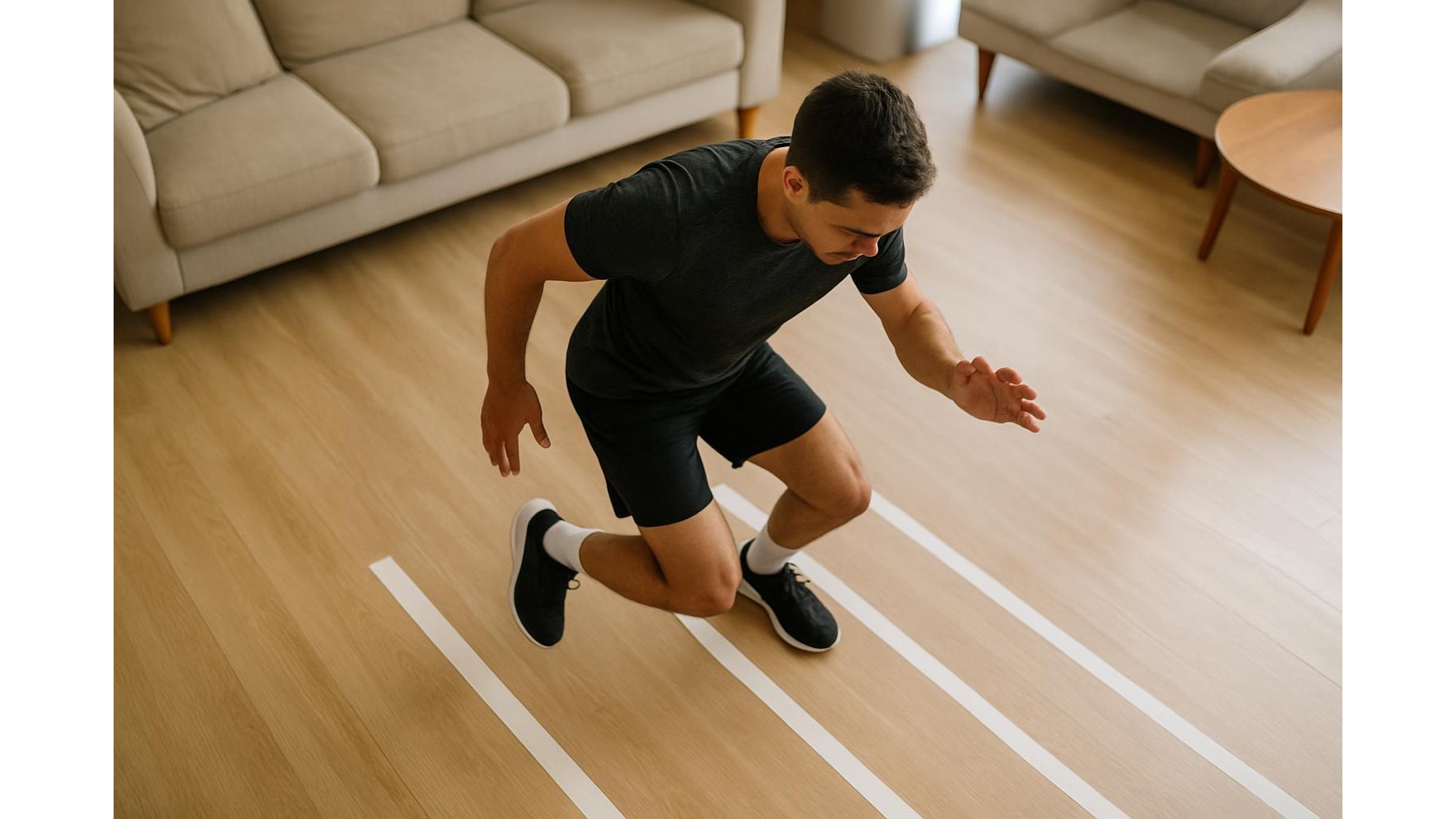
Start by clearing a safe, flat area of about 2–3 metres in length. Use painter’s or masking tape to create your agility lines so they stick firmly but are easy to remove. A basic layout is three parallel lines, each around 40–50 cm apart. This spacing mimics the steps of a classic agility ladder and works for most heights. If you are taller or have long legs, widen the gaps slightly; if you are shorter or a beginner, keep them closer. You can also add one diagonal line crossing the centre to introduce direction changes. Train in supportive shoes with good grip, and always test the floor for slipperiness before you start moving at speed.
Dynamic warm-up for joints and coordination
A quality warm-up primes your ankles, knees and hips for fast footwork while waking up your nervous system. Spend 5–7 minutes here. Begin with 60 seconds of marching in place, driving the knees high and swinging the arms. Follow with 30 seconds of heel kicks to the glutes and 30 seconds of side steps over the tape lines, focusing on light, quiet landings. Then perform 10–12 bodyweight squats, 10 alternating reverse lunges and 10–15 seconds of gentle ankle bounces on the spot. Finish with 2 rounds of slow “ladder” steps: walk forward placing one foot in each gap between the lines, then walk backwards without crossing your feet. This builds rhythm and prepares you mentally for the faster drills to come.
Main linear footwork drills
The first block develops straight‑line speed and rhythm using classic patterns adapted from ladder work. Perform each drill for 30 seconds followed by 30 seconds of rest, cycling through the list 2 times. Drill one: one-in each – run forward placing one foot between each pair of tape lines, pumping your arms and landing on the balls of your feet. Drill two: two-in each – step left‑right into each space between lines before moving to the next, keeping your torso tall. Drill three: in-in-out-out – start with both feet outside the outer line, then step both feet in, then out on the opposite side, moving forward. Beginners can walk the patterns instead of running, and shorten the work interval to 20 seconds if needed while focusing on precise placement over pure speed.
Lateral and multi-directional agility patterns
To truly train agility, you must move sideways and diagonally, not just straight ahead. Stand to the left of your tape grid for a lateral two-step: step the inside foot into the first gap, bring the outside foot in, then step the inside foot out to the other side of the grid, shuffling down the lines. Maintain a low athletic stance with soft knees. Next, use the diagonal tape to practice cutting movements: start on one end and perform quick diagonal steps along the line, leading with one foot, then repeat leading with the other. Add a simple forward–back” burst: stand straddling the centre line, step both feet forward across it, then both feet back, as fast as possible for 20–30 seconds. Keep your chest up, brace your core and imagine you are reacting to an opponent in front of you. If coordination breaks down, reduce speed, simplify the pattern and rebuild the rhythm.
Beginner regressions and low-impact options
If you are new to footwork drills, there is no need to jump immediately into high‑speed hops. Turn every pattern into a walked sequence: step deliberately from space to space, counting “1‑2‑3‑4” as you move to maintain timing. For a low‑impact option, focus on heel‑toe rolls instead of bouncing on the balls of your feet, and avoid any drills that cause knee discomfort. You can also shorten the tape layout to only two lines, which reduces the complexity and step length. Keep work intervals at 15–20 seconds with 40–45 seconds of rest. Over several sessions, gradually increase either the speed or the duration, but not both at once. The goal for beginners is smooth coordination and confidence, not exhaustion.
Cool-down, progression and consistency
Finish your 30‑minute home agility workout with 3–5 minutes of gentle movement and stretching. Walk around the room until your breathing slows, then perform light calf, hamstring and hip flexor stretches, holding each for 20–30 seconds. To progress over the weeks, add more complex patterns (such as crossover steps or hopscotch‑style jumps), shorten your rest periods or slightly extend each working interval. You can also combine these tape line drills with bodyweight strength exercises like squats and push‑ups for a complete home conditioning circuit. With minimal space, zero equipment beyond tape and your own bodyweight, you can build faster feet, sharper coordination and better control over every change of direction in your daily life and sport.