If you train at home and feel your usual routines are getting too easy, this advanced home workout challenge will push you to the next level. This 300‑rep bodyweight circuit is designed to build full body strength, improve cardio conditioning and sharpen mental toughness, all without any equipment. You will cycle through compound moves for the upper body, legs and core while keeping rest short and intensity high, with clear options to scale up or down depending on your current fitness.
How the 300-rep bodyweight circuit works
The structure is simple but demanding: perform 6 exercises for 50 reps each, for a total of 300 bodyweight reps. Move from one exercise to the next with as little rest as possible, only pausing when your form begins to break. The focus is on quality reps and steady pace, not racing the clock. The circuit: 1) push‑ups, 2) bodyweight squats, 3) reverse lunges (25 per leg), 4) hip thrusts or glute bridges, 5) plank shoulder taps (25 per side), 6) sit‑ups or crunches. Beginners can break each block into mini‑sets (for example 5 x 10 reps) while advanced home athletes can aim for bigger unbroken sets to increase the challenge.
Upper body focus: push-ups and plank variations
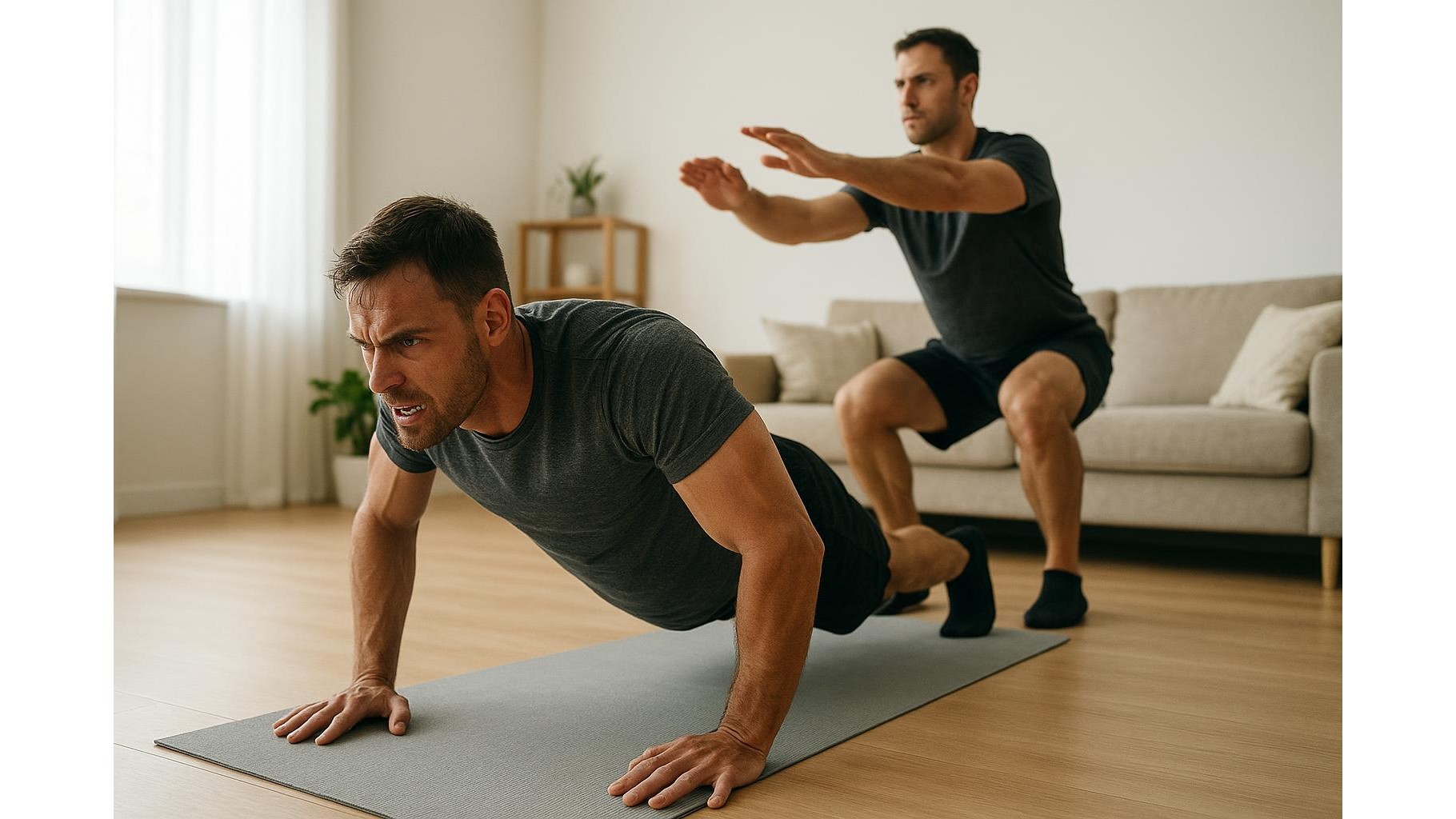
The upper body portion targets chest, shoulders, triceps and the stabilising muscles of the core. Standard push‑ups should be your base movement, with hands slightly wider than shoulder width, body in a straight line and chest reaching just above the floor. To scale down, perform incline push‑ups by placing your hands on a sturdy table or sofa. To scale up, try decline push‑ups with your feet elevated, or close‑grip push‑ups to hit the triceps harder. Plank shoulder taps add anti‑rotation core work: in a strong high plank, tap each shoulder with the opposite hand while minimising hip sway. Move slowly and keep your glutes and abs braced to prevent your lower back from sagging.
Lower body fire: squats, lunges and glute bridges
The leg block of this home workout challenge is built around bodyweight squats, reverse lunges and hip thrusts/glute bridges. Squats should be performed with feet shoulder‑width apart, chest proud and knees tracking in line with your toes, sinking as low as your mobility allows. Reverse lunges (stepping back instead of forward) are kinder to the knees and demand more balance and hip stability. Alternate legs to accumulate 25 reps per side. Finish each lower‑body section with glute bridges or hip thrusts on the floor to attack the posterior chain—especially the glutes and hamstrings—which supports better posture and running performance. Advanced trainees can slow the tempo with 3‑second descents or add a single‑leg variation to increase difficulty.
Core conditioning: building strength and resilience
Although your core works throughout the entire 300‑rep circuit, including a direct core block ensures you build midline strength to support heavy breathing and fatigue. After your plank shoulder taps, move into sit‑ups or crunches, focusing on curling the spine segment by segment rather than flinging your arms for momentum. If full sit‑ups irritate your lower back, switch to crunches with your feet on the floor and lower back pressed firmly into the ground. You can also add dead bugs or hollow body holds as optional extras for a more gymnastic‑style challenge. A strong, stable core not only improves performance in this circuit but protects your back in daily life and during other sports.
Scaling, pacing and recovery for advanced home athletes
To make this advanced home workout truly fit your level, play with scaling and pacing. Novice athletes might complete 2 rounds of 25 reps per exercise (total 300 reps) with generous rest between movements. Intermediate athletes can stick with the 50‑rep blocks and cap rest to 30–45 seconds. Experienced home athletes may tackle all 50 reps unbroken, use harder variations (pause squats, decline push‑ups, single‑leg glute bridges) or turn it into an EMOM (every minute on the minute) style challenge. Prioritise a thorough warm‑up—dynamic leg swings, arm circles, light squats and walk‑outs—and schedule at least 48 hours before repeating this session. Post‑workout, use gentle walking and stretching to promote circulation and recovery.
This 300‑rep bodyweight circuit is a powerful way to test your full body strength, cardio capacity and mental grit without a single piece of equipment. By combining big compound movements for the upper body, legs and core with smart scaling options, it stays accessible yet challenging for a wide range of home athletes. Use it as a weekly benchmark workout, log your times and rep breaks, and gradually tighten your rest periods or upgrade the exercise variations. With consistency and intelligent progression, this simple circuit can deliver serious results from the comfort of your living room.