
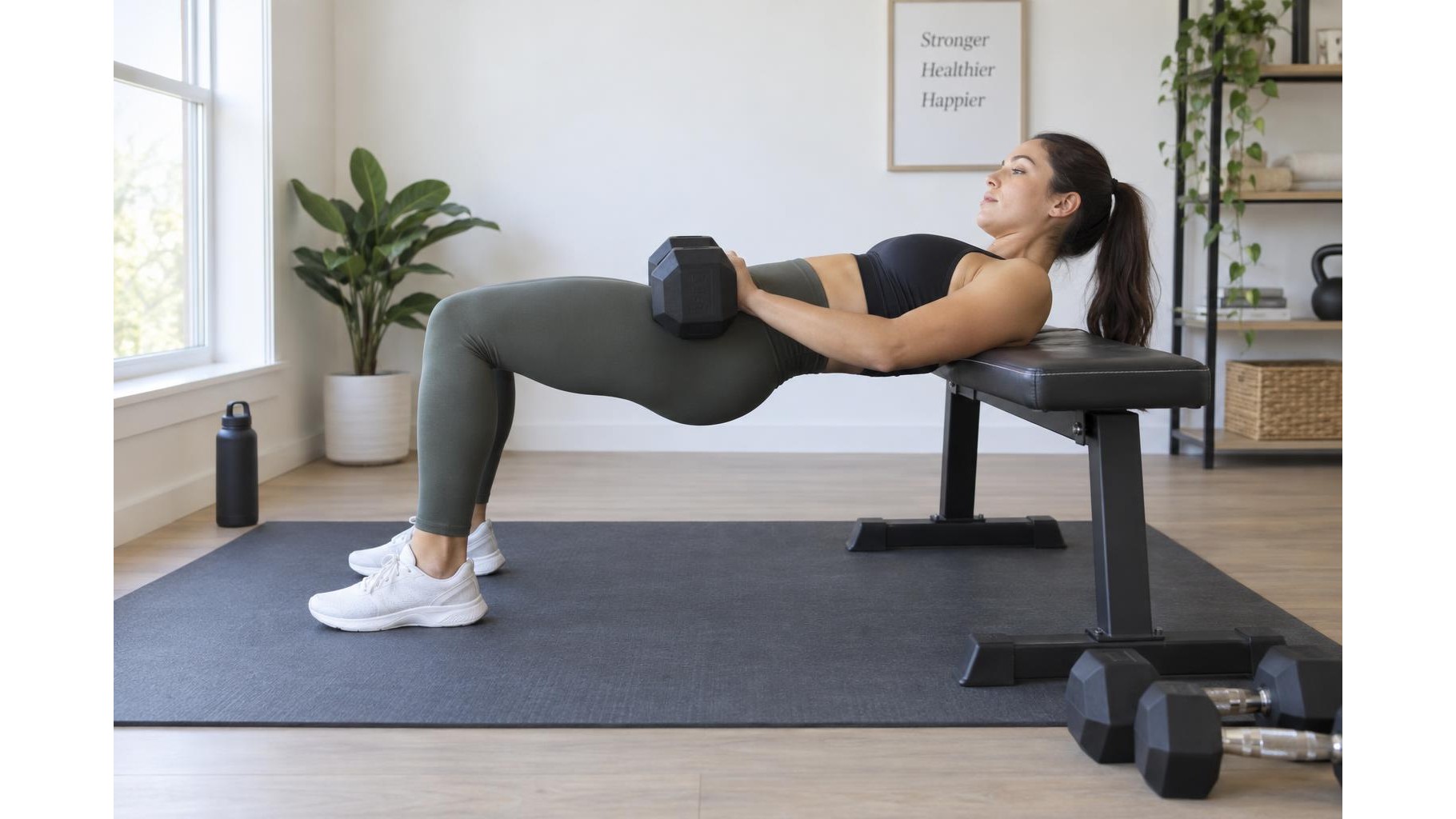
A stronger, more capable set of glutes does not require a full gym or a complicated routine. This 30-minute home workout combines glute bridges, loaded hip thrusts, split squats and controlled hinge work using a dumbbell and a stable support. Adjust the load, range of motion and exercise variations to suit your space and experience. Aim for smooth, controlled repetitions rather than rushing through the session.
Prepare your space and warm up
Set up a clear, non-slip area and check that your bench, sofa or other support is stable before leaning against it. Keep a dumbbell within easy reach, and use a folded towel or pad across your hips for comfort. Warm up for about five minutes with easy marching, bodyweight squats, hip hinges and a few glute bridges. Move through each action without pain, and practise the hip thrust position before adding weight. If you are new to training, begin with bodyweight variations and stop if you feel sharp or unusual discomfort.
Activate with controlled glute bridges
Start on your back with knees bent, feet about hip-width apart and heels close enough that you can reach them with your fingertips. Brace your midsection, gently tuck your pelvis and press through your whole foot to lift your hips. Squeeze your glutes at the top without arching your lower back, then lower slowly. Complete two sets of 12–15 repetitions, resting for 30–45 seconds. To make this easier, shorten the lifting range or pause only briefly at the top. When it feels comfortable, hold a light dumbbell securely across your hips.
Build strength with loaded hip thrusts
Position your upper back against a stable bench or sofa, with the edge around the bottom of your shoulder blades. Plant your feet about hip-width apart and place a padded dumbbell across your hip crease. Lower your hips under control, then drive through your feet until your torso is roughly parallel to the floor. Keep your ribs down and finish by squeezing your glutes, not by overextending your back. Perform three sets of 8–12 reps, resting 60–90 seconds between sets. Choose a weight that lets you maintain the same steady technique throughout.
Train each side with split squats
Stand in a staggered stance, feet far enough apart to keep your balance, with a dumbbell in each hand or one held at your chest. Lower your back knee toward the floor while keeping your front foot planted and your torso comfortably upright. Press through the front foot to return to standing. Complete two sets of 8–10 reps per side, resting about 45–60 seconds. Hold a wall or chair for support, use bodyweight only, or reduce the depth if balance or mobility is a challenge. Switch sides before starting the next set.
Finish with a controlled dumbbell hinge
Hold one or two dumbbells in front of your thighs, soften your knees and push your hips back as the weights travel close to your legs. Stop when you feel a stretch in your hamstrings and can still keep your back neutral; stand by driving your hips forward and squeezing your glutes. Do two sets of 10–12 repetitions, taking 45–60 seconds to rest. Practise without weights or shorten the range if you are learning the movement. Keep every repetition deliberate rather than lowering farther than your control allows.
Scale the session and progress gradually
Allow around five minutes for the warm-up, 20–22 minutes for the four exercises and a few minutes to transition and cool down. If time is tight, complete two quality sets of each movement. If you need more recovery, rest longer; the workout does not need to be rushed to fit the clock. As the exercises become easier, add a small amount of weight, a repetition or a brief pause at the top—not all at once. Keep a note of your loads and reps so you can progress gradually while maintaining sound form.
This simple session covers hip extension, single-leg strength and a controlled hinge in one home-friendly plan. Use a stable setup, choose variations you can perform confidently and give yourself enough rest to keep each set crisp. Start with a manageable effort and build over time: consistent, well-controlled training is a practical route to stronger glutes.









