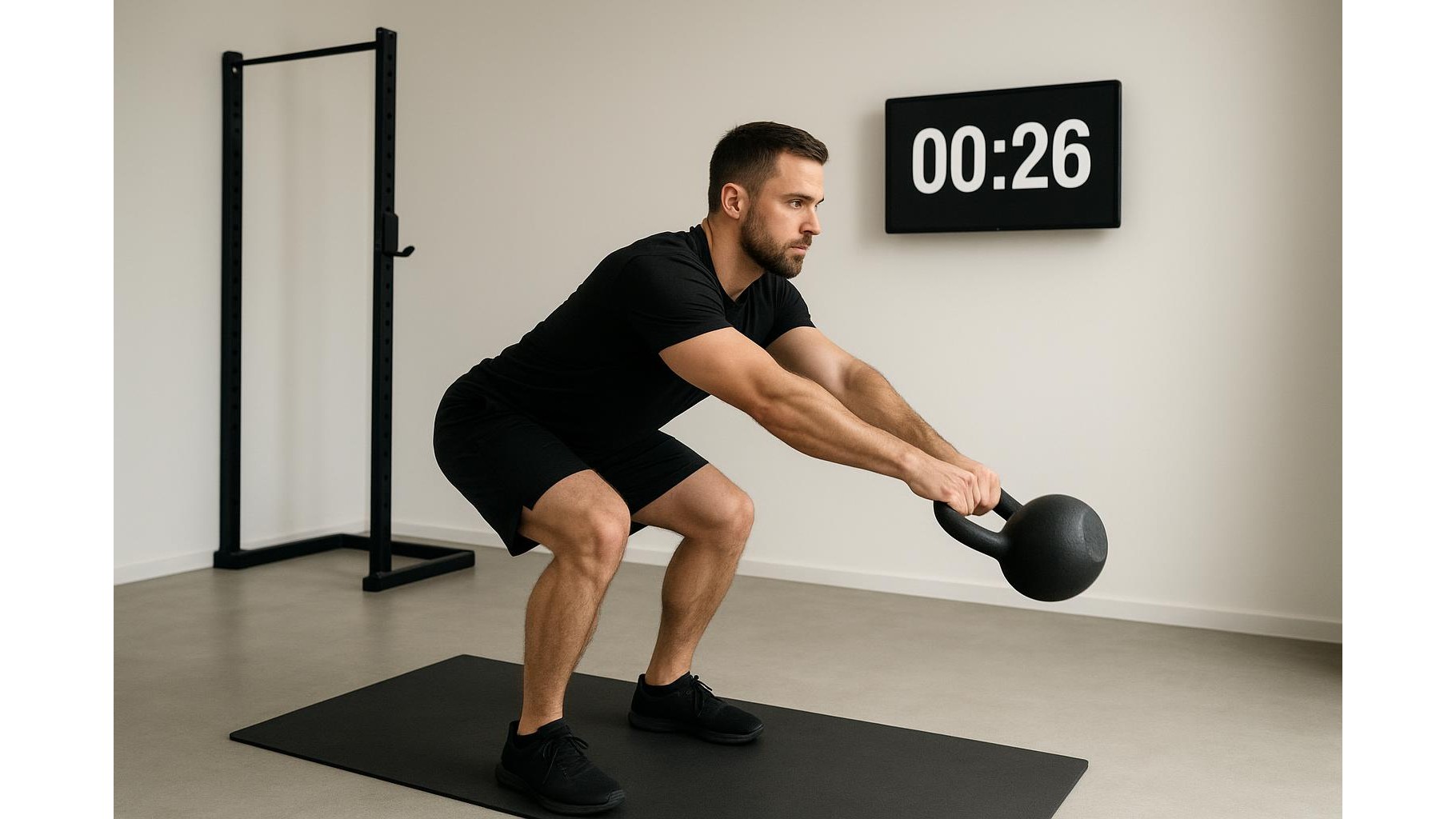
If your home gym includes at least one solid kettlebell, you can build impressive strength and conditioning with a smartly designed 45-minute EMOM workout. This intermediate-friendly plan uses simple movement pairs and clear scaling so you can push hard without frying your joints. All you need is floor space, a timer and a kettlebell that feels moderately heavy for 6–8 reps.
How this 45-minute kettlebell EMOM works
EMOM stands for Every Minute On the Minute: you start your set at the top of each minute, complete the prescribed reps, then rest with any time left. This 45-minute session is split into five 9‑minute blocks (9 minutes = 9 rounds). Perform 30–40 seconds of work, then aim for 20–30 seconds of rest. If you finish the reps with less than 15 seconds to spare, the weight or volume is too high; if you get more than 30–35 seconds of rest, you can likely go heavier or add reps. Stay consistent across all rounds rather than chasing a single all-out minute.
Warm-up and equipment setup
Before your first EMOM block, spend 5–7 minutes on a focused warm-up. Cycle through 2–3 rounds of hip hinges, bodyweight squats, cat–camel for the spine, and light kettlebell deadlifts and halo rotations. Choose 1–2 kettlebells: one that is comfortable for overhead work and, if available, a heavier bell for swings and squats. Place the bell between your feet with the handle aligned across your midfoot, and keep your training area clear so you can drop the bell safely if needed. Set a repeating EMOM timer on your phone or watch for 45 minutes or use five separate 9‑minute intervals.
The 45-minute EMOM kettlebell strength protocol
Work through five 9‑minute blocks, resting 1 minute between blocks if needed. Block 1: Minute 1 – kettlebell swings x 12–15; Minute 2 – goblet squats x 8–10; alternate for 9 minutes. Block 2: Minute 1 – single-arm floor press x 6–8/side; Minute 2 – bent-over rows x 8–10/side. Block 3: Minute 1 – Romanian deadlift x 8–10; Minute 2 – half-kneeling overhead press x 6–8/side. Block 4: Minute 1 – kettlebell clean x 6–8/side; Minute 2 – reverse lunges in goblet hold x 6–8/leg. Block 5: Minute 1 – kettlebell swing x 10–12; Minute 2 – plank pull-throughs x 10–12 total. Keep form crisp and stop a rep or two before failure.
Scaling options for intermediate lifters
To match your current level, adjust one variable at a time: load, reps or range of motion. If you are on the lighter side of intermediate, stay closer to the lower rep ranges and use a bell you can press overhead for 8–10 solid reps. For a stronger intermediate, bump reps to the top of the range or use a heavier bell while keeping rest above 15 seconds. You can also replace overhead presses with push presses for a bit of leg drive, or trade cleans for dead cleans (no swing) if timing is a challenge. Preserve technique first, intensity second.
Joint safety, technique and recovery tips
For long-term progress, joint safety must anchor every home kettlebell workout. Maintain a neutral spine in all hip hinges and swings; the bell should float from hip power, not be lifted with your arms. In goblet squats and lunges, keep knees tracking roughly over midfoot and avoid collapsing inward. Press and clean from a tight, braced core to protect your lower back and shoulders. If your form breaks, reduce load or reps next minute rather than grinding through. After the workout, cool down with gentle hip flexor and hamstring stretches and 3–5 minutes of easy walking or breathing to bring your heart rate down.
This 45-minute kettlebell EMOM strength workout offers an efficient, repeatable structure that balances strength, conditioning and joint-friendly volume for intermediate home athletes. By pairing complementary movements, controlling your work–rest ratio and scaling the load intelligently, you can turn a single kettlebell into a full home gym. Run this session once or twice a week, track your weights and rest times, and progress gradually to keep building muscle, power and resilience at home.