
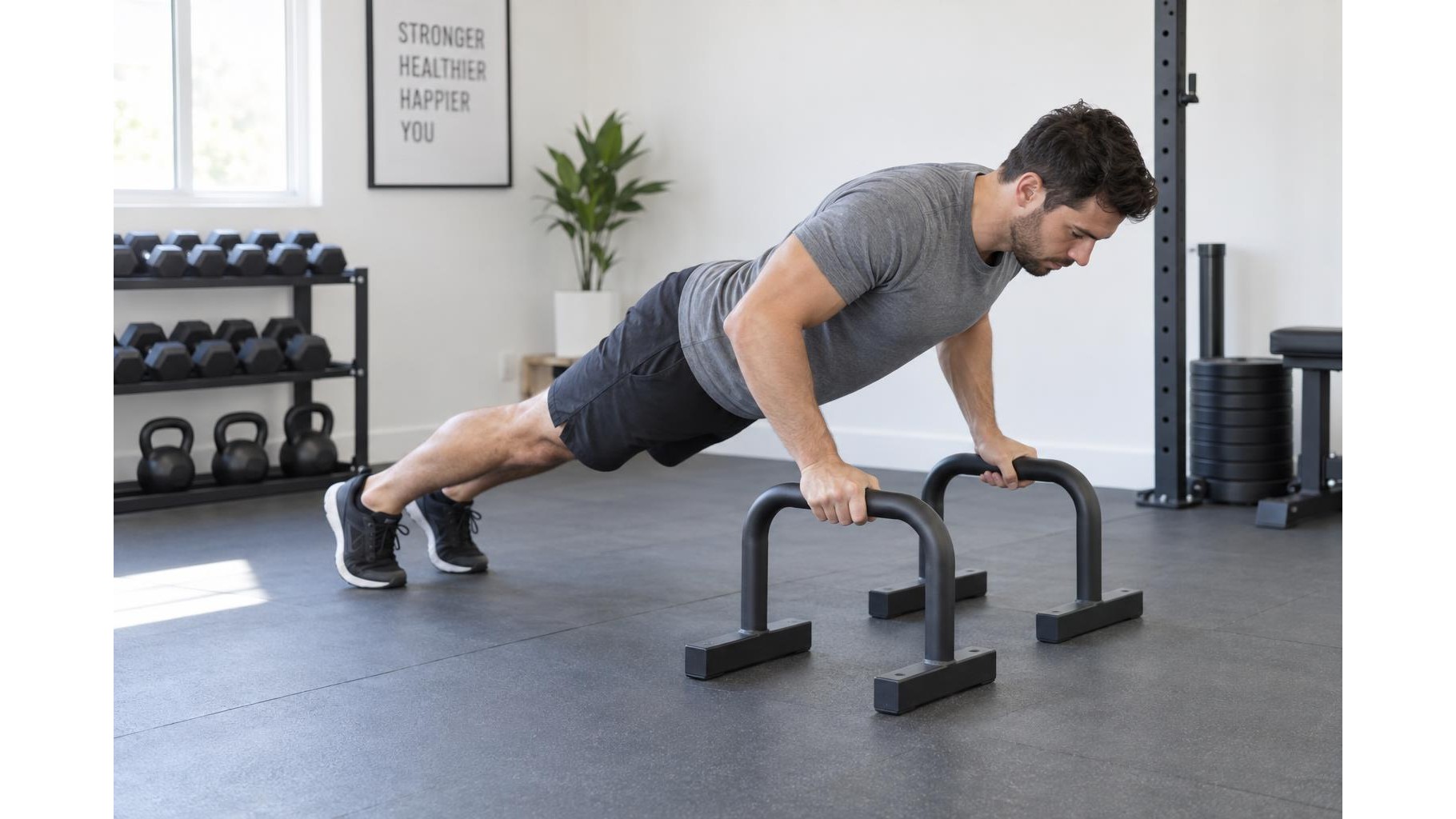
Parallettes can make a home workout feel more stable and give your hands a neutral grip while you train pushing strength and core control. This 30-minute session combines support holds, incline push-ups, knee raises and controlled shoulder work. Adjust the leverage and range of motion to suit your current ability; the goal is smooth, comfortable repetitions, not forcing your wrists or chasing fatigue.
Set up safely and warm up
Place the parallettes on a dry, level, non-slip surface, spaced about shoulder-width apart. Before loading them, press down and gently test that they do not rock, slide or tip. Check that your hands can wrap securely around the handles and that there is clear space around you. Spend five minutes warming up with easy arm circles, shoulder-blade squeezes, wrist movements and a few incline wall push-ups. Keep your shoulders away from your ears and stop if you feel sharp pain, numbness or joint discomfort.
Build a steady support hold
Set the bars beside your hips, grip them firmly and press down to lift your chest. Begin with your feet on the floor and elbows straight but not locked; hold for three rounds of 15–25 seconds. Actively push the bars away, keep your ribs stacked over your pelvis and breathe steadily. If lifting your body feels too demanding, stay seated and practise pressing into the handles, or use one foot lightly for assistance. Rest 30–45 seconds between holds. Progress by extending the hold gradually, not by shrugging or holding your breath.
Train pushing strength with incline push-ups
Keep the parallettes stable and position them so your body forms a straight line from head to heels. Bend your elbows to lower your chest between the handles, then press back up without letting your shoulders collapse. Complete three sets of 6–10 controlled repetitions, resting 60 seconds. Beginners can bend their knees or raise the bars on a secure, low platform to reduce the load; never balance bars on an unstable surface. Choose a height that lets you keep good form and a pain-free range. Lower for about two seconds and avoid flaring your elbows widely.
Add knee raises for core control
Return to a supported position with your feet grounded or lightly assisted, then lift one knee at a time toward your chest. Work for three sets of 6–8 raises per side, moving slowly and keeping your torso as still as possible. If you can maintain a stable support hold, try lifting both knees together for 5–8 repetitions. Otherwise, practise seated knee tucks with your hands on the bars. Rest 45–60 seconds between sets. Keep breathing and avoid swinging; controlled lowering is just as important as the lift.
Finish with controlled shoulder work
For a low-impact finisher, stand facing the bars, hold them lightly and perform scapular push-ups: keep your elbows straight while letting your chest move slightly down, then press the handles away to spread your shoulder blades. Do two or three sets of 8–12 repetitions. Keep the movement small and deliberate, with no shrugging or pinching. If your wrists feel sensitive, use a lighter grip, reduce the range or perform the movement against a wall without the bars. Stop well before your form breaks down.
Allow roughly five minutes for setup and warm-up, 20 minutes for the strength and core sets, and five minutes to cool down and check how your wrists and shoulders feel. Repeat this session two or three times weekly, leaving a rest day between sessions when needed. Build progress by adding a repetition or a few seconds to a hold at a time. Consistent parallettes training should feel challenging but controlled, with comfortable wrists and clean technique as your priorities.









