
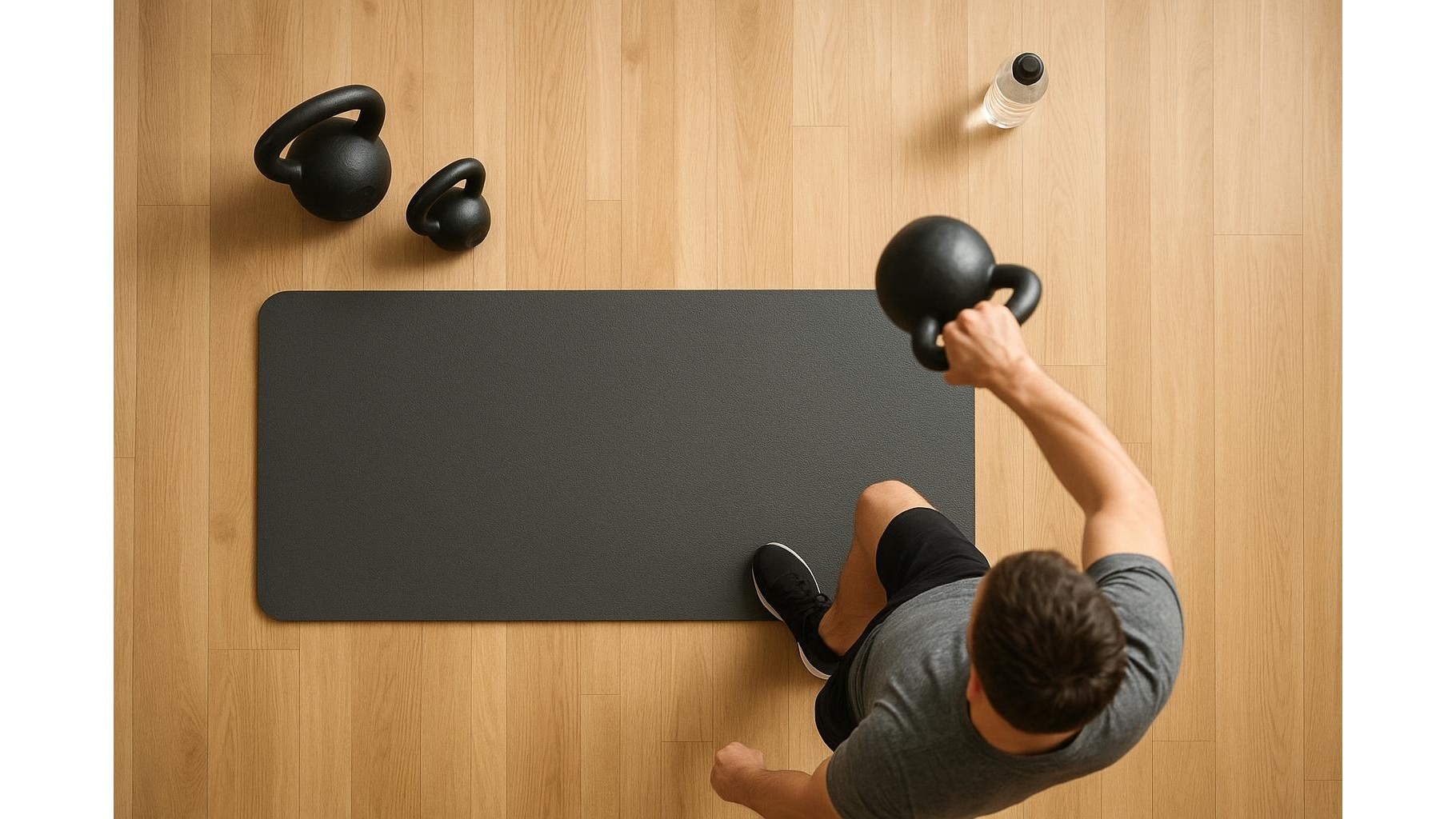
This 3‑day kettlebell and bodyweight split is designed for intermediate lifters training at home with minimal gear. You only need one or two kettlebells, some floor space and your bodyweight. Across three weekly sessions you’ll rotate through an upper body day, a lower body day and a full‑body conditioning day to build strength, endurance and work capacity without machines.
How the 3‑day split is structured
This home kettlebell and bodyweight program uses an upper / lower / full‑body split you can repeat every week. Aim for three non‑consecutive days, such as Monday (upper), Wednesday (lower) and Friday (full‑body). Each session starts with a short warm‑up, then focuses on 4–6 compound movements. Work mostly in the 6–10 rep range for strength and 10–15 reps or timed intervals for conditioning. Rest 60–90 seconds between sets for strength moves, 30–45 seconds for high‑rep or circuit work. Progress by adding reps, sets or slightly heavier kettlebells while keeping technique crisp.
Day 1: Upper body strength focus
Day 1 targets the chest, back, shoulders and arms with a mix of kettlebell presses and bodyweight pulling. After a brisk warm‑up, perform 3–4 sets of: kettlebell floor or bench press, 6–8 reps per arm; kettlebell one‑arm row, 8–10 reps per arm; push‑ups or deficit push‑ups, 8–12 reps; and inverted rows under a sturdy table or bar, 8–12 reps. Finish with kettlebell overhead press, 6–8 reps per arm, and bodyweight dips between chairs for 2–3 sets to near technical failure. Keep your core tight, avoid flaring your ribs on overhead work and emphasise a full range of motion for shoulder health.
Day 2: Lower body and core power
Day 2 is built around kettlebell leg exercises and bodyweight core work. Start with goblet squats, 3–4 sets of 8–10 reps, sitting deep while keeping your chest tall. Move to Romanian deadlifts or suitcase deadlifts with the kettlebell, 3–4 sets of 8–10 reps, focusing on hamstrings and glutes. Add reverse lunges or split squats, 3 sets of 8–10 reps per leg. For power and conditioning, include kettlebell swings, 4–6 sets of 15–20 reps, resting 45–60 seconds between sets. Finish with a short core circuit: plank, side plank and dead bug, 20–30 seconds each, for 2–3 rounds.
Day 3: Full‑body strength and conditioning
The final day blends full‑body kettlebell and bodyweight training into a conditioning circuit. Choose 4–5 moves and cycle through them for 4–6 rounds: kettlebell clean and press (5 reps per arm), kettlebell front squat (8 reps), push‑ups (10–15 reps), kettlebell swings (15 reps) and mountain climbers (20–30 total). Rest 60–90 seconds between rounds. Keep the weights moderate so you can maintain good form while your heart rate climbs. This session improves cardio, work capacity and muscular endurance, complementing the heavier strength work from the first two days.
Warm‑up, mobility and recovery tips
Each workout should start with 5–8 minutes of dynamic mobility: arm circles, hip hinges, lunges with rotation and light kettlebell halos. Before heavy swings or deadlifts, groove the hip hinge with slow bodyweight reps. After training, spend a few minutes on static stretches for hips, hamstrings, chest and lats. Prioritise sleep, hydration and protein intake to recover between sessions. If you feel excessively sore, keep the 3‑day split but reduce volume temporarily. Small weekly progressions and consistent technique will deliver better gains than sporadic max‑effort workouts.
This 3‑day kettlebell and bodyweight split at home gives intermediates a simple, repeatable structure for strength and conditioning without machines. Rotate through the upper, lower and full‑body days, track your loads and reps, and gradually raise the challenge. With focused effort and smart recovery, you can build serious strength, stability and cardio capacity in your home gym using just a couple of kettlebells and your own bodyweight.









