Feeling wired, tense or restless before or after training is more common than you think. This 25-minute at-home routine blends core stability, controlled breathing and gentle mobility to calm your nervous system while still making you feel like an athlete. You will not need any equipment, just a mat or soft surface and a quiet corner where you can focus on your body and breath.
Set up your 25-minute calm-performance block
Before you start, decide that these 25 minutes are a no-distraction zone. Silence your phone, dim the lights if possible and set a timer for each mini-block so you do not keep checking the clock. The session is split into four phases: grounding (5 minutes), core activation (8 minutes), flowing movement (7 minutes) and downshift (5 minutes). Move with a slow, deliberate tempo, especially on the exhales. If your mind races, simply return your attention to the physical sensations in your abs, ribs and feet.
Phase 1 – Grounding breath and body scan (0–5 minutes)
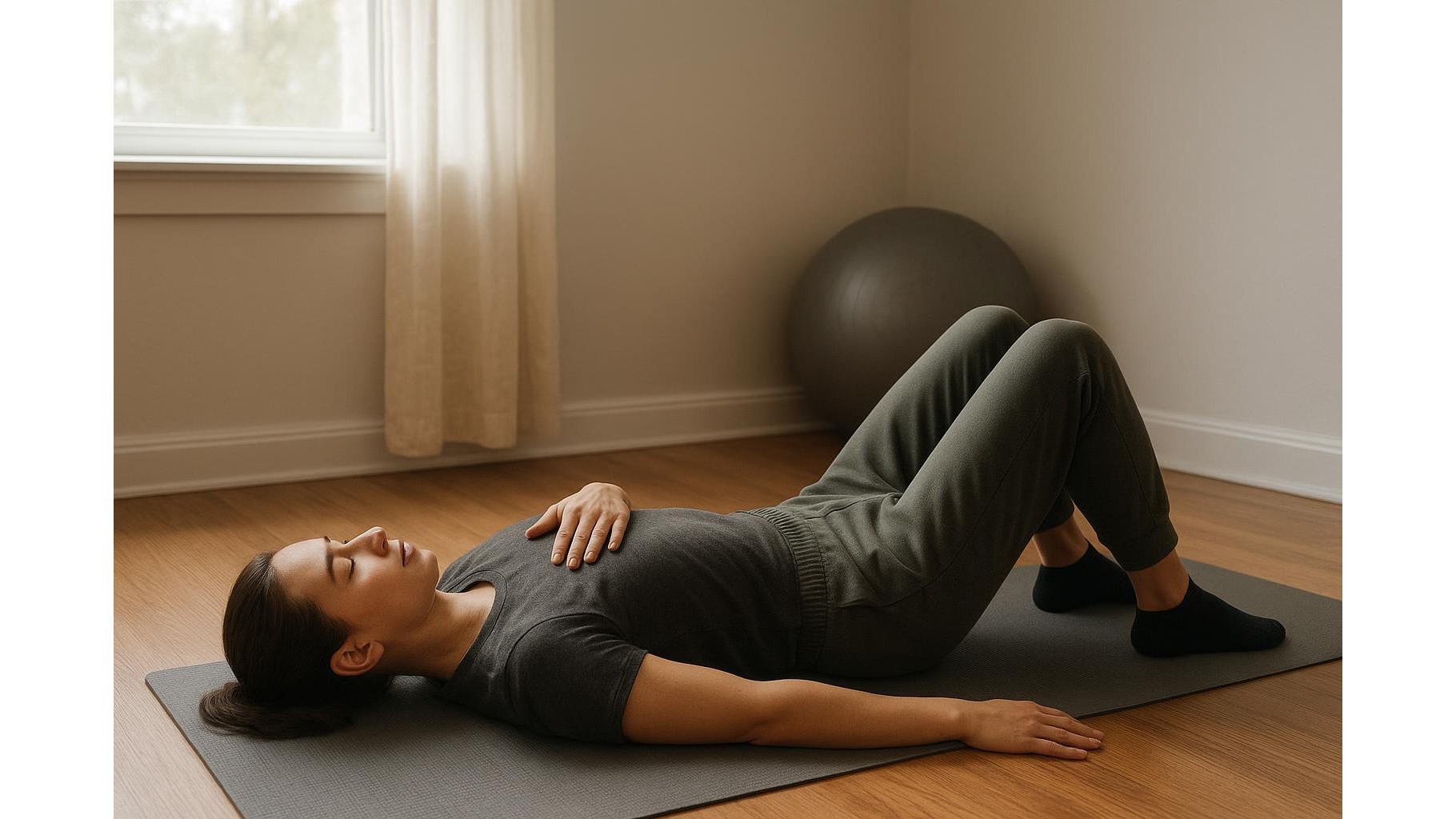
Lie on your back with knees bent, feet flat, one hand on your chest and one on your belly. Inhale gently through your nose for 4 seconds, feeling the lower hand rise first, then exhale through pursed lips for 6 seconds. Repeat for 10–12 cycles, keeping your jaw and shoulders loose. Then shift to a quick body scan: mentally move from feet to head, noticing areas of tension without trying to fix them. Each exhale is a cue to soften one small area, like the forehead or hips. This primes your nervous system for safer, more efficient core training.
Phase 2 – Core activation with controlled breathing (5–13 minutes)
Stay on the floor for three main exercises: dead bug, glute bridge with reach and side plank variations. For dead bugs, lie on your back, arms up, knees bent at 90°. Exhale as you slowly lower opposite arm and leg, keeping your lower back gently connected to the floor; inhale as you return. Perform 2 sets of 6–8 slow reps per side. Move to glute bridges: push through your heels to lift the hips, exhaling as you drive up and reaching your arms overhead, then inhaling as you lower. Finish with a short side plank (knees down if needed) for 20–25 seconds per side, focusing on long, smooth breaths rather than maximal effort.
Phase 3 – Flowing movement to release tension (13–20 minutes)
Transition to all fours for a gentle flow that combines mobility and breath coordination. Begin with 6–8 cat–cow repetitions: inhale as you drop the belly and open the chest, exhale as you round your spine and lightly draw your ribs down. Then move into the world’s easiest lunge: one foot forward, back knee down, hands on the front thigh. Inhale to lengthen the spine, exhale to sink the hips a few millimetres, feeling the front of the hip open. Alternate sides for 2–3 rounds. Finish with slow shoulder circles and arm sweeps while maintaining steady nasal breathing.
Phase 4 – Downshift and nervous system reset (20–25 minutes)
Sit cross-legged or lie on your back again. We will use a simple box breathing pattern: inhale through the nose for 4 counts, hold gently for 4, exhale for 4, hold empty for 4. Repeat for 8–10 cycles. If the holds feel stressful, drop them and just keep the long, quiet exhale. Let the muscles around your eyes and mouth relax. Allow thoughts to come and go without chasing them; your job is only to maintain the rhythm of your breathing and notice how your rib cage and abdomen move with each cycle.
Integrating this routine into your training week
Use this 25-minute session 2–4 times per week on non-lifting days, or directly after intense workouts as a cool-down. Over time you will build stronger deep core support, better breath control and a more reliable way to dial down anxiety without needing extra equipment. If you are particularly anxious before big sessions, try doing just Phase 1 and Phase 2 as a pre-lift primer. Adjust the pace, but keep the focus on awareness rather than performance; treating your nervous system as part of your training is what turns this into a long-term athletic advantage.
This routine is not about crushing yourself; it is about creating a repeatable, 25-minute practice that supports both your performance and your mental state. By pairing deliberate breathing with focused core work and gentle movement, you give your body a clear signal of safety and control. Keep the structure, respect the easy tempo and let consistency do the heavy lifting for your anxiety and your home training results.