
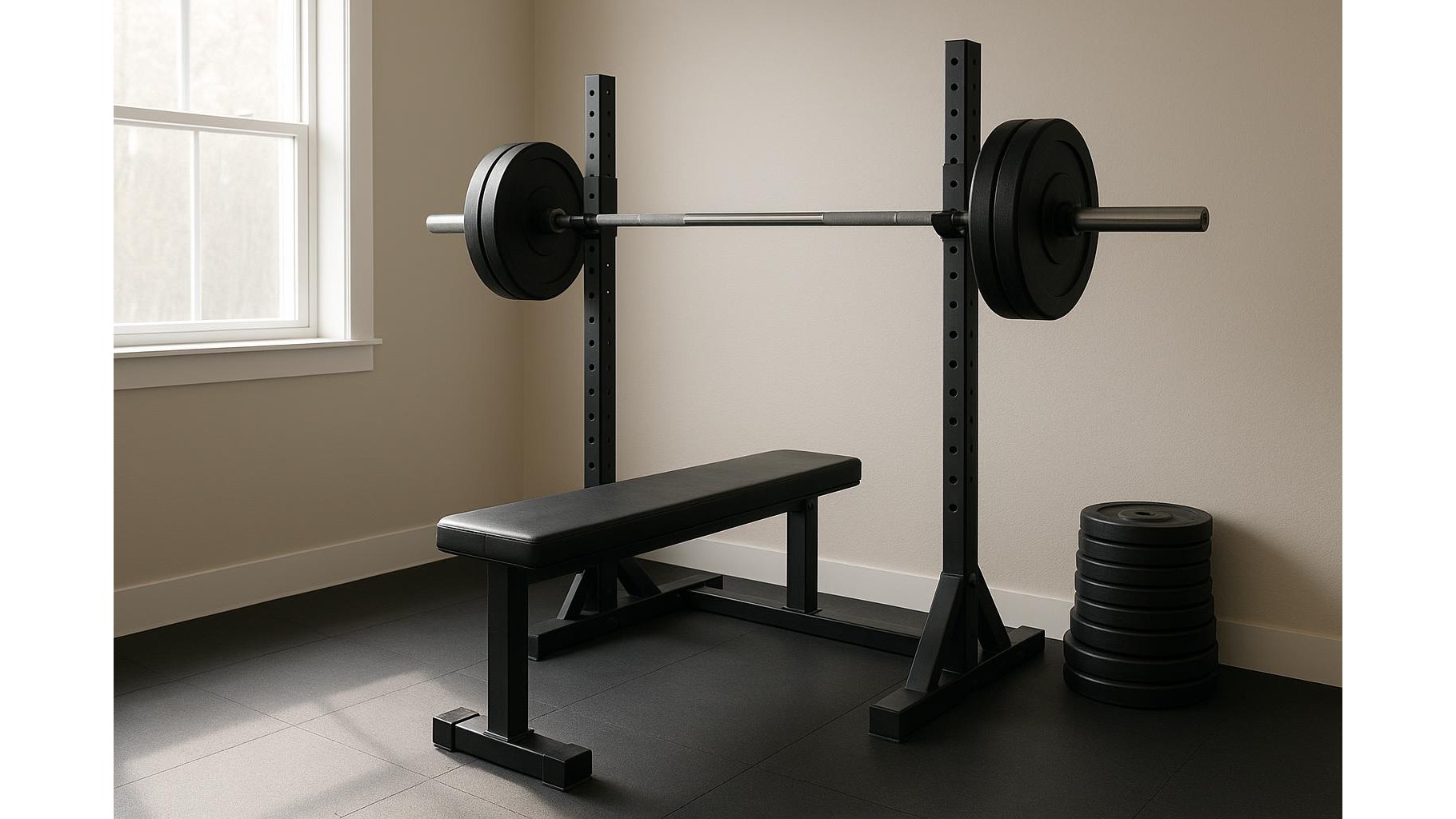
Building serious strength at home does not require a commercial gym. With a barbell, plates, a sturdy rack and a flat bench, intermediate lifters can run a structured, 12-week strength program that drives progress in the big compound lifts while managing fatigue. This plan uses simple, proven periodization so you can keep adding weight to the bar without burning out.
Program overview and required equipment
This barbell-focused home program revolves around four main lifts: back squat, bench press, deadlift and overhead press. Accessory work fills in weak points using the same minimal setup: rows, Romanian deadlifts, lunges, hip thrusts and close-grip bench. You only need a power rack with safety pins, an adjustable bench, a standard barbell and enough plates to challenge you in the 3–10 rep range. Training is organized into three 4-week phases that shift from volume emphasis to peak strength, ending with a deload to consolidate gains.
Weekly structure and training days
The core schedule is a 4-day upper/lower split: Lower A (squat focused), Upper A (bench focused), Lower B (deadlift focused), Upper B (overhead press focused). Space sessions across the week, such as Monday, Tuesday, Thursday and Friday, leaving at least one rest day between lower-body workouts. Each workout starts with a main lift, followed by 2–4 accessory movements. A typical Lower A day might include back squat, Romanian deadlift, split squat and calf raises, while Upper A focuses on bench press, barbell row, close-grip bench and face pulls with bands if available.
Phase 1 (Weeks 1–4): Volume and base building
In Phase 1 the goal is to build work capacity and refine technique with moderate loads and higher volume. Perform the main lifts for 4 sets of 5–8 reps at about 70–77% of your estimated 1RM, leaving 1–2 reps in reserve. Accessories sit in the 8–12 rep range for 3–4 sets. Add 2.5–5 kg to upper-body lifts and 5–10 kg to lower-body lifts each week if you complete all reps with solid form. This phase lays the foundation for heavier work by strengthening connective tissue and improving bar path consistency.
Phase 2 (Weeks 5–8): Intensification and strength focus
Phase 2 shifts to heavier loads and lower reps to drive maximal strength gains. Main lifts move to 5–6 sets of 3–5 reps at roughly 78–85% 1RM. Accessories drop to 6–10 reps to reduce overall fatigue while still targeting hypertrophy and weak links. Continue weekly load increases as long as you can maintain technique and keep at least 1 rep in reserve on most working sets. If you miss reps on two consecutive sessions of the same lift, hold the weight steady the following week and focus on tighter setup, bracing and bar speed.
Phase 3 (Weeks 9–12): Peak, testing and deload
In Phase 3 you peak your home strength program. Weeks 9–10 use 4–5 sets of 2–3 reps at 85–90% 1RM on main lifts, with minimal accessories to keep fatigue low. Week 11 is a testing week: after a thorough warm-up, work up to 1–3 heavy singles in the 90–95% range to gauge true progress without grinding to failure. Week 12 is a deload: reduce volume by about 50% and load by 10–15%, focusing on crisp, fast sets of 3–5 reps. Throughout the 12 weeks, prioritize 7–9 hours of sleep, a small daily calorie surplus and at least two rest days per week to support recovery.
This 12-week barbell program gives intermediate lifters a clear path to stronger squats, benches, deadlifts and presses using only a rack and bench at home. By progressing from volume to intensity and finishing with a strategic peak and deload, you can add meaningful weight to the bar while staying healthy and consistent. Run the cycle, reassess your maxes, then repeat with slightly higher starting loads to keep your home strength journey moving forward.









