Travel can derail even the most disciplined home gym athlete. Long flights, strange beds and limited equipment make it tempting to skip training completely or, worse, to push too hard and come back more fatigued than when you left. A smart recovery week while travelling flips this script: you deliberately lower volume and intensity, use simple tools in rentals and hotels, and focus on joints, mobility and sleep so you return to your home gym feeling genuinely refreshed.
Why travel is the perfect time for a recovery week
Instead of fighting your schedule and hunting for a full commercial gym, treat trips as a planned deload week. Travel already adds systemic stress: sitting for hours, time zone shifts, irregular meals. Keeping your normal heavy lifting routine on top of that often leads to nagging pain, poor sleep and stalled progress. A recovery week reduces training volume (sets and reps), pulls back intensity (no max efforts) and emphasises movement quality. Aim for short 20–30 minute sessions with bodyweight and light resistance work on 3–4 days of your trip. You maintain your habits and coordination, but give your muscles, tendons and nervous system the break they need to supercompensate when you get back to your home gym.
How to adjust volume and intensity in hotels and rentals
On the road, think in terms of movement patterns instead of specific lifts: push, pull, hinge, squat, carry and core. Replace heavy barbell work with low‑load, higher‑control variations. For example, swap barbell squats for slow tempo split squats, bench press for incline push‑ups on the bed or desk, and deadlifts for hip hinges and single‑leg Romanian deadlifts using bodyweight. Keep your sets at RPE 6–7 (you could do 3–4 more reps) and cut total working sets by 40–60% versus your normal week. Sprinkle in isometric holds at end ranges to challenge muscles without joint pounding. This approach keeps you “switched on” while letting joints and connective tissues off the hook from heavy loading.
Minimal equipment that fits in your carry‑on
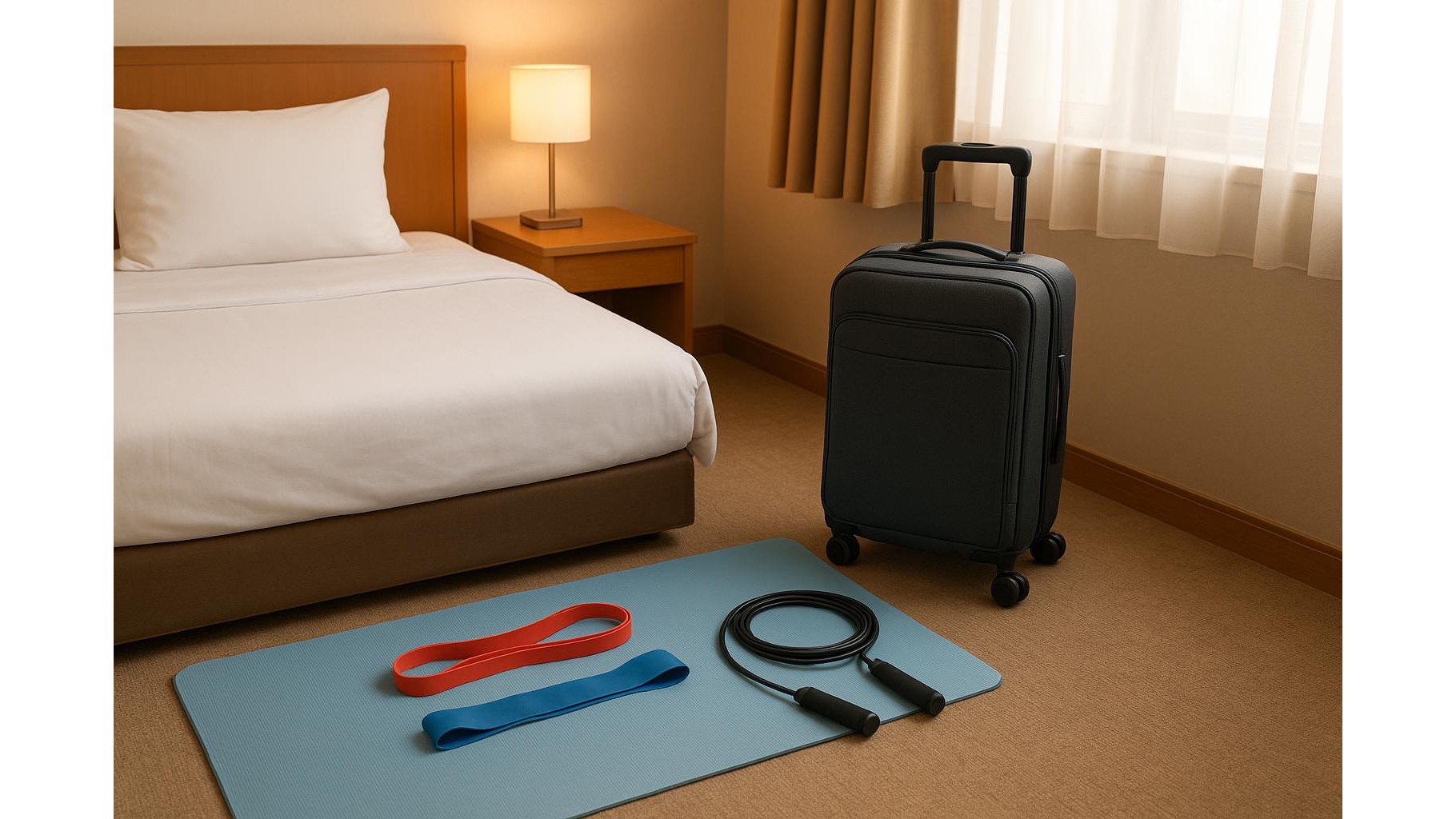
You don’t need a full gym in your suitcase. A simple mini travel kit can turn any rental or hotel room into a versatile training space. Prioritise light, packable tools such as resistance bands, a compact jump rope and a small massage ball. With a set of looped bands you can train rows, presses, pull‑aparts, hip work and shoulder activation without relying on hotel machines. A rope lets you add low‑impact conditioning in short bursts between strength blocks. A massage or lacrosse ball works wonders on glutes, calves and upper back after long travel days. Build your recovery week sessions around circuits that alternate band strength, mobility drills and short conditioning bouts, keeping total time tight and purposeful.
Protecting joints and posture after long journeys
Hours in planes, trains and cars almost guarantee tight hip flexors, stiff thoracic spine and cranky shoulders. Your recovery week training should start with 5–10 minutes of targeted mobility and activation. Focus on hip openers (half‑kneeling hip flexor stretches, 90/90 rotations), thoracic spine extensions over a pillow or rolled towel, and scapular control drills like wall slides and band pull‑aparts if you packed a band. Prioritise slow, controlled reps and longer exhales to down‑regulate your nervous system. In the main session, choose joint‑friendly exercises: elevated push‑ups instead of deep dips, supported split squats holding onto a chair, and glute bridges instead of heavy hip thrusts. Finish with gentle walks, ideally outside, to restore posture and circulation.
Sample recovery‑week schedule for travellers
Use a simple template and adjust based on your itinerary. Day 1: 20–25 minutes of full‑body strength (push, hinge, core) using bodyweight and bands, followed by 5–10 minutes of stretching. Day 2: low‑intensity cardio like a brisk walk plus an extended mobility session. Day 3: another short strength circuit focusing on pull, squat and core, keeping reps smooth and stopping well shy of failure. Day 4: off or just walking. If your trip is longer, repeat this 4‑day block. Keep at least one day completely free of structured training to let fatigue drop. Throughout, track how you feel: if sleep is poor or travel is hectic, cut sets further and lean more into mobility and breathing work. The aim is recovery, not performance.
When you return to your home gym, resist the urge to test maxes immediately. Instead, use your first 1–2 sessions as a bridge: return to your normal exercises, but keep loads at 80–90% of what you used before travelling, and rebuild volume over the week. By treating trips as intentional recovery weeks, dialling down volume and intensity, and using minimal equipment to move well in rentals and hotels, you arrive home with fresher joints, better mobility and renewed motivation to attack your next training block.