
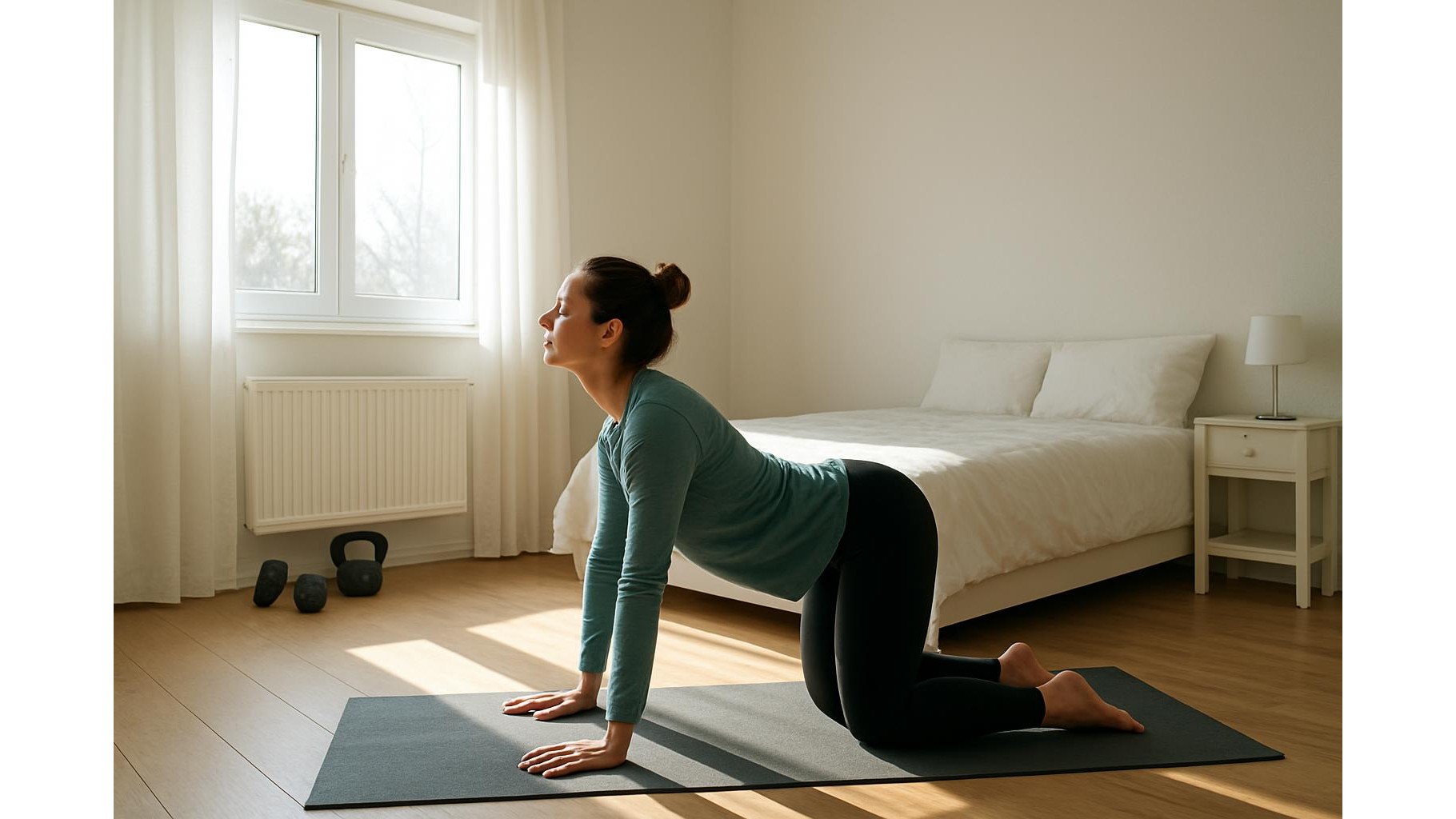
Waking up with morning stiffness can make your home workouts feel heavier than they should. A short, targeted mobility and activation routine helps your spine, hips, knees and shoulders move more freely, reduces the risk of tweaks, and mentally transitions you from sleep to training mode. In just ten minutes, you can loosen up in a tiny bedroom or living room, using only your bodyweight and a couple of simple tools.
Set the base: gentle spinal wake-up
Start by waking up your spine, as it influences how your hips and shoulders move. From a quadruped position on the floor (hands under shoulders, knees under hips), perform slow cat–cow repetitions: gently flex and extend your spine, synchronising with your breath. Focus on smooth, controlled movement, not forcing range. Follow with a low child’s pose with side reaches to lengthen the lats and the sides of the ribcage, which can feel tight after a night’s sleep. This segment should feel like oiling a rusty hinge: low intensity, no pain, just restoring basic motion before you ask your body to lift or run.
Open the hips and knees for smoother squats
Your hips and knees take a lot of load in most home workouts, especially if they include squats, lunges or step-ups. Start with hip CARs (controlled articular rotations): standing and holding a wall for balance, draw slow circles with your knee, keeping your torso quiet. Then move to a deep squat hold, using a door frame or chair for support, gently shifting weight from side to side to explore your available range. Finish with a few slow reverse lunges, focusing on knee alignment over the mid-foot. These targeted movements lubricate the joint surfaces, increase synovial fluid circulation and prepare connective tissues for the loading that will follow in your main workout block.
Prime your shoulders and upper back
Stiff shoulders and a locked upper back are common after a night of side-sleeping or hunching over screens the day before. In a standing or kneeling position, perform big, controlled shoulder circles, keeping ribs down to avoid cheating with your lower back. Add a few wall slides: place forearms and wrists on a wall and slowly slide upward, trying to maintain contact. This opens the thoracic spine and activates the stabilising muscles around the shoulder blades. If you use light household items, such as water bottles, keep them very light and focus on scapular control, not heavy lifting. The goal is to feel warmth and easier overhead motion, not fatigue.
Activate your core for better control
Before you move on to push-ups, rows or kettlebell work, wake up your core so it can support the spine. Start with a few rounds of dead bug: lying on your back, arms and legs in tabletop, slowly extending the opposite arm and leg without letting your lower back arch off the floor. Follow with a short set of glute bridges to activate the posterior chain, holding each rep for two to three seconds and focusing on a strong squeeze at the top. These simple drills improve lumbo-pelvic stability, meaning your hips and shoulders can move more freely while your midsection stays solid, reducing the risk of compensations and minor strain once the intensity ramps up.
Integrate everything with dynamic patterns
To finish your 10-minute reset, connect your freshly mobilised joints with light, dynamic patterns that resemble your workout. Think of bodyweight squats, walking lunges in place (if space is tight), and inchworms where you fold forward, walk your hands out to a high plank and then back to stand. Keep the tempo smooth and the range of motion comfortable, using the last minute or two to gently elevate your heart rate. This phase teaches your body to use the new range you’ve opened up, improving movement quality in your actual training session and making it more likely that you’ll feel loose rather than rusty under load.
Make morning mobility a non-negotiable ritual
Turning this 10-minute morning routine into a habit can transform the way your home workouts feel. By consistently addressing the spine, hips, knees and shoulders with low-intensity, science-informed movements, you reduce stiffness, sharpen body awareness and step into each session with better mechanics. You don’t need a big space or complex equipment—just a small corner of your bedroom or living room and a willingness to move with intention. Over time, you may notice fewer aches, smoother reps and more enjoyable training, all starting with a short reset as soon as you wake up.









