Building a home gym is exciting, but many people forget one crucial detail: lumbar support. Whether you are pressing on a bench, doing floor work or sitting at your desk between sessions, your lower back takes a lot of stress. With a few simple cushions, rolled towels and everyday props, you can create effective DIY lumbar support that keeps your spine neutral, reduces fatigue and helps you train more consistently at home.
Why lumbar support matters in a home gym
Your lumbar spine naturally curves slightly inward. Long periods of sitting, heavy lifts with poor form or repeated flexion on the floor flatten or exaggerate this curve, irritating discs and joints. Proper lumbar support maintains a neutral curve so muscles do not have to overwork to stabilise the area. In a home gym, this means you can press, row and hinge with more control and less discomfort. It also helps you avoid compensations in the hips and upper back, which often show up as tight hamstrings, cranky shoulders or recurring “tweaks” after training.
Simple cushion setup for office chairs and sofa breaks
Start where you probably spend the most time: your office chair or sofa. You do not need special gear. Take a small, firm cushion or a tightly rolled towel and place it at the small of your back, roughly in line with your belt. Sit all the way back so your pelvis is against the backrest and let the cushion gently fill the natural hollow of your lower back. Your goal is light contact, not a hard push. Adjust the thickness until your chest can stay relaxed and your ribs are not flaring. Use the same trick on the sofa: place the cushion vertically behind your lower back instead of slouching into the cushions. This keeps your spine in a training‑ready position even when you are answering emails or watching TV.
DIY lumbar support on the weight bench
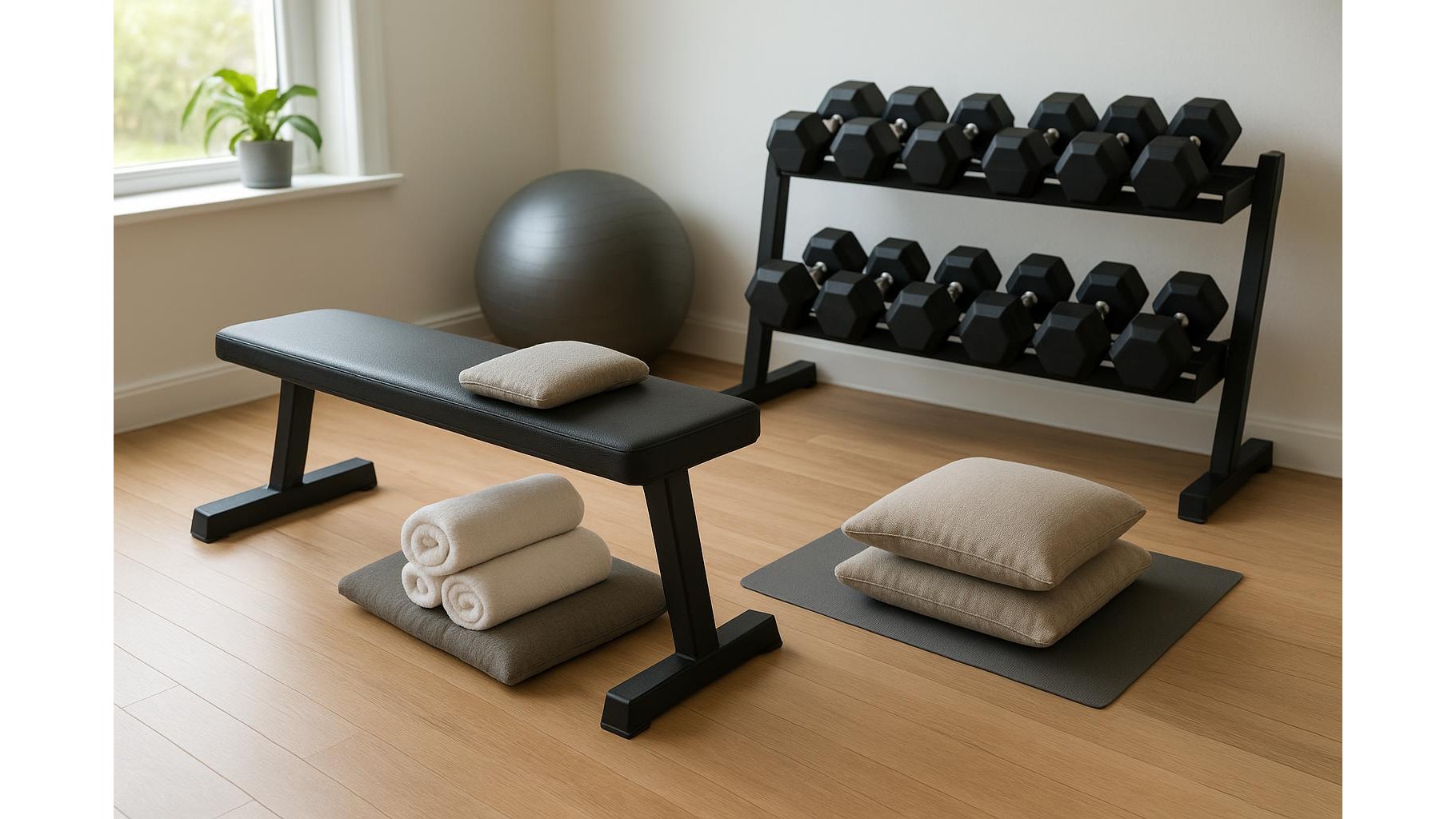
Flat weight benches are often too hard or too wide to match your natural lumbar curve. To create bench lumbar support, lie on the bench without weight and slide a folded hand towel or small pillow under your lower back. The aim is to “meet” your curve, not arch your back more. Check that your hips and ribcage stay level, and that you can still brace your core and plant your feet. For movements like dumbbell presses or pullover variations, this support encourages a stable torso so your shoulders do the work instead of your spine. If you perform hip thrusts or glute bridges on a bench, you can also use a cushion behind your sacrum as you set up to avoid sinking into the edge, then remove it before you start the set.
Floor setups: cushions, towels and yoga props
Floor exercises can be surprisingly tough on a sensitive lower back. Use a medium‑thickness exercise mat, and add a folded towel or pillow under your lumbar area during supine core work. When doing dead bugs, heel taps or leg raises, the support stops your lower back from collapsing into the floor. For side‑lying work like clamshells, place a cushion between your waist and the floor so your spine stays straight rather than bending sideways. During relaxation poses, such as a supported bridge, you can rest your pelvis on a firm cushion with another small towel under your lower back to gently decompress the area. These small adjustments make long holds more comfortable and let your muscles relax instead of gripping defensively.
Quick pre‑workout routines for a happy lower back
A short pre‑workout lumbar routine prepares your spine and hips before loading them. Spend 3–5 minutes on three elements: breathing, mobility and activation. First, lie on your back with your feet on a cushion and one hand on your belly. Take slow nasal breaths, expanding your lower ribs in all directions while keeping a light lumbar contact with the mat or towel. Next, do gentle cat‑cow on all fours to move the spine through flexion and extension, followed by hip hinges with a dowel along your back to groove neutral alignment. Finish with glute bridges and bird dogs, focusing on a strong, even brace instead of height. You can use a cushion between knees for bridges to encourage better recruitment of the inner thighs and core.
Post‑workout decompression and daily habits
After training, spend a few minutes “giving back” to your lower back. Lie on the floor with your calves resting on a chair or sofa and a small cushion supporting the natural lumbar curve. Breathe slowly for 2–3 minutes. Then roll to your side and gently stretch hip flexors and hamstrings without forcing range. A supported child’s pose with a cushion between your hips and heels can feel restorative for many people. Outside of workouts, keep using your DIY lumbar supports on chairs and benches, and avoid long slouching sessions with no breaks. Over time, these small, consistent habits will help you maintain a strong, resilient lower back so you can enjoy your home gym safely and progress your training with confidence.