
The first three days of the menstrual cycle can turn even the most dedicated home workout into a struggle. Cramps, deep fatigue, lower-back aches and a foggy head often mean your usual high-intensity routine is not the best option. Instead of forcing yourself through a heavy session, you can shift towards a gentle recovery routine that respects your body’s needs while still supporting circulation, mobility and relaxation. Below you’ll find an easy plan that fits into your home training schedule or replaces it entirely when rest is the smarter choice.
Listening to your cycle: when to swap training for recovery
On days 1–3 of your period, hormone levels are at their lowest and your body is working hard. This is often when period cramps, lower energy and mood dips are strongest. Instead of seeing this as a failure in your fitness plan, treat it as a scheduled deload phase. If you wake up with heavy bleeding, stabbing cramps or dizziness, that is a clear signal to replace your usual home workout with low-impact recovery: stretching, breathing and relaxation. On milder days, you can still move, but keep intensity at an easy level, avoiding max-effort lifts, jump training and long HIIT circuits. This compassionate approach protects your joints, supports hormonal balance and often leaves you feeling better for the rest of the cycle.
Breath-led warm up to ease cramps and fatigue
Before any movement, spend 5–10 minutes on breathing exercises to calm your nervous system and loosen pelvic tension. Lie on a mat or carpet, bend your knees and place your feet flat on the floor. Rest one hand on your chest and one on your lower belly. Inhale slowly through your nose for a count of four, letting the lower hand gently rise; exhale through pursed lips for a count of six. Aim for long, smooth breaths rather than forceful ones. This type of diaphragmatic breathing signals your body that it is safe to relax, which can reduce the perception of pain and soften tight abdominal muscles. After a few minutes, gently circle your knees side to side to mobilise the lower back and hips, always syncing movement with your breath.
Gentle mobility and stretches for lower back and hips
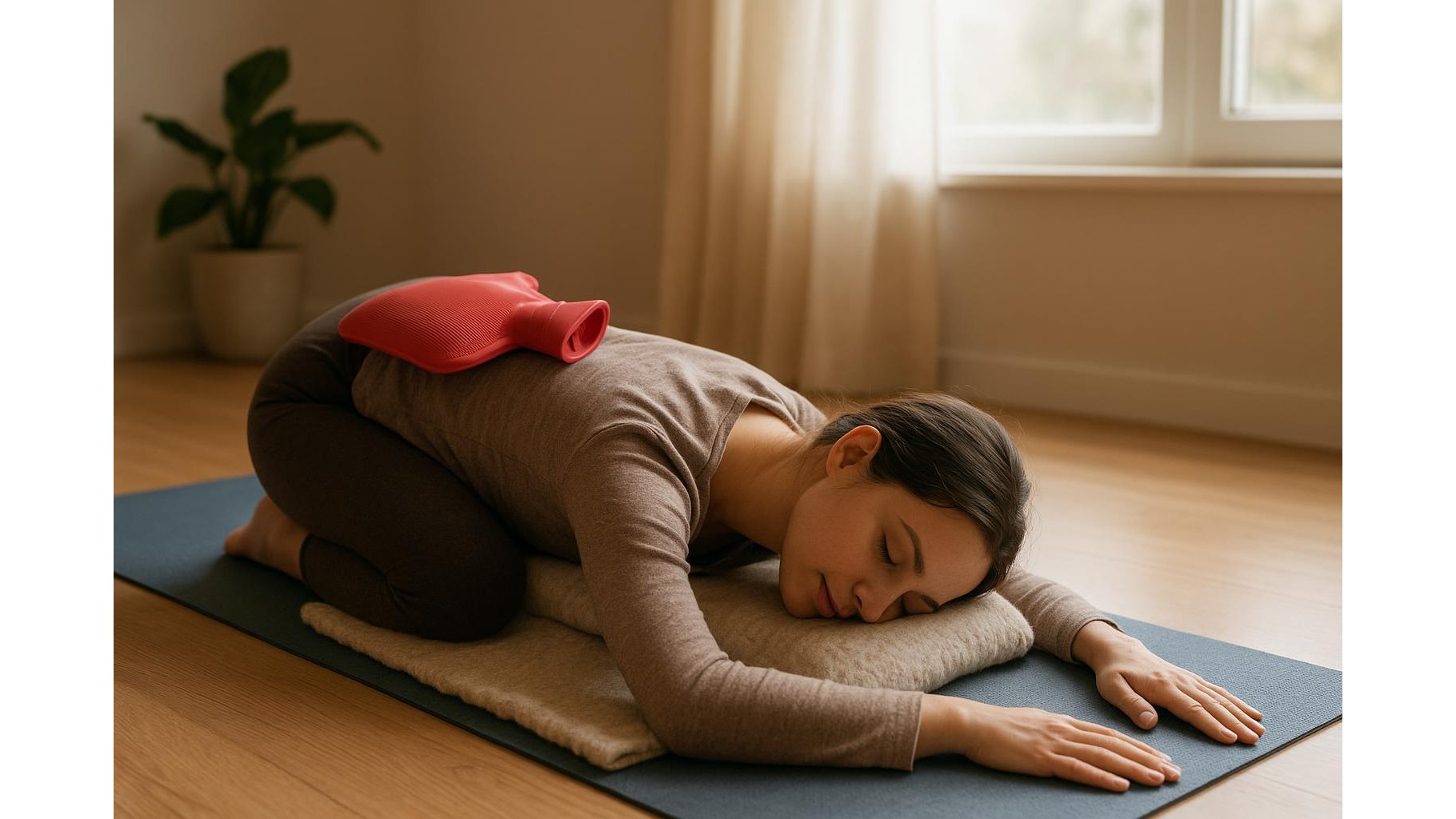
Once your breathing has settled, move into a short mobility sequence focused on the hips, glutes and lower back. Stay close to the floor to keep effort low. Cat–cow on hands and knees helps to massage the spine: as you inhale, arch your back gently and open your chest; as you exhale, round your spine and draw your navel towards your back. Follow this with a supported child’s pose, widening your knees and resting your torso on a folded blanket or cushion. Hold for 1–2 minutes, breathing into your lower ribs. Next, try a reclining figure-four stretch by lying on your back and crossing one ankle over the opposite knee; this releases glute tension that can refer pain into the lower back. Keep each stretch mild, avoiding any aggressive pulling. The goal here is comfort and circulation, not pushing your flexibility limits.
Heat and self-massage to relax the abdominal wall
Heat is a classic ally against menstrual cramps, helping blood vessels dilate and muscles relax. At home, you can use a hot water bottle or an electric heating pad placed over your lower abdomen or lower back while you lie semi-reclined on the sofa or on your bed. Combine this with gentle self-massage: using your fingertips, draw small circles around your navel, then follow the line of your hip bones and lower belly in a slow clockwise direction. Keep pressure light and stop if anything feels uncomfortable. Adding a drop of a neutral body oil can help your hands glide more easily. Ten to fifteen minutes of heat plus self-massage can make it much easier to sit, stand and walk without sharp cramping, and it pairs perfectly with quiet activities like reading or watching a film on recovery days.
Mini movement snacks when a full workout is too much
On heavy cycle days, it can be mentally tough to skip your usual home training entirely. Instead of an all-or-nothing mindset, experiment with movement snacks—very short bouts of activity spread across the day. For example, perform 5 minutes of gentle marching in place or slow bodyweight squats in the morning, another 5 minutes of wall push-ups and shoulder rolls in the afternoon, and finish with your stretching and breathing routine at night. These tiny sessions keep joints mobile, support circulation and give you the psychological boost of having “moved,” without demanding the same energy as a full workout. Use a simple timer on your phone or a kitchen timer to keep them brief and manageable. If at any point your cramps worsen, give yourself permission to stop; on these days, rest is productive.
When you honour your body during days 1–3 of your menstrual cycle, your home fitness routine becomes more sustainable and kinder. Swapping intense training for breath work, mobility, gentle stretching, heat and self-massage does not mean losing progress; it means training in sync with your physiology. By listening to pain and fatigue signals and choosing supportive recovery instead of forcing performance, you build a long-term relationship with exercise that respects every phase of your cycle, leaving you better prepared for stronger sessions once your energy naturally returns.









