After squats, lunges, or a challenging home leg workout, your quadriceps may feel tired or mildly stiff. A short, comfortable cool-down can help you transition from exercise to rest without adding another demanding session. Keep every movement easy, breathe normally, and treat this routine as an option for ordinary post-exercise tightness—not a way to push through pain.
Start with a gentle movement check
Take a minute to notice how your legs feel before stretching. If the sensation is general muscle fatigue or mild stiffness, begin with two to five minutes of easy walking around your home. Keep your steps relaxed and shorten your stride if needed. You could also march slowly in place while holding a sturdy support. The aim is simply comfortable movement; you should be able to speak easily and feel no sharp, increasing, or joint-focused pain. If walking feels uncomfortable, sit and rest instead.
Try an easy seated knee extension
Sit toward the front of a firm chair with both feet on the floor. Slowly straighten one knee only as far as feels comfortable, pause briefly, then lower your foot with control. Repeat five to eight times per side. Keep the movement smooth rather than snapping the knee straight, and avoid leaning back or holding your breath. If sitting with your knees bent feels awkward, use a higher chair or place a cushion behind your back. Stop if the motion produces pain rather than a mild sense of movement.
Use a supported quadriceps stretch
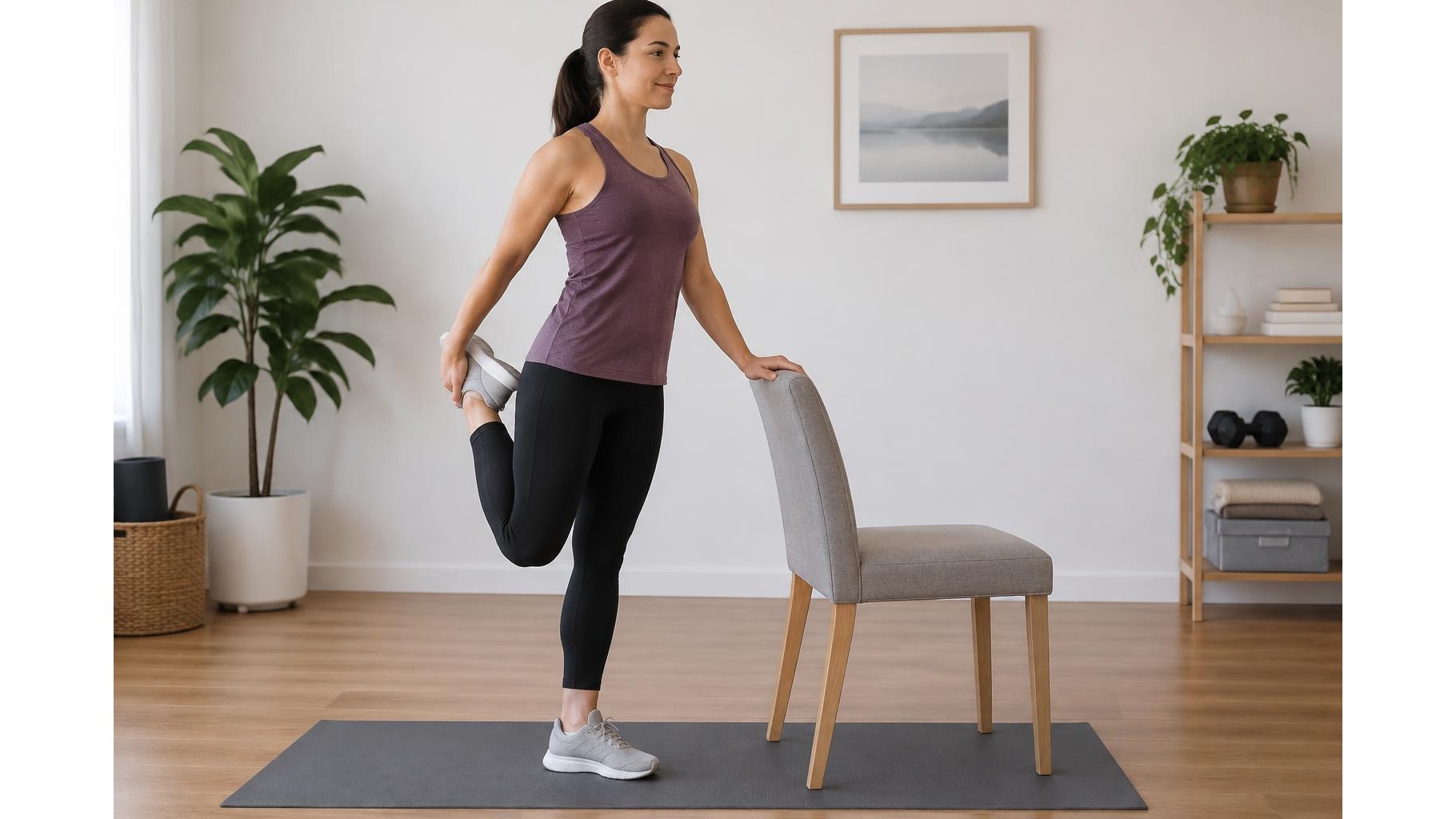
For a light front-of-thigh stretch, stand beside a wall or counter and hold it for balance. If comfortable, bend one knee and bring your heel gently toward your buttock, holding your ankle or trouser leg. Keep your knees close and your torso upright; do not pull hard or arch your lower back. Hold for about 10 to 20 seconds while breathing steadily, then release and switch sides. If reaching your foot is difficult, skip the standing version or use a strap around your ankle without tugging. A stretch should feel mild, not painful.
Choose a mobility-friendly alternative
You do not need to force a deep lunge or kneeling position to recover. If standing on one leg feels unsteady, keep both hands on a stable support, or perform the routine seated. If kneeling bothers your knees, avoid floor-based stretches altogether. You can also lie on your side with your head supported and gently bend the upper knee only within an easy range. Adjust the position until it feels secure and relaxed. Mobility modifications are useful ways to make recovery comfortable, not signs that you are doing it incorrectly.
Keep the effort light and brief
One gentle round is enough; recovery does not need to become another workout. Move slowly, rest between sides, and finish feeling the same or more comfortable than when you started. Avoid bouncing, forcing a larger range, or using aggressive pressure on a sore area. Normal delayed muscle soreness can develop after training, but extra stretching is not a requirement for preventing it. Drink to thirst and allow time for rest. If your legs feel increasingly irritated, stop and give them a break rather than trying more techniques.
Know when to seek professional advice
Contact a healthcare professional if pain is severe, worsening, sharply localized, or making it difficult to walk or use the leg normally. Seek prompt assessment for notable swelling, bruising, marked weakness, or symptoms that do not improve as expected. Sudden one-sided swelling, warmth, or redness also deserves urgent medical advice; seek emergency help for chest pain or shortness of breath. Do not assume these symptoms are ordinary workout soreness. A clinician can assess the cause and advise when it is appropriate to resume training.
A gentle quadriceps cool-down can be as simple as easy walking, a few controlled knee extensions, and a mild supported stretch. Choose positions that suit your balance and mobility, keep the effort comfortable, and stop if symptoms worsen. When pain or swelling is concerning, professional assessment matters more than completing a routine.