Designing a home gym corner inside a living room or bedroom is a smart way to work out without needing a dedicated room. The challenge is keeping your training area visually separate while still preserving light, safety and floor space. Instead of building walls, you can use lightweight room dividers, folding panels and curtains to create a subtle boundary that looks good and still lets you move freely during workouts.
Define a visual boundary without building walls
The first step is to think in terms of a visual boundary, not a solid barrier. A lightweight room divider that you can move and reconfigure is ideal for a home gym, because it won’t steal valuable square metres from your training area. Look for options with an open or semi-transparent design so that light continues to pass through, preventing the gym corner from feeling like a dark storage space. Place the divider where it clearly marks the start of the gym zone – usually along the side of your rack, bench or cardio machine – but keep at least a small safety gap so nothing can tip into it while you train.
Use folding panels to hide equipment when not in use
Folding room dividers are perfect when you need the flexibility to close off your gym visually and then open it up again. A classic three- or four-panel folding screen can be pulled across to hide a rack of dumbbells or a stationary bike when guests come over, then folded flat against the wall the moment you start a workout. Because they are hinged, they adapt well to awkward corners and sloping ceilings. Choose a divider made from light materials such as fabric, bamboo or thin wood and check that the feet or base are stable enough that they will not wobble if someone brushes past during a set. Neutral colours or light wood tones help the panel blend with your furniture and keep the room feeling airy.
Install curtain tracks for the most space-efficient separation
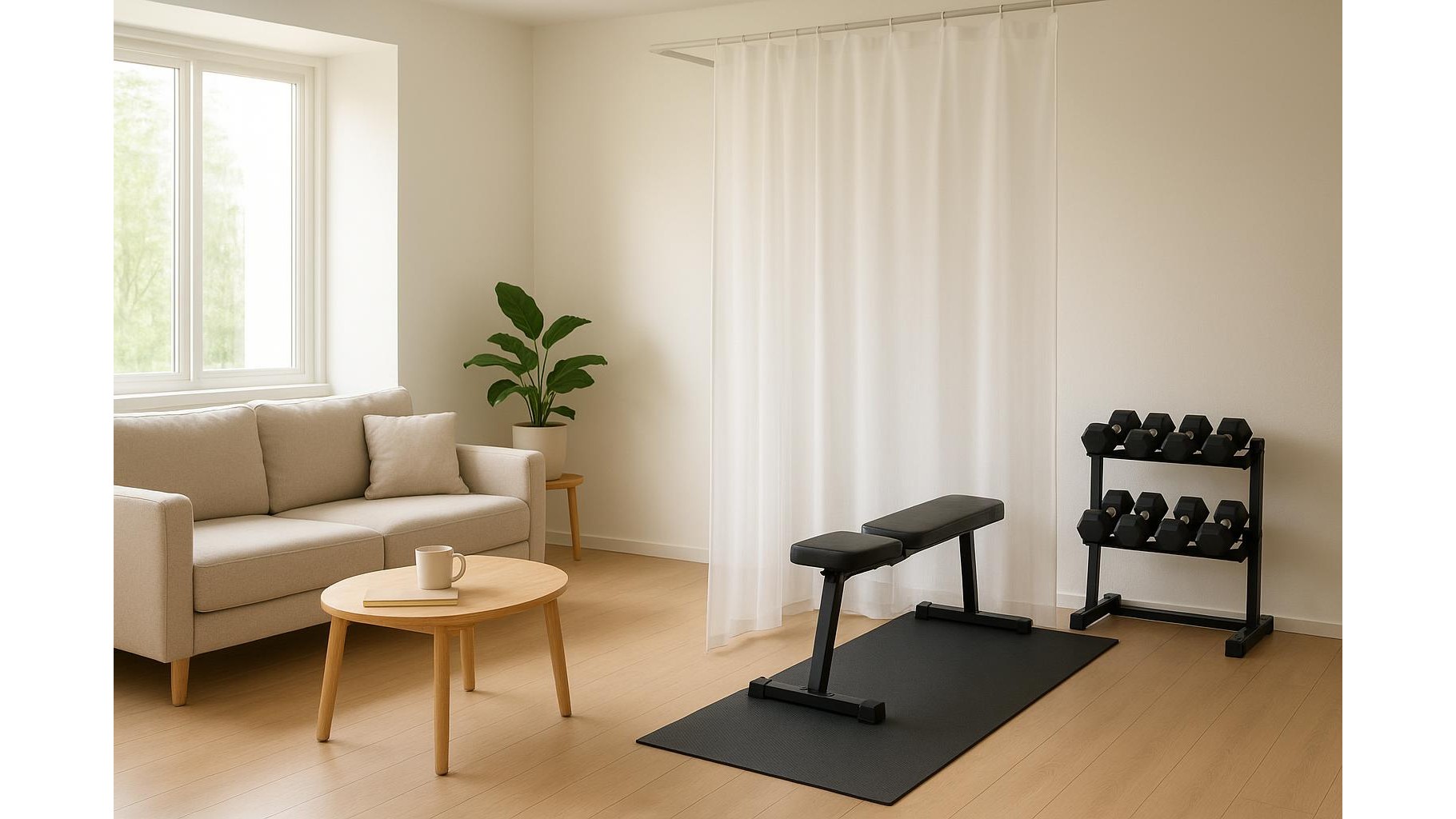
If you truly want to separate a home gym from the living or bedroom area without losing space, ceiling-mounted curtains are often the best solution. A slim curtain track fixed to the ceiling follows the line you want to create – straight or curved – while the curtain itself takes up almost no floor footprint. When closed, a thick but breathable fabric can hide mats and equipment; when open, the curtain stacks neatly to one side. For safety, make sure the track is securely anchored into the ceiling and that the curtain is short enough not to drag under your feet during lunges or dynamic moves. Light-filtering fabrics are ideal: they preserve natural light but still create a sense of privacy and focus while you train.
Balance light, noise and airflow in your gym corner
Whatever room divider solution you choose, keep in mind three comfort factors: light, noise and airflow. Solid partitions can block light and ventilation, which is not ideal for home workouts. Semi-transparent panels, slatted designs and light curtains allow daylight to flow through while still giving the feeling of a separate zone. If noise from weights or music is an issue, consider a slightly thicker fabric or a divider with soft surfaces that can absorb some sound reflections. Avoid placing dividers directly in front of radiators, fans or windows you need for fresh air; instead, offset them slightly so that air can move freely around your training space and keep you comfortable during longer sessions.
Position dividers to keep training safe and functional
Positioning is just as important as the type of room divider you pick. Leave enough clearance around your main equipment for full range of motion: think about the path of a barbell in a press, the reach of your arms in lateral raises or the side-to-side movement during cardio. Dividers should never sit where a falling dumbbell or kettlebell could strike them. Instead, use them along low-risk edges such as behind a bench or to screen storage shelves. If space is very tight, a single panel or curtain that marks just one side of the gym corner can still create a strong visual cue that “this is the workout zone” without boxing you in. The goal is to maintain a clean, organised look while ensuring every movement remains free and safe.
In summary, creating a visually separated home gym inside a shared room is all about smart use of lightweight dividers, folding panels and curtains. By choosing designs that let in light, mounting curtain tracks to save floor area and positioning each element with safety and mobility in mind, you can enjoy a dedicated training corner that feels like its own space without sacrificing comfort or precious square metres in your home.