Setting up a compact home gym that still allows heavy vertical pulls and horizontal pulls can be challenging. A good home cable pulley system solves this by letting you train back, arms and core in a small footprint. In this guide we break down the main types of systems — wall‑mounted, rack‑mounted and door‑mounted — and explain which cable attachments you actually need for a balanced programme.
Table of contents
Understanding what you need from a cable pulley
Before you buy, be clear on your goals and space. For pure strength work with heavy lat pulldowns, seated rows and tricep pushdowns, you’ll want a system that can handle higher loads and smooth movement. If you mainly do light accessory work, face pulls and core drills, a simpler setup is fine. Measure your ceiling height and wall or rack width, and decide where you can safely anchor the system. Also think about whether you want both high pulley (for vertical pulls and pushdowns) and low pulley (for curls, rows and leg work), or are happy with just one position.
Wall-mounted cable systems: stable and versatile
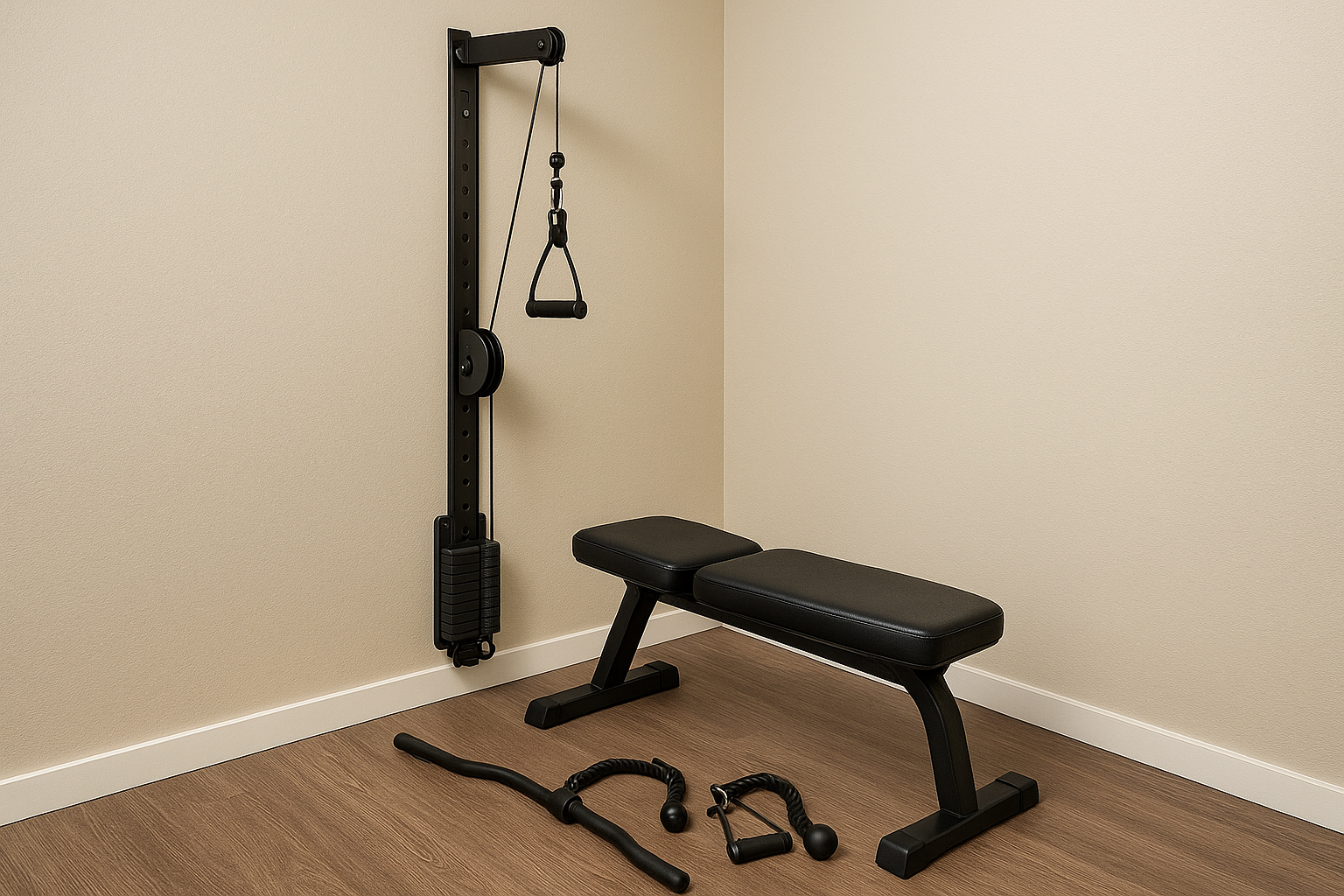
Wall-mounted cable pulley systems are ideal if you have a permanent home gym corner and solid walls. They typically offer a fixed high pulley, and some models add a low pulley for seated rows and curls. Look for thick steel construction, smooth pulley wheels, and a weight capacity that comfortably exceeds your planned loads. A wall mount is great for consistent vertical pulls like lat pulldowns, straight‑arm pulldowns and ab crunches using a rope. The main trade‑off is that installation requires drilling into masonry or reinforced studs, and once it’s up, it isn’t easily moved. For most lifters focused on back and arm work in a dedicated space, this is the most stable, long‑term choice.
Rack-mounted pulley systems: best for existing power racks
If you already own a power rack, a rack-mounted cable pulley system can be the most space‑efficient option. These units attach to the uprights and use either weight plates or a built‑in stack. They allow both vertical pulls and horizontal pulls without needing extra wall space, and many can be repositioned up and down the uprights for different cable angles. Check compatibility with your rack’s height, hole spacing and steel dimensions. A good rack‑mounted setup makes it easy to switch between squats, bench presses and cable work during the same session, turning a simple rack into a complete home gym. The downside is that your rack position dictates where your cable work happens, so planning your layout is essential.
Door-mounted cable systems: portable and beginner-friendly
For very small spaces, rentals or multi‑use rooms, a door-mounted cable pulley can be a practical entry point. These systems loop over or clamp to a sturdy door, letting you perform lighter lat pulldowns, face pulls, tricep work and core rotations. They pack away quickly and don’t require permanent installation, which is ideal for apartments. However, their weight capacity is usually lower, and the feel is less stable than a wall‑ or rack‑mounted system, especially for heavy rows and pull‑downs. They’re best suited to beginners, people focusing on hypertrophy accessories with moderate loads, or anyone who needs a portable cable option that still covers basic back, arm and core movements.
Essential attachments for back, arms and core
Regardless of the mounting style, you only need a handful of cable attachments to build a complete routine. A lat pulldown bar covers wide‑ and close‑grip pulldowns and straight‑arm variations for the lats. A tricep rope handles pushdowns, overhead extensions and cable crunches. A simple single D‑handle lets you perform one‑arm rows, lateral raises, chest flyes and bicep curls. Finally, a short straight bar or EZ‑style bar is useful for curls and pressdowns. With these four pieces you can hit upper back, lats, rear delts, biceps, triceps and core without cluttering your home gym with extra gear you rarely use.
Choosing the right home cable pulley system comes down to matching the mounting style to your space and training priorities. Wall‑mounted and rack‑mounted options suit heavier, long‑term setups focused on powerful vertical and horizontal pulls, while door‑mounted systems favour portability and light accessories. Invest in a solid, smooth‑running unit with just a few well‑chosen attachments and you’ll unlock hundreds of effective back, arm and core exercises in even the smallest home gym.