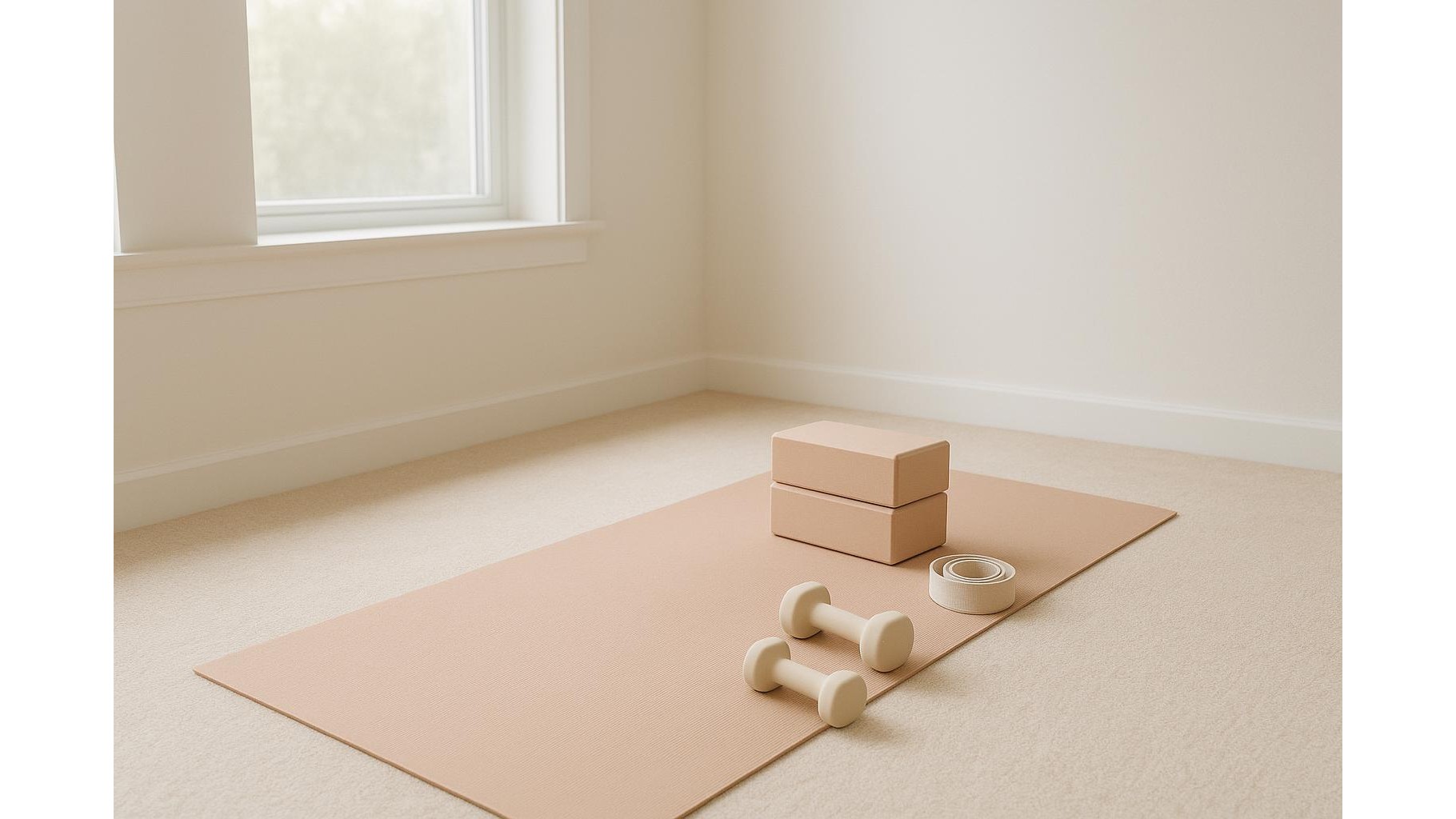
Creating a dedicated home mobility corner is one of the easiest ways to move more, feel better and stay consistent with your stretching. You do not need a full gym: with just a couple of yoga blocks, a stretch strap and a pair of light dumbbells, you can build a compact, mobility‑focused setup that fits in almost any room and budget.
Why a mobility starter kit beats a full home gym
When space and money are limited, a simple mobility starter kit is often more useful than a bulky multi‑station machine. Tools like blocks, straps and light weights support gentle stretching, joint health and posture, which most people need more than maximal strength work. A small flexibility corner is quicker to set up, less intimidating, and easier to keep tidy. You can roll out a mat, grab your props, and be training in under a minute. This simplicity boosts adherence: short, frequent mobility sessions are more sustainable than occasional long workouts.
Choosing yoga blocks for stability and support
Yoga blocks are the foundation of your home mobility bundle. Look for blocks that are lightweight yet firm enough to support your weight in standing and seated positions. Foam blocks are comfortable for beginners and versatile for floor work, while cork models provide extra stability if you are heavier or want a more grounded feel. Ideally, get a set of two blocks so you can elevate both hands evenly in lunges, hamstring stretches and balance drills. Prioritise non‑slip surfaces and standard dimensions so online routines are easy to follow. Store them stacked in a basket or on a shelf: they take up almost no space but dramatically expand what you can do safely.
How to pick the right stretch strap
A good stretch strap lets you access positions that would otherwise be uncomfortable or impossible. Opt for a woven cotton or nylon strap with several loops or a buckle so you can adjust tension without wrapping it around your hands. This design helps you maintain better alignment in hamstring stretches, shoulder openers and hip mobility drills. For tight shoulders, a longer strap is more forgiving; if you mostly train lower‑body flexibility on the floor, standard lengths are enough. Choose a bright colour so it is easy to spot among your gear and roll it up after use: it fits in a drawer yet becomes one of the most impactful tools in your home flexibility corner.
Light dumbbells for controlled, joint‑friendly movement
Light dumbbells in the 1–3 kg range are perfect for mobility‑focused training because they encourage controlled, long‑range motion rather than brute force. Use them for shoulder CARs (controlled articular rotations), arm circles, lateral raises through a pain‑free range and slow core work. For most beginners, a pair around 1–2 kg is enough to add feedback and stability without causing tension in the neck and upper traps. If you share the kit with someone stronger, consider two pairs at different weights. Compact neoprene or vinyl‑coated models are kind to floors, easy to wipe down and stack neatly in a small box or basket beside your mat.
Bundle ideas for different budgets and spaces
You can scale your home mobility starter kit to your budget and available space. On a tight budget, start with one strap and a single block; you can still modify dozens of stretches and gradually add a second block and light dumbbells later. With a mid‑range budget, aim for two quality blocks, a looped strap and one or two pairs of dumbbells. If you have a little more room, add a thick mat and a small storage crate so your flexibility corner always looks tidy and inviting. The key is to keep the footprint minimal: your entire kit should fit into a corner or under a desk while still covering all major joints and movement patterns.
Simple routines to get the most from your kit
Once your tools are in place, build short daily routines around them. For example, a 10‑minute session could include block‑assisted lunges for hip flexors, hamstring stretches with the strap, gentle shoulder rotations holding light dumbbells and a supported chest opener lying over a block. Aim for slow breathing and control rather than intensity. Consistency is more important than complexity: even two or three sets of five deep breaths in each position, performed most days, will improve your mobility, posture and comfort at the desk. Over time, your small flexibility corner becomes a powerful daily habit, proving that you do not need a huge gym to move and feel better.
In summary, a compact home mobility starter kit built around yoga blocks, a stretch strap and light dumbbells offers a low‑cost, space‑saving way to prioritise flexibility and joint health. By choosing stable blocks, an adjustable strap and comfortable light weights, you create a corner that invites regular practice and supports your body through progressive, sustainable mobility work.