Adding a battle rope to your home gym is one of the most effective ways to get full‑body conditioning in a very small footprint. With just a few metres of space and a solid anchor, you can train power, endurance and core stability without machines. The challenge, especially in compact flats or garage gyms, is choosing the right rope length, thickness, material and anchor solution so you get maximum benefit without drowning your floor in heavy cable. This guide walks you through the key decisions for small spaces and suggests budget‑friendly options available on Amazon UK.
How battle rope length works in a small home gym
The classic commercial setup uses 15 m ropes, but that is rarely realistic in a home gym. For tight spaces, look at 9–12 m battle ropes (often sold as 30–40 ft). Remember that half the rope is on each side of the anchor, so a 9 m rope needs roughly 4–4.5 m of clear floor length. If your training area is shorter, you can run the rope on a slight diagonal or around a heavy base to save space. Shorter ropes feel more “twitchy” and less fluid, but are still excellent for high‑intensity intervals. Prioritise a length that allows a full wave motion without hitting furniture or walls, even if that means going slightly shorter than you see in commercial gyms.
Choosing rope thickness and weight for your goals
The two most common diameters are 1.5 inch (38 mm) and 2 inch (50 mm). In a home setting, especially where storage and fatigue are concerns, 1.5 inch is usually the smarter choice. It is lighter, easier to grip for smaller hands and more versatile for longer conditioning sets. Thicker 2 inch ropes create huge waves and tax the forearms, but they are better suited to strong athletes who want short, heavy power intervals. In small spaces, you will often perform shorter, more frequent bouts of work, so an excessively heavy rope may limit your training variety. Look for heat‑shrink or rubber‑coated handles at each end to improve grip and extend the life of the rope.
Best materials and construction for home use
Most quality home battle ropes are made from polypropylene or poly‑dacron blends. These synthetics are durable, resist fraying and are far less messy than traditional manila, which sheds fibres and absorbs moisture. For an indoor home gym, a poly blend with a tight braid is ideal because it glides smoothly on the floor and is easier to coil and store. Check that the rope has sealed or capped ends and, if possible, a light protective sleeve over the section that contacts the floor or anchor. While you will find budget ropes that are slightly lighter, avoid ultra‑cheap options with loose braiding, as they kink easily and make wave work frustrating in a confined space.
Smart anchor options when you don’t have a dedicated rig
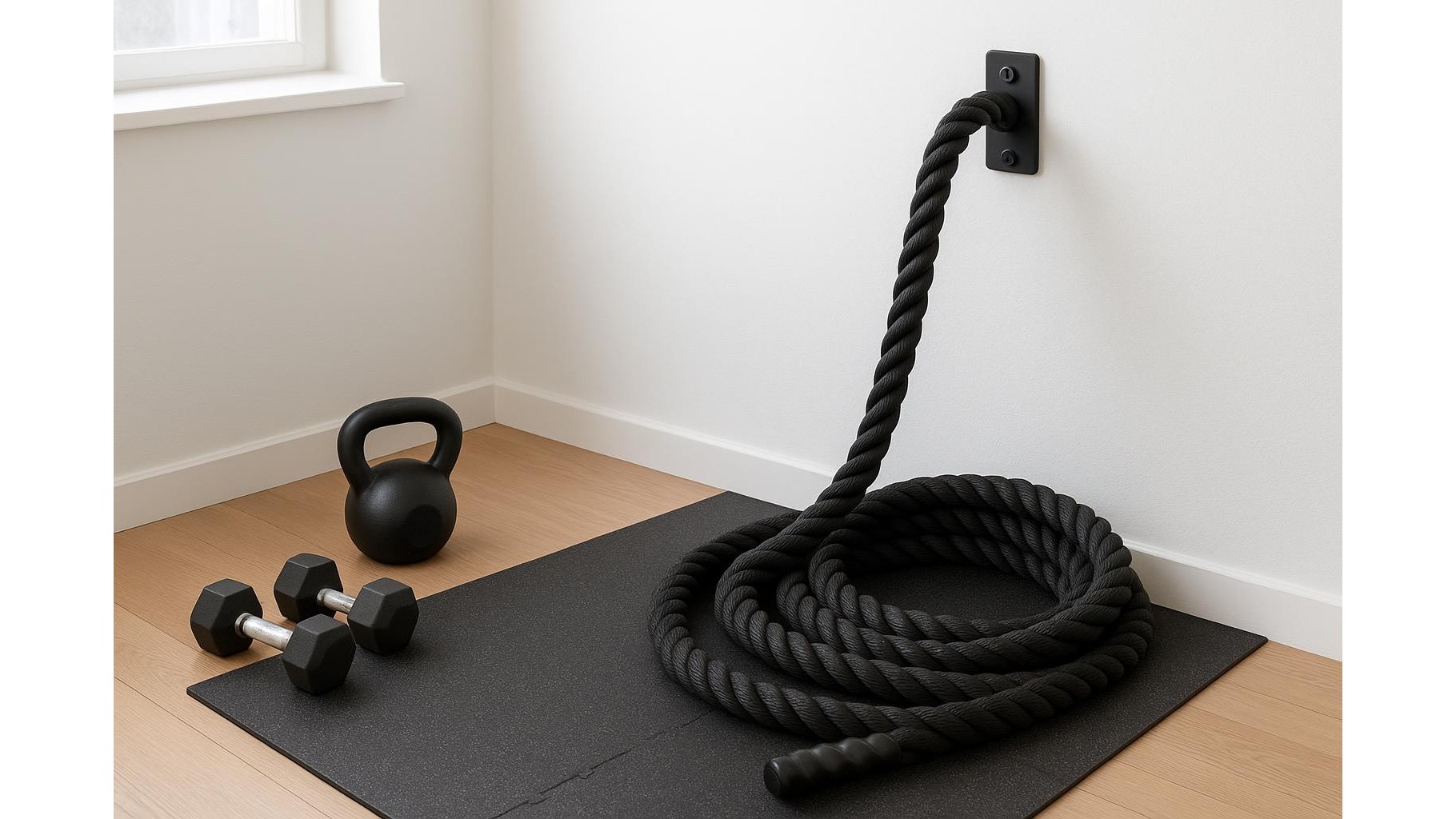
In a small home gym, the anchor solution is often more important than the rope itself. The simplest option is a wall‑mounted or floor‑mounted anchor bracket fixed into solid masonry or structural timber; this takes very little room and keeps your training zone tidy. If you rent or cannot drill, you can loop the rope around a heavy, stable object like a power rack, weight tree or loaded sled. Some kits include a fabric anchor strap that wraps around pillars or posts and protects the rope from abrasion. Always set the anchor at floor level or just above so the waves travel cleanly, and make sure there is no sharp edge that could cut into the rope. For multi‑use rooms, choose a low‑profile anchor that you can tuck behind furniture when not in use.
Fitting battle rope training into a compact home routine
Once you have the right length, thickness and anchor, you can integrate battle ropes into almost any home workout. In tight spaces, prioritise short, intense intervals: 15–30 second rounds of alternating waves, double waves and slams, paired with bodyweight moves like squats or push‑ups. Because the footprint is essentially the rectangle in front of your anchor, you can place the rope along one side of a room and still have space for dumbbells or a bench. Coil the rope neatly when you are done to avoid trip hazards and to protect the fibres. Over time, you can progress by adding intervals, switching to more demanding patterns like side‑to‑side waves and circles, or—if you outgrow your current setup—upgrading to a slightly longer or thicker rope.
Choosing the right home gym battle rope for a small space comes down to a few smart compromises: slightly shorter length for better manoeuvrability, manageable thickness for your grip strength, durable synthetic materials and a compact yet solid anchor. With these boxes ticked, you can unlock powerful conditioning sessions without dedicating an entire room to equipment. A well‑chosen rope turns even a narrow strip of floor into a high‑intensity training lane, making your compact home gym feel far more versatile.