Building a home gym that actually supports long-term progress does not have to mean heavy racks and stacks of plates. A well-chosen color‑coded resistance band set can deliver full‑body strength training, clear progression from beginner to advanced, and easy storage in even the smallest space. The key is understanding how band colours translate into resistance, how to organise them like a barbell with different plates, and how to use accessories to safely load every major movement pattern.
Table of contents
Why colour‑coded resistance bands work for progressive overload
Strength gains come from progressive overload: gradually increasing the resistance your muscles must overcome. Color‑coded resistance band sets make this visual and intuitive. Each colour represents a different tension range, so you can move up or down just like changing plates on a barbell. For beginners, lighter bands allow you to learn movement patterns with good technique. As you improve, you can step up to a darker, heavier colour or combine two bands to fine‑tune the load. This lets you avoid plateaus while keeping joints happy, since bands provide variable resistance that is easier at the bottom of a lift and harder near lockout, where you are mechanically stronger.
How to choose a colour‑coded set that suits your goals
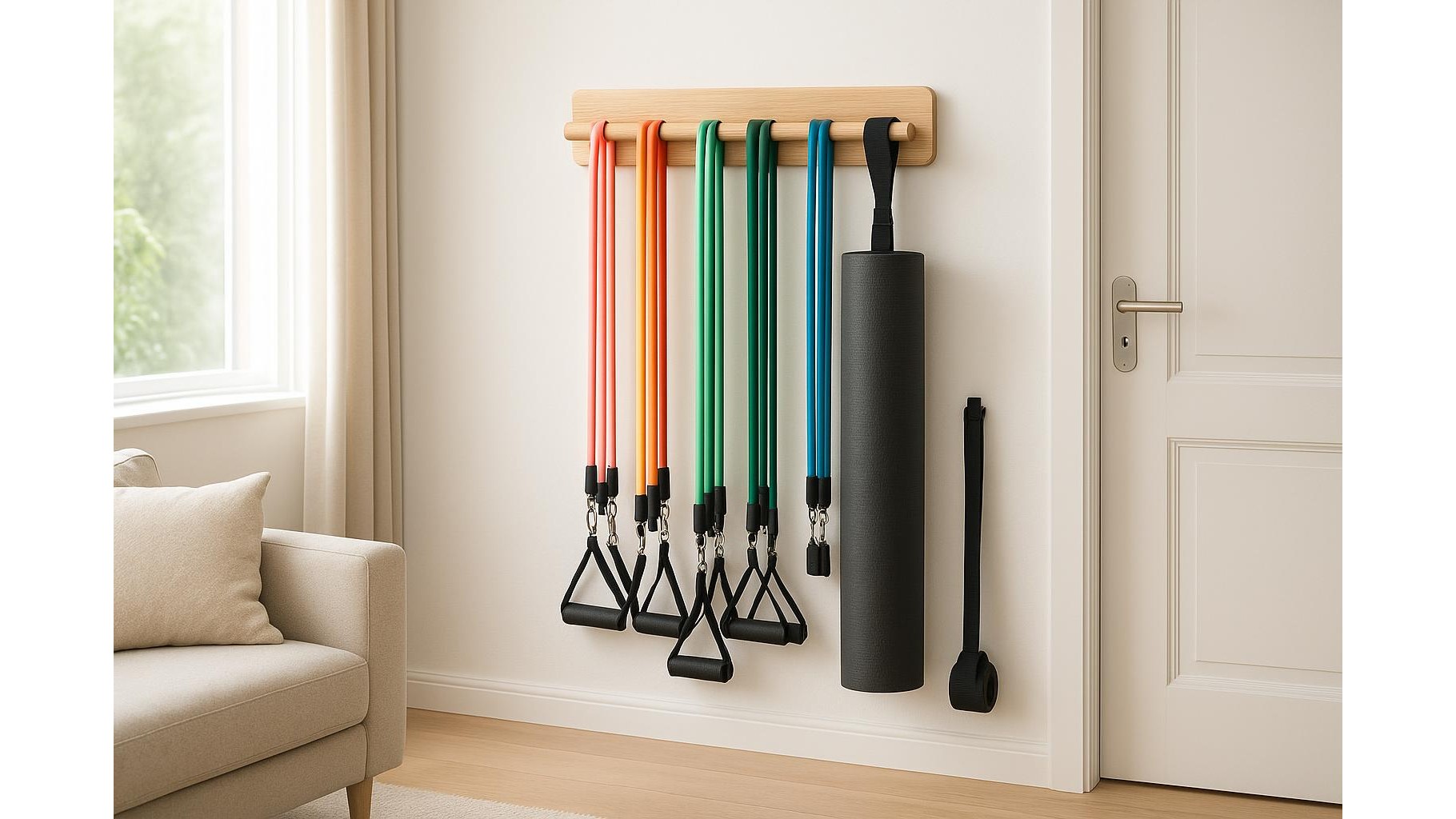
When selecting a resistance band set for your home gym, prioritise a wide range of tensions, durable materials and practical accessories. A good starter bundle should include several loop bands at different strengths plus handles, ankle straps and a door anchor, so you can train both upper and lower body. Look for clear labelling (colour plus estimated kg or lb of tension) and latex or premium synthetic rubber that resists snapping and overstretching. If you plan to progress towards heavier strength work, ensure the heaviest band is genuinely challenging for rows, presses and squats; you should not outgrow your heaviest band within a few weeks of consistent training.
Organising your bands like a mini barbell system
To turn your bands into a progressive system, treat each colour as if it were a specific weight plate. First, arrange bands from lightest to heaviest on a wall hook or in a labelled box, so you always know your progression order. Then assign each colour a simple rating (for example: yellow = very light, red = light, green = medium, blue = heavy, black = very heavy). For each exercise, note in a training log which colour or colour combination you used and how many reps you completed. Over time, aim to either increase reps with the same colour or move up to the next heavier colour at the same rep range. This habit transforms a pile of random bands into a structured progressive overload tool, comparable to a well‑programmed barbell routine.
Designing full‑body band workouts from beginner to advanced
A full‑body band programme should cover all major movement patterns: squat, hinge, push, pull and core. Beginners can start with lighter colours for banded squats, glute bridges, seated rows, chest presses against a door anchor, and standing anti‑rotation holds for the core. Intermediate and advanced lifters can progress to heavier colours and more complex moves like single‑leg RDLs, unilateral presses, face pulls and band‑assisted pull‑ups. Use simple rep targets such as 3 sets of 8–12 reps, increasing resistance when you can comfortably exceed the top end of the range. Rotate exercises every 6–8 weeks to avoid plateaus, but keep tracking your band colours so you clearly see strength improvements across cycles.
Safety, maintenance and getting the most out of your bands
To keep your color‑coded bands reliable and safe, inspect them regularly for cracks, thinning or fraying, especially around anchor points. Avoid sharp edges and always set your door anchors at solid hinge sides or structural posts. Store bands away from direct sunlight and extreme heat to prevent material fatigue. During workouts, maintain control through the entire range of motion and avoid letting the band “snap” back to start. For convenience and adherence, keep your most‑used colours easily accessible so you can train quickly, even on busy days. With consistent care and smart programming, a small set of resistance bands can provide years of progressive, joint‑friendly strength training at home.
In summary, color‑coded resistance band sets offer a compact, affordable way to build a structured home gym system from beginner to advanced. By choosing a set with a broad tension range, organising colours like weight plates, and logging which bands you use for each exercise, you create a clear path for long‑term progression. Combine that with full‑body programming, good technique and simple maintenance, and you can develop strength, mobility and muscle effectively without ever needing bulky equipment.