Most home lifters collect endless tabs, screenshots and bookmarked threads about home workouts, mobility drills and nutrition tips. Then, when it is time to train, all that content is impossible to find. By using read-it-later apps like Pocket and Instapaper as a structured library, you can turn scattered fitness content into a searchable system that directly supports your home training plans.
Why read-it-later apps are perfect for fitness content
Apps such as Pocket and Instapaper are built to capture articles, videos and guides from across the web and keep them in one place. For a home gym athlete, this means every workout article, mobility routine, kettlebell guide or recovery piece can live inside a single, organized library. Instead of letting social media algorithms decide what you see, you create a personal database of proven resources that match your goals: strength, fat loss, hypertrophy, or general health. The offline reading features also help you review training material during commutes or pre‑session warm‑ups, without distractions.
Setting up your tag system for home workouts
The real power of these apps is in tagging. Start by creating a simple tag framework around your home gym and goals. For example: “full-body”, “kettlebell”, “dumbbell”, “bodyweight”, “mobility”, “warm-up”, “conditioning”, and “programming”. Whenever you save a new article, assign two or three tags that describe equipment, training focus and level (e.g. “beginner” or “intermediate”). Over time, this turns your read-it-later account into a filterable training library, where you can instantly pull up all bodyweight-only conditioning sessions or all dumbbell strength workouts that fit the gear you have at home.
From saved articles to structured training plans
Saving content is only half the job; the goal is to turn that content into actual workouts. Once a week, schedule a short “library review” session. Open your app, search for a specific tag like “full-body” or “kettlebell”, and pick two to four articles that look most relevant. Extract the key points: exercise list, sets, reps, rest times and any coaching cues. Add these into your written program, a spreadsheet or a training planner app. You can even create a dedicated tag like “plan-ready” for articles you have already converted into usable sessions, so you do not waste time re-reading the same material every week.
Review rituals and bookmarking what actually works
Over months of training, some articles will become staples while others prove less useful. Use bookmarks, favourites or an extra tag such as “go-to” or “proven” to mark the workouts that have genuinely delivered results in your home gym. During your weekly or monthly review, archive or retag anything that is outdated, overly complex or not aligned with your current goals. This regular curation keeps your fitness library lean and practical. When you have only limited time between work and family, opening your app to a clean list of tried-and-tested routines is far more motivating than scrolling through hundreds of half-read links.
Linking your training library with your home gym space
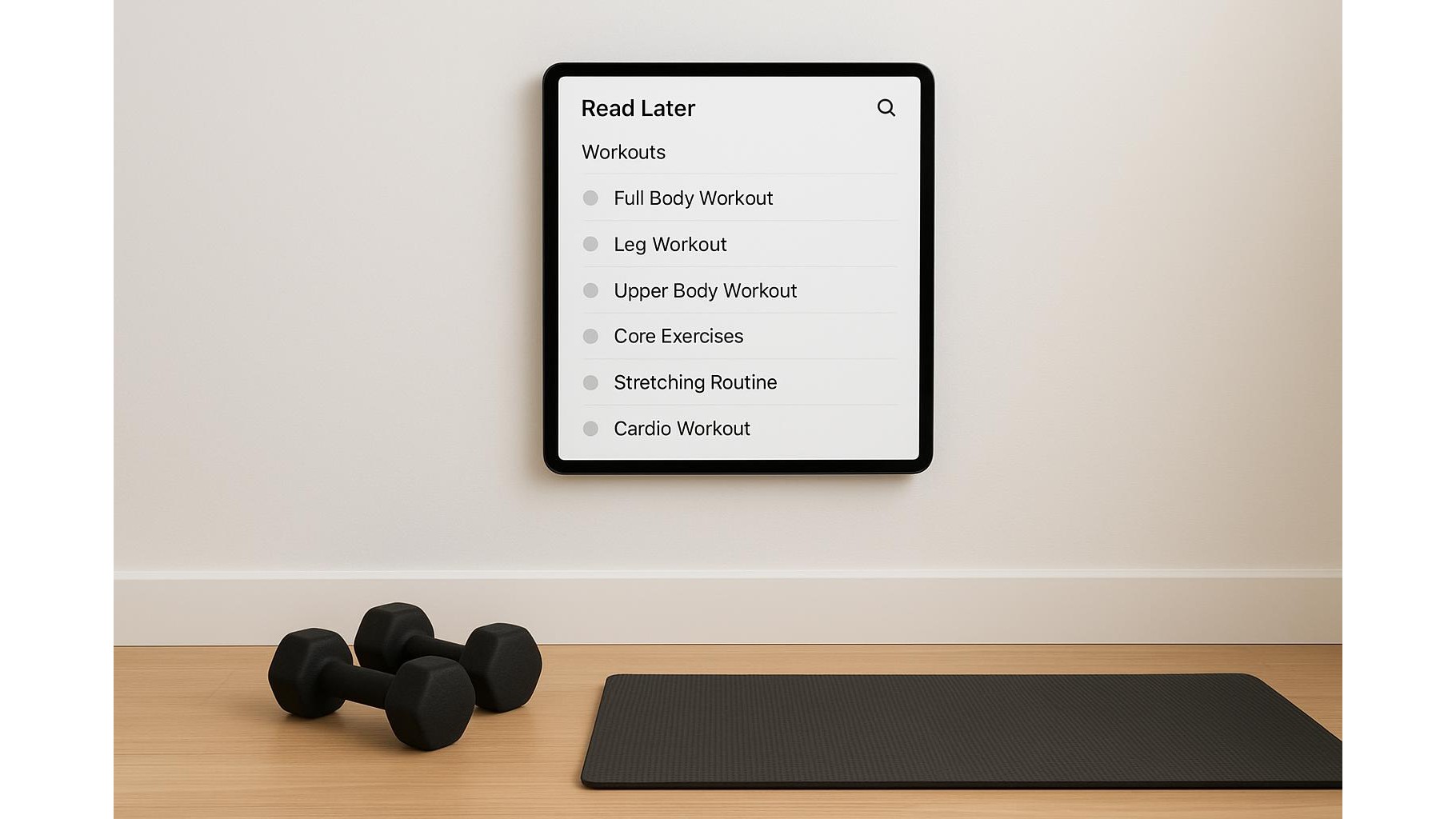
To make your digital library visible in your physical space, consider printing a few of your best routines or summarising them onto one-page sheets and storing them near your equipment. You can also keep a tablet or old smartphone docked in your home gym, logged into your read-it-later app, with a default view filtered by a tag like “this-week”. Before each session, open the app, filter by the appropriate tag (for example “upper-body” or “conditioning”), and choose your workout. This bridge between digital organization and real-world training helps you act on the information you have collected instead of just consuming more of it.
By turning Pocket, Instapaper and similar tools into a structured training library, you move from passive reading to intentional practice. Clear tags, regular reviews and a simple link between your devices and your home gym equipment ensure that the best articles you find are always ready to be used in your next session, not buried in an endless scroll of forgotten content.