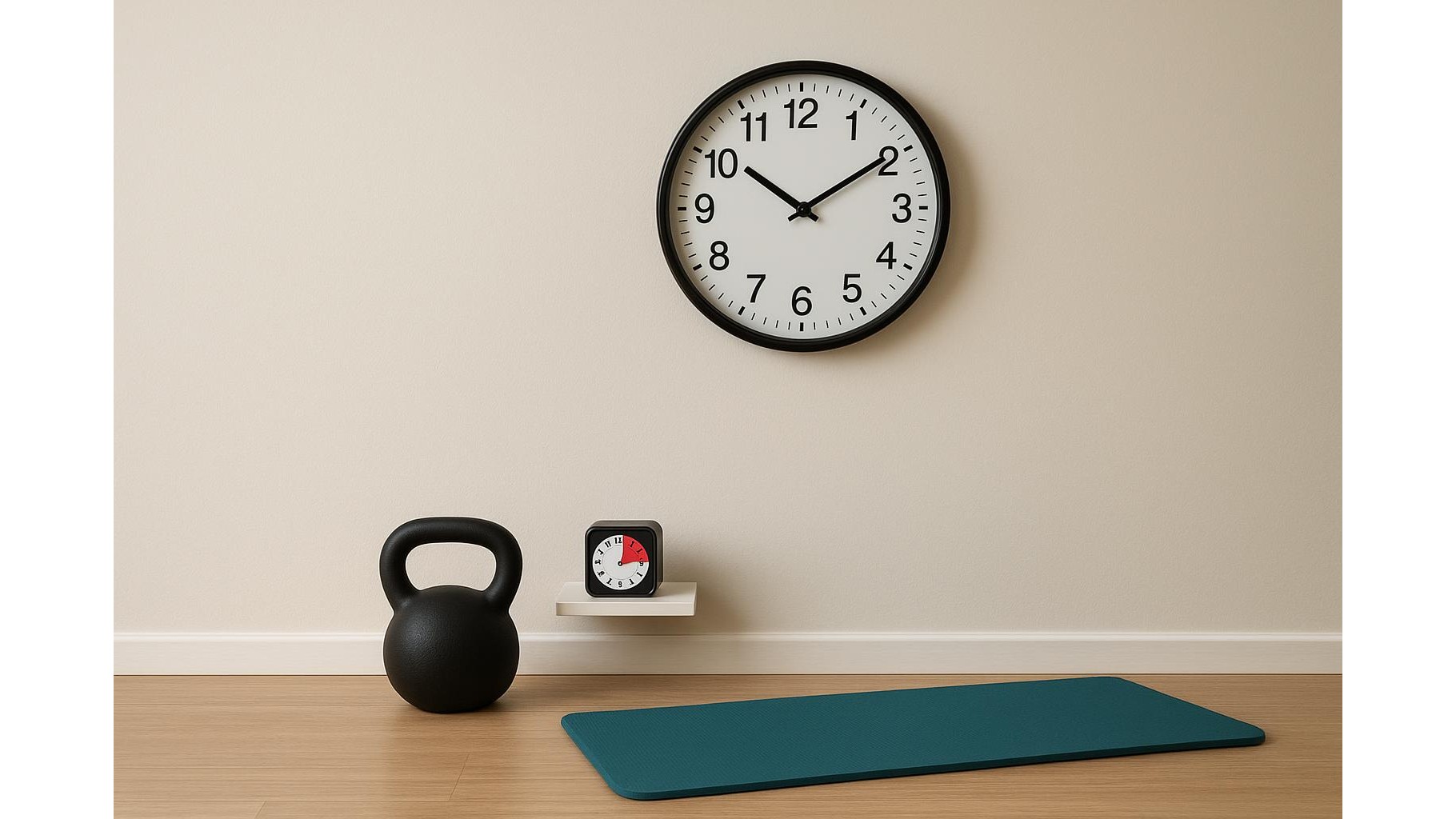
Combining a simple interval timer cube with a basic analog wall clock is one of the easiest ways to bring structure to your home workouts without relying on complex apps or screens. By pairing a tactile cube timer for short work–rest blocks with a clear clock for tracking minutes and tempo, you can run EMOM sessions, tempo strength work, and rest-controlled circuits that feel almost like training in a coached class—using tools that are robust, affordable and distraction-free.
Table of contents
Choosing a simple cube timer for EMOM and intervals
A basic workout cube timer is ideal for at-home interval training because it gives you preset durations with zero setup. You simply flip the cube so the desired time faces up, and it starts counting down automatically. Look for a cube with common gym-friendly intervals such as 15, 30, 45 and 60 seconds, or 30, 60, 90 and 120 seconds; these cover most HIIT, tabata-style and strength accessory blocks. A compact plastic body is durable enough for garage use, and large printed numbers are easy to see mid-set. Compared to a phone app, a cube timer reduces screen time, avoids notifications and keeps your focus on movement instead of menus.
Picking an analog wall clock that works in a home gym
To complement your cube, mount a clear analog wall clock where you can see it from your main training area. Prioritise large, bold numerals and high-contrast hour and minute hands so that checking the time is effortless between sets. A quiet or “sweep” second hand helps if you train early or late and want to avoid ticking noise. In a home gym, a lightweight plastic frame and glass or acrylic front are practical, and battery operation keeps things simple. The analog face makes it intuitive to track tempo work—for example, lowering a weight over exactly three seconds—as well as total session time and long rest periods between heavy sets.
Running EMOM and short intervals with cube + clock
To run an EMOM workout (Every Minute On the Minute), use your analog clock to track minutes and the cube timer to manage work duration inside each minute. Start your EMOM when the clock hits a full minute (e.g., 10:00). Immediately flip your cube to 30 seconds and perform the prescribed reps until the cube beeps. Once the beep sounds, you rest for the remainder of the minute while watching the wall clock. At the next full minute, repeat. This combination makes pacing natural: the cube governs how long you work; the clock governs when each round starts. For more advanced structures—like 40 seconds work, 20 seconds rest—just keep flipping the cube for work and use the clock to monitor the total number of rounds.
Using the wall clock for tempo strength and long rests
For strength-focused home sessions, the analog clock becomes your main tool, while the cube may stay idle. To perform tempo squats or presses, fix your eyes on the second hand: lower the weight over a strict three to five seconds, pause for one second at the bottom, then drive up over one to two seconds. This simple visual anchor promotes consistent tempo from set to set. For heavy barbell or dumbbell lifts, use the minute hand to enforce 2–3 minute rest periods, preventing you from starting too early just because you “feel ready”. Over time, this disciplined rest control improves performance and makes your training more repeatable and measurable.
Designing rest-controlled circuits at home
A powerful way to use both tools is to build rest-controlled circuits. For example, choose three exercises—push-ups, kettlebell swings and reverse lunges. Use the cube to set 30 seconds of work per station: flip it, work until the beep, then immediately transition. After one full round of the circuit, look at the wall clock and rest exactly two minutes before repeating. The cube maintains intensity inside each block, while the clock enforces recovery between rounds. This hybrid approach works well for limited equipment home gyms and can be scaled by adjusting cube intervals (e.g., 20 or 40 seconds) and clock-based rest (shorter for conditioning, longer for strength endurance).
Keeping structure without complex technology
Using a simple timer cube and a basic wall clock together creates surprisingly robust structure for home gym workouts. The cube handles micro-timing—short work and rest bouts—so you do not need to tap screens or configure intervals, while the analog clock controls macro-timing—EMOM starts, tempo counts and long rests. This combination keeps your environment low-tech and focused, yet still highly organised. With just these two tools, you can run effective EMOMs, tempo strength blocks and rest-controlled circuits that rival much more complex app-driven setups, all while keeping your attention where it belongs: on quality movement and progressive overload.