Setting up a tiny home gym is all about maximizing every centimetre, and your Bluetooth speaker is no exception. You need enough volume and clarity to power through your workouts without annoying neighbours or drowning out online trainers. At the same time, your speaker has to cope with sweat, the occasional splash from a water bottle and constant Bluetooth connections to phones, TVs and fitness apps. This guide shows you what to look for in a compact Bluetooth speaker that really works in a small workout space.
Prioritise sound quality at low and medium volume
In a small room you rarely need full blast, but you do need clear sound at low volume. Look for speakers that mention a balanced sound profile, good bass at modest volumes and low distortion. Tiny units often overemphasise treble, which can make HIIT timers and coach voices sound harsh. Instead, choose a compact model with at least a 5W–10W driver and, ideally, a passive radiator for bass so music still feels motivating even at neighbour‑friendly levels. Avoid speakers that only sound good when turned up; user reviews that mention “surprisingly full sound for the size” at normal volume are a good sign for a small home gym.
Check splash and sweat resistance ratings
In a home workout space, your speaker will be exposed to sweat, humid air and the odd water bottle mishap. Look for an IP rating such as IPX4, IPX5 or higher. IPX4 protects against splashes from any direction, which is usually enough if the speaker sits on a shelf away from direct spray. If your gym corner is near a bathroom or you train with windows open, consider IPX7 so the speaker can survive being knocked into a puddle. A rubberised exterior and covered ports add an extra layer of security, making the speaker easier to grip with sweaty hands and more durable when moved around between yoga mats, dumbbells and resistance bands.
Battery life and charging in a multi‑use space
Because a tiny home gym often doubles as an office or bedroom, your speaker will likely be moved and used for different tasks. Focus on battery life that comfortably covers your longest training days: 8–12 hours is ideal so you do not have to recharge after every session. Check whether the manufacturer quotes battery life at 50% volume; in a small room, you will often listen below that, which means you can expect even longer real‑world use. USB‑C charging is more convenient than older micro‑USB ports and lets you share cables with modern phones and laptops. If your workouts rely on strict timing, avoid speakers that keep playing while charging but add audible interference or fan noise from cheap power bricks.
Mounting, placement and avoiding clutter
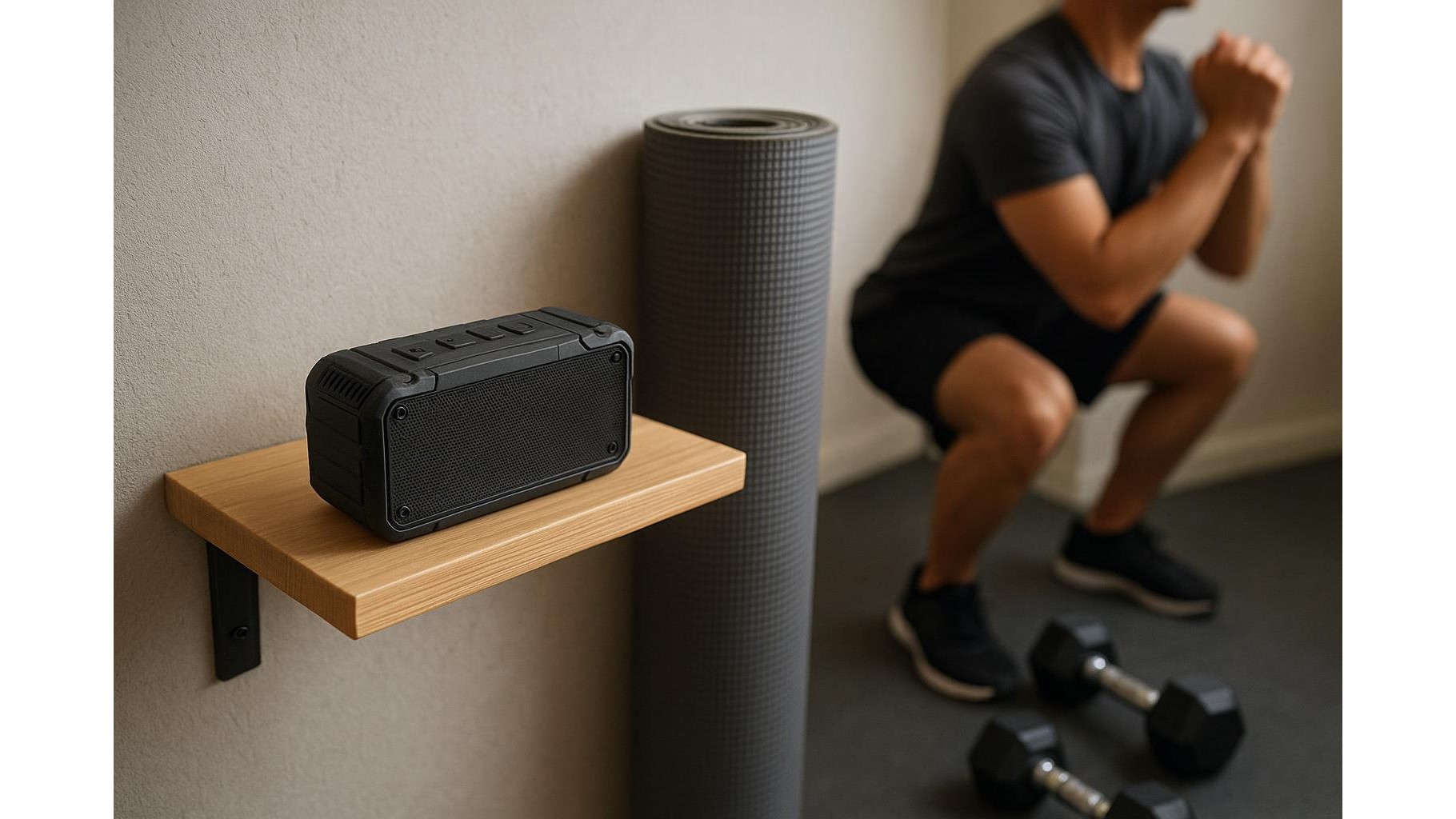
Space is precious in a compact workout area, so think about mounting options before buying. A speaker with a built‑in strap, hook or threaded insert can hang from a wall rack, pull‑up bar or shelving unit, freeing the floor around your mat and weights. Flat, rubberised bases are helpful if you place the speaker on a narrow windowsill or desk, reducing vibration when you crank up the bass for cardio sessions. Position the speaker at ear level where possible; in a very tight room, angling it slightly away from walls can reduce boomy reflections and keep coach instructions intelligible. Lightweight designs are easier to reposition as you switch from yoga flows to strength circuits without adding clutter or trip hazards.
Bluetooth connections, latency and app compatibility
For a home gym Bluetooth speaker, a stable connection is just as important as sound. Choose a model with Bluetooth 5.0 or newer for better range and more reliable pairing in apartments crowded with devices. If you follow workouts on a smart TV or tablet, look for low‑latency performance so music and trainer cues stay in sync; user reviews that mention minimal lag with video streaming are useful here. Multi‑point pairing is handy if you switch between a phone for music and a laptop or TV for guided classes. To avoid connection issues, keep your speaker away from Wi‑Fi routers and thick walls, and clear old pairings from the device memory if it struggles to reconnect. A simple control layout on top of the speaker lets you pause, skip tracks and adjust volume mid‑set without hunting for your phone.
When choosing a Bluetooth speaker for a tiny home gym, focus on what really matters in a small, multi‑purpose space: strong low‑volume sound, basic splash resistance, dependable battery life and practical mounting or placement options. Combine that with up‑to‑date Bluetooth standards and sensible positioning to minimise connection hiccups with your phone, TV and favourite fitness apps. With a little planning, a compact speaker can transform even the smallest workout corner into a motivating, clutter‑free training zone.