Creating a powerful upper-body cardio routine at home is easier than ever thanks to compact ellipticals with moving arms. These machines combine lower-body pedalling with push–pull handles to work your chest, back, shoulders and arms, all while protecting your joints. The challenge, especially in flats and small houses, is finding a model that actually fits your space, your ceiling height and your noise limits. This guide walks you through the key specs to check and shows how to turn a compact elliptical into a true full-body cardio station in your home gym.
Why choose an elliptical with moving arms for small spaces
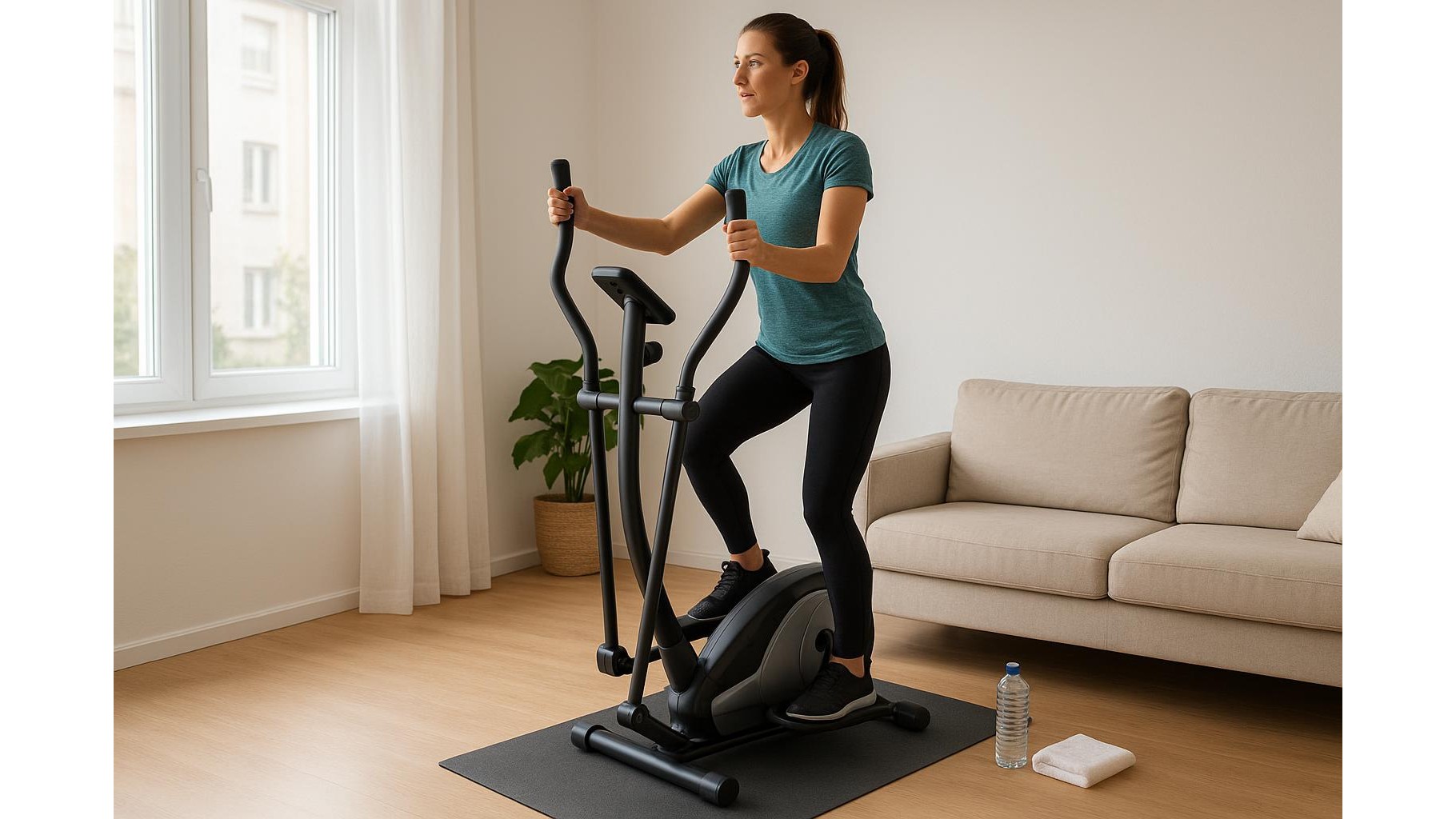
Ellipticals with moving handles are ideal if you want low‑impact full‑body cardio in a tight footprint. Unlike treadmills, they have no belt that overhangs into the room, and unlike rowers they do not need as much horizontal space. The coordinated leg stride and arm motion increase calorie burn and help build endurance in your upper body without loading your joints the way running or heavy bag work can. For example, a compact home cross trainer can give you continuous resistance for the legs while the moving arms target the upper back and shoulders, making it easier to maintain intensity even at lower speeds. If you live in a flat, a smaller elliptical is also easier to position in a corner or along a wall and often runs quieter than budget treadmills, which is kinder to neighbours.
Key specs to check: size, stride length and weight capacity
When you shop for a compact elliptical cross trainer, the first specs to check are the footprint and stride length. Measure the area where you plan to train and compare it with the manufacturer’s length and width; look for models under about 130 cm long if you are truly tight on space. At the same time, do not go ultra‑short on stride: anything below roughly 30–35 cm can feel choppy for taller users and may turn into more of a stepper than a fluid elliptical. A balanced choice is a machine that keeps the footprint compact while still offering a natural, elliptical path. Also look at the maximum user weight, aiming for a rating that comfortably exceeds your own body weight for long‑term stability. Extra features such as transport wheels make it easier to roll the trainer away after workouts, which is crucial if your living room doubles as your home gym.
Handle and upper‑body design: getting real arm engagement
Not all moving arms are equal when it comes to upper‑body engagement. Study the handle design and hand positions before you buy. Ideally, the elliptical will have long, curved handles that let you push and pull at chest height without hunching your shoulders. Multiple grip options help you vary muscle emphasis between chest, back and triceps. Fixed side handles are useful for warm‑ups and for users who occasionally want to isolate the lower body. Check that the arm motion remains smooth at higher resistance levels and that the linkage feels solid rather than wobbly, as flexy arms will absorb power and reduce the training effect. If you plan to integrate interval training, a machine with quickly adjustable resistance—either manual or electronic—makes it easier to alternate heavy upper‑body pushes with easy recovery phases.
Noise levels, resistance system and ceiling height issues
In small homes and flats, noise control is non‑negotiable. A magnetic resistance system is usually quieter and smoother than older friction systems, especially at higher speeds. Heavier flywheels tend to create a more stable feel with less vibration, which reduces rattling through the floor. Place the elliptical on a thick rubber mat to dampen sound further and protect your flooring. Ceiling height is another deal‑breaker many buyers overlook. Stand on the highest point of the pedals and add your own height, then compare that total with your room’s ceiling. In low basements or lofts, choose a model with a lower step‑up height to avoid feeling cramped or brushing the ceiling. Positioning the trainer away from light fittings or sloped ceilings will make workouts feel less claustrophobic and more natural.
Turning a compact elliptical into a full‑body cardio station
Once you have chosen the right elliptical, you can turn it into a dedicated home cardio station without needing a separate room. Place the machine along a wall near a power socket if it needs electricity, and keep a small rack or basket nearby with essentials: a heart‑rate monitor, resistance bands, a mat and a towel. Use the moving arms actively instead of just resting your hands on them; think about pushing through the palms and pulling with the mid‑back to keep the upper body working throughout the session. Mix steady‑state rides with intervals where you increase resistance for 30–60 seconds and drive hard with the arms. Between intervals, you can step off onto your mat for quick strength moves like push‑ups or band rows, then jump back on. This way, even in a studio flat, your compact elliptical becomes the centrepiece of a smart, space‑efficient full‑body workout.
In summary, choosing an elliptical with moving arms for a small home gym is about balancing compact size with effective stride length, solid handle design and quiet performance. Measure your available floor space and ceiling height, check weight capacity and resistance type, and think about how actively you want to involve your upper body. With the right setup and a few smart accessories, even a modest corner of your living room can become a powerful upper‑body cardio zone that supports regular, low‑impact training at home.