Choosing the right elliptical cross trainer for your home gym goes far beyond price and brand. The most important comfort factor is stride length: get it wrong and every session will feel awkward, strain your joints and waste your investment. Combine this with suitable handle positions and a compact footprint, and you get a machine that feels natural to use and actually fits your room. This guide walks you through how stride length works, how to match it to your height, and what to look for when you are training in a limited home space.
Why stride length matters more than you think
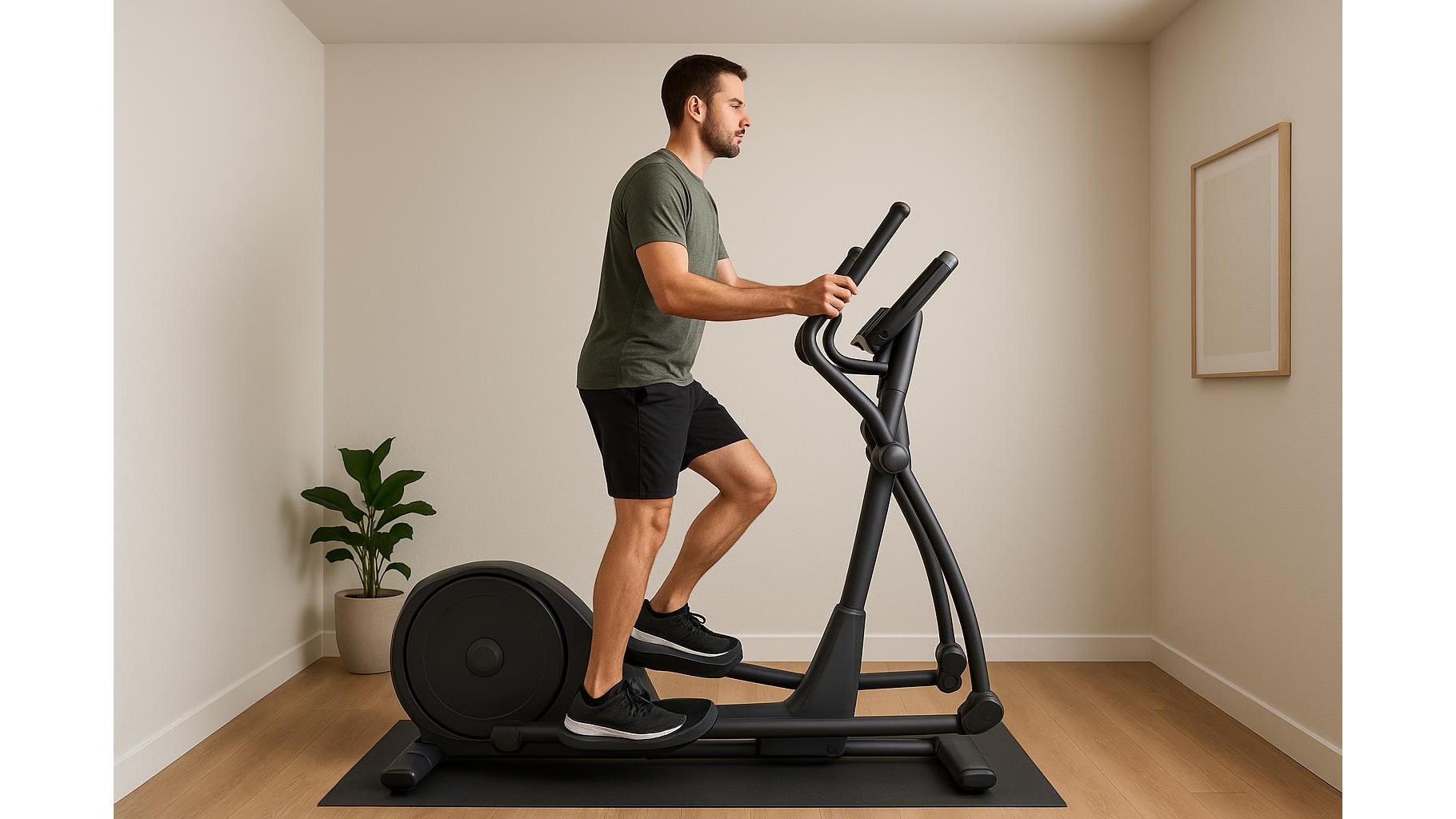
On an elliptical, stride length is the distance your foot travels from the back of the movement to the front. If the stride is too short for your height, your motion becomes choppy and more like stepping on a stair climber than gliding. This can overload your knees and hips and make longer workouts uncomfortable. If the stride is too long, you may overextend at the hips and lower back, which can cause soreness and force you into an awkward posture as you reach for the pedals. A correctly matched stride length lets you maintain a natural running or brisk walking pattern with a slight bend in your knees at the farthest point forward, helping protect your joints while keeping your workouts smooth and low impact.
How to match stride length to your height
As a rule of thumb, users under 5’3″ (160 cm) are usually comfortable with a 14–16 inch stride, those between 5’3″ and 5’9″ (160–175 cm) do well around 18 inches, and taller users above 5’9″ (175 cm) often prefer 20 inches or more. In a shared home gym, an adjustable stride or at least an 18–20 inch fixed stride is the safest bet to suit multiple people. When you test an elliptical in-store, stand tall on the pedals and let your legs follow their natural arc: your knees should never lock out, and your hips should not rock side to side. At home, once installed, start at a lower resistance and focus on how your joints feel after 10–15 minutes. Mild muscle fatigue is normal, but sharp discomfort in knees, hips or lower back is a sign that the stride is not a match for your body.
Handle positions and upper body comfort
Stride length is only half the equation; handle positions affect posture and comfort just as much. Look for ellipticals with multi-grip moving handles so you can change hand position during longer sessions and avoid shoulder fatigue. The handles should allow a small bend in your elbows without forcing your shoulders to shrug up toward your ears. Static inner handles are useful for users who want to focus on lower-body training or need extra stability. When stride length and handle height are balanced, your torso stays upright, your core engages naturally, and your wrists remain in a neutral line with your forearms. Poorly placed handles can make even a perfect stride feel wrong, so always evaluate upper-body ergonomics along with stride length.
Footprint, ceiling height and home gym layout
Before you fall in love with any elliptical, check its footprint and clearance. Measure the available floor space in your home gym and compare it to the machine’s length and width, allowing room to safely mount and dismount. Equally important is ceiling height: add your own height to the maximum pedal height to ensure you have several centimetres of clearance above your head, especially in basements or loft spaces. Front-drive models are often slightly more compact, while rear-drive designs may offer a more natural feel but need extra space behind the machine. If you are tight on space, look for ellipticals marketed as slim profile or compact footprint, but still offering at least a 16–18 inch stride so you do not sacrifice biomechanics for the sake of saving a few centimetres.
Key features beyond stride length
Once stride length, handle positions and footprint are aligned with your needs, consider the extra features that will keep you motivated to use your elliptical regularly. A heavy flywheel and smooth resistance system reduce jerky motion and noise, which is crucial if you share walls with neighbours. Built-in training programmes, app connectivity and heart-rate monitoring can help structure your workouts and track progress over time. Pay attention to maximum user weight and overall build quality; a more stable frame feels safer at higher cadences and higher resistance. If multiple people use the same machine, adjustable incline (manual or powered) adds variety without changing the essential stride feel. Ultimately, the best elliptical for your home gym is the one that fits your body and your space so well that stepping on it becomes a habit rather than a chore.
Choosing the right elliptical stride length for your height is the foundation of a comfortable, joint-friendly home workout setup. Start by matching stride length to your body, then make sure handle positions support an upright posture and that the footprint works in your room with safe clearance. Layer on smooth resistance, solid build and features that match your training style, and you will have a home elliptical that feels natural to use, protects your joints and genuinely supports your long-term fitness goals.