Staring at the wall on your treadmill or bike is a fast track to quitting your workouts. The fix is not another pricey app, but turning each session into a simple interval game. By playing with speed, resistance and targets, you can turn any treadmill, exercise bike, rower or stepper into a fun challenge that boosts motivation and cardio results at home.
Turn your treadmill into a sprint arcade
Even a basic folding treadmill with manual controls can become a cardio arcade. After a 5‑minute warm‑up walk, alternate 30 seconds of faster running with 60 seconds of easy walking for 10–15 rounds. Treat each faster interval as a “level”: you only move to the next level when you can complete all intervals without grabbing the handrails. To keep things fresh, use music‑based intervals: during the chorus of a song, increase speed by 0.5–1.0 km/h, then drop back for the verse. You can also create a “hill quest” by nudging the incline up one level every 2 minutes, then back down, chasing a total climb target like 100–150 m per session.
Make your exercise bike a points‑based challenge
On an indoor exercise bike, intervals are all about resistance and cadence. Start with 5 minutes of easy pedalling, then ride 40 seconds at a brisk cadence (around 80–100 RPM) with moderate resistance, followed by 20 seconds very easy. Give yourself 1 point for each “clean” interval where you hold the target cadence; aim to beat your score next time. You can also build a ladder game: 1 minute hard / 1 minute easy, then 2 hard / 2 easy, up to 4, before stepping back down. If your bike shows distance, set a mission such as “3 virtual sprints to the next town”: ride 1 km easy, 0.5 km hard, repeat, and try to shorten your total time each week without cranking resistance so high that your form breaks.
Rowing machine missions for full‑body intervals
A rowing machine is perfect for short, sharp interval games that light up your whole body. After a gentle 5‑minute row, try a 20‑on/40‑off format: 20 seconds of strong strokes, 40 seconds light, for 10–12 rounds. Count strokes instead of seconds if you like: for example, 20 powerful strokes, then 20 easy. Turn it into a mission by tracking total metres rowed in your “attack round” and trying to add 50–100 m per week. Another fun format is a pyramid workout: 30 seconds hard, 30 easy; 45 hard, 45 easy; 60 hard, 60 easy, then back down. Focus on smooth, powerful drives and relaxed recoveries so intensity comes from better technique, not just flailing faster.
Stepper and step platform patterns that beat monotony
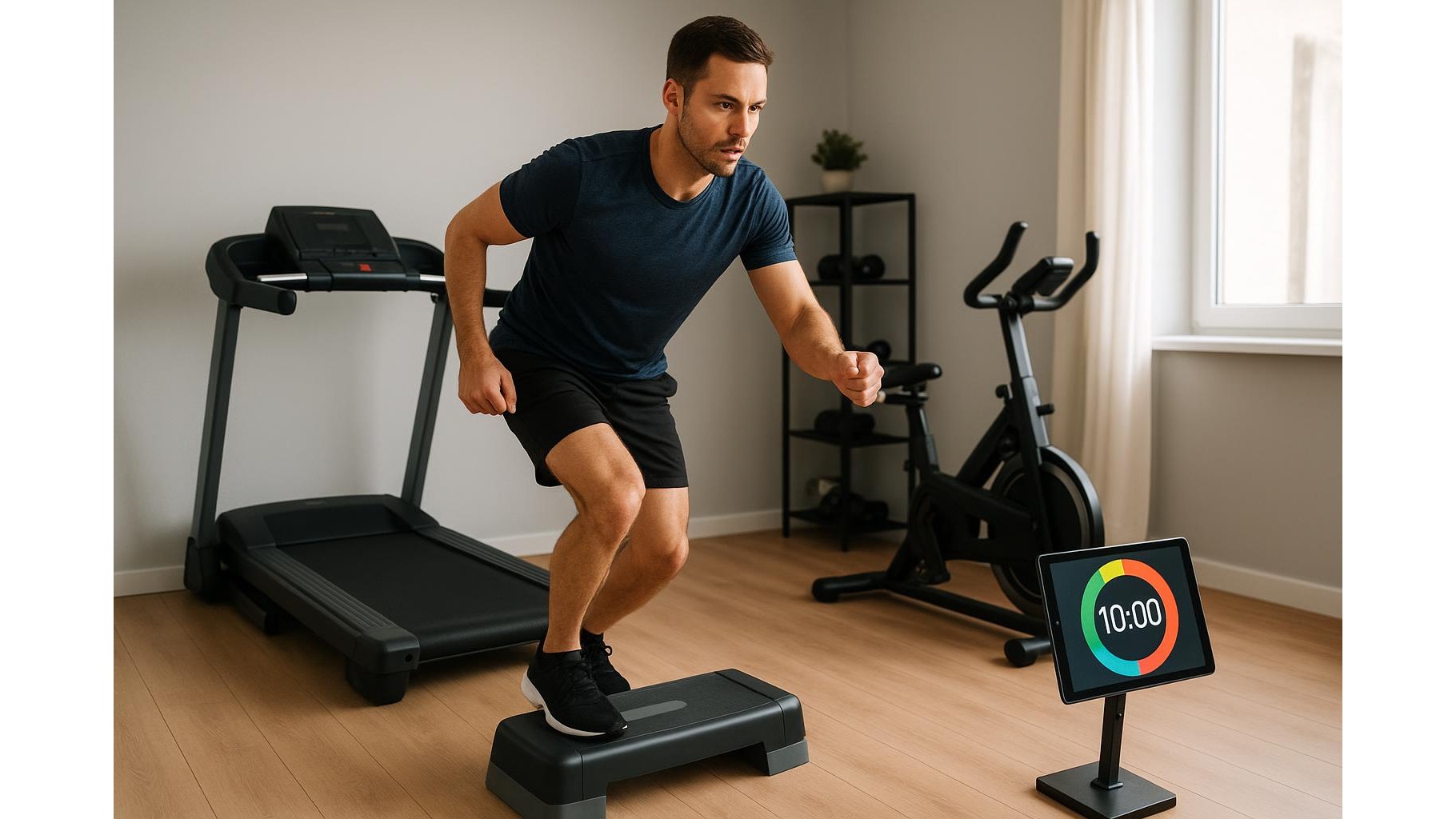
A stepper or aerobic step platform can feel repetitive if you just go at one pace. Instead, play with height, tempo and foot patterns. Try 2 minutes of basic up‑down steps at an easy pace, then 1 minute of quick, shallow steps, repeating for 15–20 minutes. Add game rules like “no double taps” or “no looking at your feet” to sharpen focus. Build a simple combo—basic step, side step, knee lift—and perform it on a 30‑seconds‑on/30‑seconds‑off loop. As you progress, add a fourth move or increase step height for extra burn. If your stepper has resistance bands, assign them to specific intervals only, such as “arm blast rounds” every third interval, so the workout feels like a changing circuit rather than a flat grind.
How to progress your home interval games safely
To keep these home cardio intervals effective and safe, change only one variable at a time: duration, intensity or complexity. For example, add two extra intervals, slightly increase speed or resistance, or introduce a new game rule—never all three at once. Keep most sessions in the moderate effort zone where you can still talk in short sentences, and reserve all‑out efforts for short bursts. Aim for 2–4 interval days per week, with at least one easier session in between. Track one simple metric per machine—distance, total intervals completed or points scored—so you can see clear progression. With a playful mindset and a bit of structure, you can turn every treadmill, bike, rower or stepper workout into something you actually look forward to.
Home cardio does not need subscriptions or perfect equipment to be engaging. By using interval games, clear targets and small weekly progressions, you can turn any machine into a flexible training partner that supports your fitness goals and keeps boredom away.